




What reloads it: cooking at lunch, bodies, the bin, damp cloths, and above all the slow re-release from curtains, sofa and rugs, which speeds up as the flat warms through the afternoon.
The fix that actually flattens the curve: a second air change. Ten minutes of cross-ventilation at five or six in the evening does more than anything you can add to the morning routine.
2. Because mopping briefly makes it worse before it makes it better. A wet floor in a closed flat raises the indoor humidity for an hour or two. Humidity both slows the evaporation of what is already there and raises how strongly you perceive it. This is why so many people report the smell coming back exactly as the floor finishes drying — the timing is not a coincidence, and the answer is to mop with the windows open so the floor dries fast rather than slowly into the room.
3. Because the afternoon is when fabric gives it all back. Odour molecules absorbed into curtains, sofa fabric, cushion covers, rugs and mattresses come out faster as the material warms. A shut 2BHK is at its warmest between roughly two and five, so the largest release event of the day happens after the cleaner has left and before anyone thinks to open a window. Mopping never touched any of it.
4. Because a 2BHK has rooms that get cleaned and then shut. The two bedrooms are usually done in the morning and closed for the rest of the day — for the AC, for privacy, or simply because nobody is using them. Each one then behaves as its own small stagnant volume, and when the doors open at seven they contribute all at once. A cleaned room with the door shut for eight hours is not a clean-smelling room at eight o'clock.
5. And fragrance belongs after the second air change. Adding scent at six sits it on top of nine hours of accumulation. Ventilate again in the late afternoon, deal with anything wet, keep the fabric on a schedule, and then let a reed diffuser or a Sukoon give the evening a character.
Made in India, composed by an ISIPCA Versailles-trained perfumer — and a portion of every order supports girl-child education through Nanhi Kali.
Levels, rates, and why nine hours always wins
It helps to think about this the way you would think about a bucket with a slow leak and a slower drain. The morning clean empties the bucket. It does not narrow the inflow and it does not widen the drain. Everything that put smell into your flat yesterday is still doing so today at the same rate: bodies, cooking, the bin, damp cloths, the washing machine, and the steady re-release from every soft surface in the place. Meanwhile the only removal mechanism available is air exchange, and in a closed flat that runs at roughly 0.2 to 0.5 air changes an hour — which over nine hours is a fraction of what the day put in. The evening smell is not evidence that the clean failed. It is evidence that cleaning and removal are different operations.
The shape of the curve matters too, because it tells you when to intervene. The first hour after mopping is often slightly worse rather than better: a wet floor raises humidity in a closed flat, and higher humidity both slows drying and increases how strongly the nose registers whatever is already suspended. Then things settle until early afternoon, when the flat reaches its warmest and the fabric reservoir starts giving back what it absorbed over previous days — warm textiles release faster than cool ones. Lunch adds aerosolised cooking oil that lands on surfaces and fabric rather than staying airborne. By five you have the day's full load sitting in air that has barely been replaced since breakfast. Which is exactly why the single most effective change is a second ten-minute cross-ventilation at around five, not a better morning routine.
What reloads a 2BHK between ten and six
 Step fourFrom ₹749A mop puts a measurable amount of water onto every hard surface in the flat, and in a closed 2BHK that water has nowhere to go but into the air. For the next hour or two the indoor humidity is higher, which slows the drying of everything else and raises the perceived intensity of every odour already present. Add to that the mop itself, which is usually rinsed and then left folded and damp in a corner, and the bucket that sits until evening. Mop with the windows open so the floor dries in minutes rather than hours, wring the mop properly, and dry it flat or hanging rather than folding it away wet.
Symptom to cause: reading the curve
The useful information here is timing. Note when in the day the smell appears, not just that it does, and match that against the rows below — each timing points at a different mechanism.
| What you notice | Most likely cause | How to confirm it | What actually fixes it |
|---|---|---|---|
| Fine at ten, closed by four, worst at six ★ | One removal event against nine hours of loading — the basic decay curve | Add a second ten-minute cross-ventilation at five for three days and compare | Two air changes a day rather than one; open internal doors during both |
| Returns exactly as the floor finishes drying | Mopping moisture raising humidity and perceived intensity in a closed flat | Mop one day with the windows open and one day with them shut, and compare | Mop with cross-ventilation running; wring properly; dry the mop flat, never folded |
| Hits you when you open the bedroom doors in the evening | Two rooms cleaned early and then sealed for eight hours | Open one bedroom at midday and leave the other shut, then compare at seven | Air the bedrooms during the ventilation window; leave doors open through it |
| Faintly of lunch by evening, in rooms you did not cook in | Aerosolised cooking oil landing on and bonding to soft surfaces | Smell the curtain nearest the kitchen against one in the far bedroom | Run the chimney longer, ventilate while cooking, wash curtains seasonally |
| Much worse in the monsoon regardless of the routine | Humidity slowing drying and raising perceived odour across the whole flat | Compare the same day of the week in a dry month and a wet one | Ventilate in dry windows; never dry washing in a closed room; dehumidify if you can |
| Sewer-like note that appears in the afternoon and fades | A drain issue — dry P-trap or a failed seal, which is a plumbing job | Follow it at floor level to each drain; pour a mug of water down every unused one | Restore the water seal or call a plumber. Fragrance is the wrong tool here. |
| If none of these fit: map it for one week. Note the time, the room and the weather each time you notice it. The pattern that emerges usually names the cause without any further testing. | |||
Reeds · always-on roomsFrom ₹749Shop →  Sukoon · when you want a switch₹1,899Shop →
  Hotel Collection · the scentFrom ₹299Shop →
Flattening the curve, step by step
First, split the day's ventilation into two events. Almost every home in this situation has one, in the morning, often only incidentally while the cleaning is being done. Add a deliberate second one at around five in the afternoon: two openings on opposite sides of the flat, every internal door between them open and wedged, five to ten minutes. That single addition targets the exact hour when the fabric reservoir has been releasing hardest and the air has been least disturbed. If nobody is home at five, do it the moment the first person walks in, before anything else.
Second, change how the cleaning itself is done, not how hard. Sweep or vacuum before mopping rather than after, so you are not turning dust into a wet paste. Mop with the windows open so the floor dries in minutes and the moisture leaves the flat rather than raising its humidity. Wring the mop out properly and dry it hanging, never folded in a bucket. Empty the bin and wash the lid and its underside, not just the liner. Run a mug of water down every drain that has not been used that day. These five habits cost no extra time and remove most of the sources that reload the flat by lunchtime.
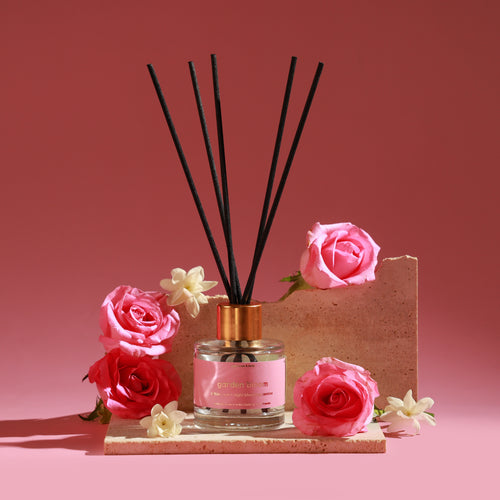
Third, put the fabric on a calendar, then choose a layer that matches the shape of the problem. Bedding weekly, cushion covers monthly, curtains at least seasonally, upholstery vacuumed with the brush attachment, rugs into direct sunlight when the weather allows. Once that is running, the fragrance choice follows from the physics: a continuous load is best matched by a continuous emitter, so a reed diffuser from ₹749 — which runs on capillary action all day with nothing to operate — is the natural fit for the living area of a 2BHK, and covers a room of up to roughly 150 sq ft on six reeds. If what you actually want is scent only for the evening, the Sukoon at ₹1,899 with a Hotel Collection scent from ₹299 covers roughly 270–320 sq ft and switches off. Neither removes anything. They are what a properly aired flat smells of afterwards.
What to do, in order
The first three steps change the arithmetic of the day, which is the actual problem. The fourth is the purchase, and here the format follows from the shape of the load.
| Step | What to do | When | Cost |
|---|---|---|---|
| 1. Remove the source | Bin lid and underside, unused drains, the mop dried flat, the washing-machine gasket, nothing damp left folded | Before anything else | ₹0 |
| 2. Move the air | Two ventilation events, not one — ten minutes in the morning and ten at around five, internal doors open | Daily, five to ten minutes | ₹0 |
| 3. Deal with what holds it | Bedding weekly, covers monthly, curtains seasonally, upholstery vacuumed, rugs sunned; mop with windows open | Weekly to monthly | ₹0 |
| 4. Then the always-on layer ★ | A SOSA reed diffuser — a continuous background that matches a continuous load, running all day with nothing to switch on | 50ml 6-8 weeks · 130ml 14-18 | from ₹749 |
| 5. Or the on-demand layer | Sukoon with a Hotel Collection scent — an evening event — an hour of scent before people arrive, covering roughly 270–320 sq ft | Run it when you want it | ₹1,899 |
Versailles
The question I ask when someone describes this is not what they clean with. It is what time they open the windows, and how many times. Almost always the answer is once, in the morning, and almost always adding a second one at around five changes the evening within a week. It is the cheapest intervention in this whole cluster and it is the one people are least willing to believe.
The mopping detail is worth repeating because it feels counter-intuitive. Mopping a closed flat makes the air briefly heavier, not lighter — you have put water into a room that cannot get rid of it. If you mop with the windows open the floor dries in minutes and the moisture goes outside. If you mop with everything shut, the moisture goes into your curtains and your sofa and stays there.
On the buying decision: I would rather sell you a reed diffuser for this than a machine, and the reason is mechanical rather than commercial. Your problem runs steadily for nine hours a day, mostly while nobody is home. A reed runs steadily too. A machine is the right answer if what you want is scent for the two hours people are in the living room, and the wrong answer if you want the flat to have a settled character at four in the afternoon. Buy the shape that matches your problem. A portion of every order funds a girl's classroom through Nanhi Kali.
Frequently asked questions
- Why does my house smell stale even though I clean it every day? — the general case, in order.
- Windows open and it still smells closed — why one opening is not ventilation.
- Spotless but not fresh — the difference between clean and fresh.
- Keeping it fresh once the smell is gone — the maintenance routine.
- Brand: the SOSA founder story.
SOSA products & prices (verified August 2026): Hotel Collection water-based ultrasonic diffuser fragrance 15ml ₹299 · 100ml ₹999 · 300ml ₹1,799 · Pack of 7 (15ml, all fragrances) ₹1,799; refills 100ml from ₹999. Seven scents: The Ritz-Carlton-inspired (white tea · bergamot · cedar), Westin-inspired (white tea · aloe · cedar), 1 Hotels-inspired (cedarwood · vetiver · green leaves), The St. Regis-inspired (amber · violet · woods), Shangri-La-inspired (jasmine · green tea · white tea), Four Seasons-inspired (citrus · floral · sandalwood), W Hotels-inspired (citrus · pepper · amber). Diffusers: Boond 300ml ₹899 · Sukoon 500ml ₹1,899 · Megh 6L ₹3,499. Water-based, phthalate-free, composed to IFRA standards for home diffusion; 3–6 drops per tank. Made in India, Pune. The Hotel Collection scents are SOSA's own interpretations inspired by the world's finest hotels; all hotel names are trademarks of their respective owners and are used only to describe the scent style — SOSA is an independent Indian fragrance house, not affiliated with or endorsed by any hotel brand. Prices and availability subject to change — see the live product pages.