


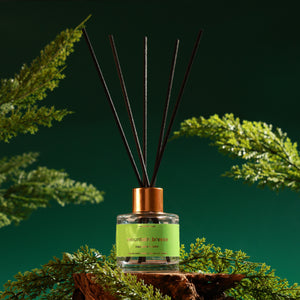
What that produces: a steep concentration gradient. High within a metre or two of the bottle, falling away quickly after that, and effectively nothing at the far side of a large volume. SOSA publishes reeds at up to about 150 sq ft for a 50ml bottle — a room, not a lobby — and that figure assumes a normal ceiling and a closed volume.
The diagnostic you can run today, free: stand beside the bottle. If the fragrance is clear and good there and absent ten metres away, the fragrance is fine and the delivery is not. Almost every complaint phrased as “our fragrance is too weak” is a distribution complaint, and buying a stronger fragrance is the one response that cannot work.
Where a reed is genuinely the right product in a club: a cloakroom, a washroom, the secretary’s office, a small closed committee anteroom, a lift lobby on a residential floor — small, enclosed, passed close to, and better off with no power, no noise and nothing to service.
The honest gaps: no reed, at any price and in any quantity, will scent a club lobby, and I would rather say so than sell you six more bottles. There is also no hotel-inspired reed diffuser at SOSA, because the Hotel Collection oils are water-based and reeds cannot carry them — the carrier decides the machine, every time.
2. The gradient is steep, and it is steep close in. What you are measuring when you walk from the desk to the door is a concentration that falls away very quickly with distance — strong within a metre or two, noticeably less at four or five, and lost in the general air of the building well before the entrance mat. SOSA publishes its 50ml reeds at up to about 150 sq ft, and that figure assumes an ordinary ceiling and a reasonably closed room. A club lobby is neither: it is large, it is frequently double-height, and it has doors opening on to the street. Reason in volume rather than floor area here, because a galleried or double-height lobby eats coverage that a square-foot figure hides entirely.
3. The lobby is also actively working against it. Every time the entrance doors open, the lobby exchanges a slug of air with outside, and air that leaves takes the fragrance with it. A lobby is the highest-air-change space in most clubs by a wide margin, which is precisely why it is the room that needs its fragrance replaced continuously rather than emitted slowly from a bottle on a console table. The reed is producing at a fixed, slow, passive rate into a volume that is being flushed several times an hour by the front door. It was never going to hold a level there.
4. You are also mis-reading your own perception, and everybody does. Perceived strength is set by the step between two spaces rather than by the absolute level in either. You come in from the street or the car park and the desk area reads as clearly fragranced because the step up is large. Ten minutes later, standing at the door, you read almost nothing — partly because there genuinely is almost nothing, and partly because your nose has already adjusted to the level it met on arrival. This is why a general manager’s own walk-round is a poor instrument and why the only honest test is to leave the building long enough to reset and come back in as a member does.
5. The remedy is a different mechanism, not a different fragrance. Waterless cold-air nebulising exists for exactly this: pressurised air shatters undiluted oil into a dry nano-mist which is then carried by the air the building is already moving, so the fragrance arrives across the volume rather than sitting at its source. Vaayu ₹11,999 is rated to up to 1000 m³ ≈ 2,000–3,000 sq ft and will lay flat, wall-mount or go into an HVAC return; Aangan ₹25,999 connects to the air handling for up to 3,000 m³ ≈ 8,000–10,000 sq ft. Keep the reeds and move them to the rooms that suit them. Alcohol-free, phthalate-free, IFRA-compliant, composed in Pune, with a portion of every order supporting girl-child education through Nanhi Kali.

What is actually happening at the bottle
It is worth being precise about the physics, because once a house committee has the mechanism in front of it the rest of the decision makes itself, and the committee stops asking for a stronger fragrance. There are three things happening at a reed diffuser, and none of them involves moving air.
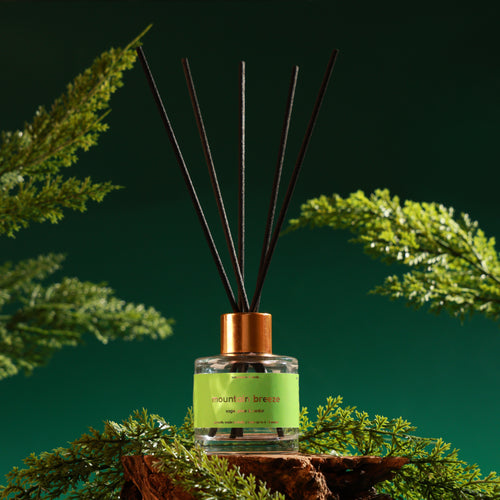
 Mountain Breeze₹849Oil climbs the six fibre reeds against gravity by capillary action, and the part of each reed standing above the neck of the bottle becomes a wetted surface from which the composition evaporates. The rate is set by how much wetted surface there is, how warm the room is and how much air happens to be passing that surface — nothing else. This has three consequences a club should know. First, adding reeds increases the surface and therefore the rate, so the bottle empties faster; it does not push the fragrance further, it simply spends it quicker. Second, a draught past the bottle raises the rate, which is why a reed near a door or an air outlet runs down noticeably sooner than one on a quiet console. Third, the carrier is engineered for this job: SOSA reeds use a heat-stable CCT carrier tested at 45°C and 85% RH, which is what allows an Indian club to keep a bottle in a warm lobby through a wet season without the composition falling apart. Published life is 6–8 weeks for the 50ml and 14–18 weeks for the 130ml, which depends on reed count, temperature and draughts.
 Vaayu₹11,999Once evaporated, the fragrance has two ways of getting anywhere: diffusion, which is genuinely slow over the distances involved in a club, and bulk air movement, which the reed contributes nothing to. So the result is entirely governed by the room. In a small closed space with gentle air movement, the zone fills the room and the reed looks like a triumph. In a lobby, three things work against it at once. The volume is large and often double-height, so the same quantity of fragrance is spread through far more cubic metres than a square-foot reading suggests. The air change is the highest in the building, because the front doors exchange air with the street every few minutes and air that leaves takes the fragrance with it. And the air conditioning both helps and hurts: it distributes what is there more evenly, and it also removes it faster than a still room would. A passive source cannot keep up with any of that, and the honest conclusion is that it is not supposed to.
Aangan₹25,999Clubs frequently try to solve the lobby by moving oil between formats, and it is worth closing that door firmly. A reed oil is formulated on a carrier designed to climb a fibre reed and evaporate slowly; it cannot go into an ultrasonic machine. The Hotel Collection fragrance oils are water-based and ultrasonic-only — three to six drops into the water tank — and they are not for reed diffusers and not for the waterless commercial machines. That is also why there is no hotel-inspired reed diffuser at SOSA: reeds cannot carry a water-based oil, so the product does not exist rather than existing badly. For the waterless commercial machines no purchasable refill oil is published at all; the fragrance is specified and quoted per property through the contact page, which for a club buyer is the expected answer rather than an evasion. The practical instruction is simple: choose the mechanism for the volume first, and then choose the fragrance within what that mechanism can carry.
Vaayu₹11,999Once evaporated, the fragrance has two ways of getting anywhere: diffusion, which is genuinely slow over the distances involved in a club, and bulk air movement, which the reed contributes nothing to. So the result is entirely governed by the room. In a small closed space with gentle air movement, the zone fills the room and the reed looks like a triumph. In a lobby, three things work against it at once. The volume is large and often double-height, so the same quantity of fragrance is spread through far more cubic metres than a square-foot reading suggests. The air change is the highest in the building, because the front doors exchange air with the street every few minutes and air that leaves takes the fragrance with it. And the air conditioning both helps and hurts: it distributes what is there more evenly, and it also removes it faster than a still room would. A passive source cannot keep up with any of that, and the honest conclusion is that it is not supposed to.
Aangan₹25,999Clubs frequently try to solve the lobby by moving oil between formats, and it is worth closing that door firmly. A reed oil is formulated on a carrier designed to climb a fibre reed and evaporate slowly; it cannot go into an ultrasonic machine. The Hotel Collection fragrance oils are water-based and ultrasonic-only — three to six drops into the water tank — and they are not for reed diffusers and not for the waterless commercial machines. That is also why there is no hotel-inspired reed diffuser at SOSA: reeds cannot carry a water-based oil, so the product does not exist rather than existing badly. For the waterless commercial machines no purchasable refill oil is published at all; the fragrance is specified and quoted per property through the contact page, which for a club buyer is the expected answer rather than an evasion. The practical instruction is simple: choose the mechanism for the volume first, and then choose the fragrance within what that mechanism can carry.
The free test that tells you which problem you have
Before anything is bought, run this, because it separates the two complaints that sound identical and have opposite remedies. Stand next to the bottle and smell it properly. Then walk to the point where members say the fragrance is missing and smell there. If the fragrance is clear, well-defined and pleasant at the source and absent at the far point, the fragrance is fine and the delivery is not: this is a distribution problem, and no reformulation, no stronger concentration and no different scent family will address it. If the fragrance is weak or muddled at the source as well, then you have a genuine composition or freshness question and it is worth looking at the age of the bottle, whether the reeds have clogged, and whether it has been standing in a draught. In my experience the first case accounts for the overwhelming majority of the complaints a club files.
Two refinements make the test more reliable. The first is to reset your nose. Anyone who has been in the building since seven in the morning has stopped reporting the fragrance while it continues to arrive exactly as before, so a walk-round by the general manager at four in the afternoon is close to worthless as evidence. Leave, spend long enough outside for the step back in to mean something, and re-enter the way a member does, from the car park through the threshold. The second is to remember that perceived strength is a step between spaces rather than a level in one. The lobby will read as fragranced mostly because the street was not. The corridor leading out of it will read as quieter even if the level is identical. So do the test at the same hour on two different days rather than at two different hours on the same day, or the building’s own timetable will confuse the result.
And before either of those, the diagnostic order that governs this entire family applies here too, because it is cheaper than anything on the price list. If the complaint is not only that the fragrance does not reach but that the lobby smells stale underneath it, then the question is not the diffuser at all. Source, then moisture, then ventilation and air change, then cleaning, and only then fragrance. A pleasant odour added to an unpleasant one produces a mixture, and the mixture is usually judged worse than the original because it reads as concealment. Get a real fresh-air provision running before opening, check every drain trap and water seal in the building, dry the carpets properly and get the curtain linings into the cleaning contract by name. A club that does all of that will smell better before it buys a machine, and that is worth saying even though it delays the sale.
Zone against volume: what each mechanism can and cannot do
This is the table I would put in front of a committee that is deciding between another box of bottles and a capital item. It is arranged by mechanism rather than by price, because the price is not the interesting variable. The last row is the one that matters most and the one nobody asks about.
| Mechanism | What moves the fragrance | Realistic reach | Where it belongs in a club |
|---|---|---|---|
| Reed diffuser — passive capillary ★ | Nothing. Oil climbs six fibre reeds and evaporates; the room does the rest or nothing does | A zone of roughly a couple of metres; published at up to about 150 sq ft for the 50ml | Cloakrooms, washrooms, the secretary’s office, small closed rooms. Never a lobby |
| Reed diffuser — the 130ml bottle | Identical mechanism, more oil in the vessel | The same zone, for 14–18 weeks instead of 6–8 | The same rooms, on a longer service interval. It buys weeks, not metres |
| Ultrasonic water mist | A water mist carrying oil diluted in the tank | Real room coverage — Sukoon ₹1,899 at 270–320 sq ft | Small offices and back-of-house. Adds humidity, which in an Indian club is usually the enemy |
| Waterless nebulising — Vaayu ₹11,999 | Pressurised air shattering undiluted oil into a dry nano-mist, carried by the room’s airflow | Up to 1000 m³ ≈ 2,000–3,000 sq ft per unit | The lobby, the arrival threshold, a lounge zone. Freestanding, wall or HVAC return |
| Waterless on the air system — Aangan ₹25,999 | The same nebulising, introduced into air the building is already moving | Up to 3,000 m³ ≈ 8,000–10,000 sq ft on an HVAC or AHU connection | A whole floor or a club on one air system, where evenness matters more than any single room |
| Larger property — Meenar ₹38,500 | The same waterless mechanism, specified for bigger buildings | Specified on enquiry; no coverage figure is published for it here | Routed to the contact page, because sizing is a volume and zoning exercise rather than a number |
| A stronger fragrance | Nothing at all. Concentration at the source is not a transport mechanism | Unchanged — it makes the zone louder and leaves the far side of the room exactly as it was | Nowhere. This is the purchase to talk a committee out of, and the commonest one |
Zone · Vaayu₹11,999See it → Air system · Aangan₹25,999See it → Larger property · Meenar₹38,500See it →
The rooms in a club where a reed is the right answer
I would be making a poor argument if I left the impression that a reed is a lesser thing. It is not; it is a different thing, and in several rooms in every club it is better than a machine for reasons that have nothing to do with price. A closed door is a real boundary for fragrance, so a small enclosed room is exactly the scale at which a passive zone becomes a fully fragranced space. And a reed needs no power, makes no noise, has no moving part to service, cannot be turned up by a night steward, and puts no electrical point on a drawing. In rooms where those things matter more than reach, the passive device wins outright.
The list I give clubs is short and specific. The cloakroom, which is small, enclosed, passed through closely and frequently and often has no convenient power. Washrooms and their lobbies, where the zone around the bottle is most of the usable volume and where the alternative is usually something far cruder. The secretary’s office and the general manager’s office, where a personal, gentle, replaceable fragrance at a desk is appropriate and a commercial machine is not. A small committee anteroom or the little room off the main staircase that everybody passes and nobody sits in. A residential or guest-room corridor landing, where the requirement is a quiet marker rather than a field. In all of these the published numbers work honestly in your favour: up to about 150 sq ft for the 50ml at ₹749–₹849, lasting 6–8 weeks, or the 130ml at ₹1,249–₹1,349 lasting 14–18 weeks, with refills at 300ml ₹2,399 and 500ml ₹3,499 for a club buying across several of these rooms at once. Six fibre reeds, a refillable glass bottle, alcohol-free, phthalate- and paraben-free, IFRA-compliant, 0 ppm formaldehyde, on a heat-stable CCT carrier tested at 45°C and 85% RH, composed in Pune.
A word on which composition to put in those rooms, because it is a different decision from the one you make for a lobby. A composition dosed low is mostly its heart and its base, since the top notes are the first thing lost, so dry and structured registers — Morning Freshness at ₹749, Mountain Breeze at ₹849, Fresh Brew at ₹849 — keep their outline when they are quiet, while sweet and powdery ones lose their shape and read as a vague smell of perfume. In a washroom or a cloakroom I would choose the clean citrus or the cedar register and nothing gourmand, because a gourmand near any part of the food route reads as competition and the kitchen always wins. And the rooms that should carry no fragrance at all remain what they always are in a club: the dining rooms, private dining and bar counters, the gym floor, the spa treatment rooms, the boardroom, and the library or card room in a heritage building, where old paper and timber are the identity worth protecting.
The order of work, and the two gaps
Here is the sequence as a committee paper would carry it. The first three lines cost nothing and two of them may make the purchase unnecessary. The last row is what this range does not contain, said plainly, because a committee will check it and a member will check it afterwards.
| Step | What it is | Why it comes here in the order | Cost |
|---|---|---|---|
| 1. Run the source test ★ | Smell it beside the bottle, then at the point of complaint, having first left the building long enough for your own nose to reset | Because it separates a distribution problem from a composition problem, and those two have opposite remedies | No purchase |
| 2. Check the building underneath it | Source, then moisture, then ventilation and air change, then cleaning. Drain traps and water seals, a real fresh-air provision before opening, carpets dried, curtain linings in the contract by name | Because fragrance laid over a stale lobby produces a mixture that reads as concealment, and because a clean well-aired lobby often ends the complaint on its own | Mostly no purchase |
| 3. Reason in volume, not floor area | Measure the lobby as a volume, note whether it is double-height or galleried, note where the entrance doors and the returns are, and note which doors stay open | Because a double-height lobby consumes coverage that a square-foot figure hides, and a closed door is a real boundary while an open plan is one volume | No purchase |
| 4. Match the mechanism to that volume | Vaayu on the airflow path or into the HVAC return for a lobby; Aangan where a whole floor sits on one air system | Because only a device that puts fragrance into moving air can produce a level across a large volume, which is the thing a reed has no mechanism for | ₹11,999 |
| 5. Keep the reeds, and move them | Cloakroom, washrooms and their lobbies, the secretary’s office, a small anteroom, a landing. 50ml ₹749–₹849 for 6–8 weeks, 130ml ₹1,249–₹1,349 for 14–18 weeks | Because in a small closed room the zone is the room, and no power, no noise and nothing to service are real advantages there | ₹749 upwards |
| Two honest gaps: what SOSA does not sell you | No reed diffuser we make, or that anyone makes, will scent a club lobby — that is a mechanism limit and not a quality one, and no price and no quantity crosses it. And there is no hotel-inspired reed diffuser at SOSA, because the Hotel Collection oils are water-based and ultrasonic-only and reeds cannot carry them. No purchasable refill oil is listed for the waterless commercial machines either — that fragrance is specified and quoted per property | Said plainly, because the alternative is selling a club six more bottles for a room where six will do exactly what one did | Quoted |
Versailles
A club secretary once wrote to me, politely and with some disappointment, to say that our reeds were not strong enough. They had six of them in the lobby, they had been recommended by a member who had them at home, and members were saying the club did not smell of anything until you reached the desk.
I asked him to do one thing before we discussed a refund. Stand next to a bottle, and tell me honestly whether the fragrance was good there. He wrote back the same afternoon and said it was excellent there, which was the whole answer, and he knew it as soon as he had written the sentence.
What he had was a transport problem, and we make no product on earth that solves a transport problem with a bottle. A reed has no fan and no pressure; it is a wick and a wetted surface, and everything past the first metre or two is the room’s business, not the bottle’s. His lobby was double-height, with automatic doors exchanging air with a main road every couple of minutes. Nothing passive was ever going to hold a level in it.
He kept all six bottles. Two went into the cloakroom and the washroom lobby, one to his own office, one to the anteroom by the committee room and two to the landings, and in every one of those rooms they were the better product — no power, no noise, nothing to service and nothing anybody could turn up. The lobby got a machine on the airflow path, set once, written down and key-locked. He told me later that the thing members finally commented on was not the fragrance but the consistency of it, which is the compliment I would rather have. Everything we make is composed in Pune, and a part of every order funds a girl’s classroom through Nanhi Kali.
Frequently asked questions
- What to fix first — the family pillar: the whole ordered checklist, with fragrance as the last line.
- Why ten reed diffusers still fail — the arithmetic of adding bottles, and why ten zones are not one field.
- Stronger fragrance or better diffusion — the same distinction, turned into a test you can run in one afternoon.
- Why a spray vanishes in a lobby — an event rather than a system, and why SOSA sells no such product for interiors.
- Why it is worst at opening and why the lounge changes by evening — what the building is doing underneath the fragrance.
- Why old clubs turn musty and why the monsoon makes it worse — the problems no diffuser of any kind addresses.
- What carpets, leather, curtains and timber hold — the stores that decide what a room smells of before you add anything.
- Brand: the SOSA founder story.
SOSA commercial scenting — facts verified August 2026: Vaayu ₹11,999, waterless cold-air nebulising, coverage up to 1000 m³ ≈ 2,000–3,000 sq ft, 400ml refillable sealed tank lasting up to about 90+ days depending on intensity and hours, Bluetooth app plus onboard buttons, run windows of 1h / 4h / 8h / 24h, day selection, adjustable intensity, auto-stop and key-lock, under 38 dB, freestanding, wall-mounted or HVAC-return mounting, DC 12V / 1A at 5W, CE, RoHS and SGS, black and white. Aangan ₹25,999, HVAC or AHU connection or standalone wall-mount or lay-flat, coverage up to 3,000 m³ ≈ 8,000–10,000 sq ft, 800ml reservoir, under 42 dB, DC 12V at 14W, intelligent PCB with programmable work and pause cycles and daily schedules, metal body 3.9 kg at 284 × 125 × 246 mm, black or white, one-year warranty, imported; it has no app and no Bluetooth, and no certifications are published for it. Meenar ₹38,500 is the larger-property option and is specified on enquiry; no coverage figure is published for it here. Ultrasonic machines: Sukoon ₹1,899 at 270–320 sq ft, Boond ₹899 at up to about 150 sq ft, Megh ₹3,499 with a six-litre tank and around 100 hours of runtime but only about 215 sq ft of coverage. Reed diffusers ₹749–₹849 for 50ml lasting 6–8 weeks and ₹1,249–₹1,349 for 130ml lasting 14–18 weeks, six fibre reeds, alcohol-free, phthalate-free, paraben-free, IFRA-compliant, 0 ppm formaldehyde, heat-stable CCT carrier, refillable glass bottle, tested at 45°C and 85% RH, composed in Pune; refills 300ml ₹2,399 and 500ml ₹3,499. The Hotel Collection fragrance oils are water-based and ultrasonic-only at 15ml ₹299, 100ml ₹999 and 300ml ₹1,799; they are not for reed diffusers and not for the waterless commercial machines, and there is no hotel-inspired reed diffuser. No purchasable refill oil is listed for the waterless commercial machines — that fragrance is specified and quoted per property. SOSA publishes no leather fragrance in any format and no tobacco or smoky fragrance for any diffuser. SOSA sells no air purifier, no dehumidifier and no room spray for interiors, and makes no health, air-quality, VOC or mould claim. No digital integration of any kind exists on any SOSA machine; the Aangan HVAC connection is mechanical. No dealer programme, reseller margin, trade price, territory or service contract is published. Free shipping above ₹499. A portion of every order supports girl-child education through Nanhi Kali. SOSA is an independent Indian fragrance house; the Hotel Collection scents are SOSA’s own interpretations inspired by the world’s finest hotels, and SOSA is not affiliated with or endorsed by any hotel brand. Prices subject to change — see the live product pages.