



The direction: unchanged by the interior — dry, low-sweetness, white tea, green tea and cedar.
What colour does change: the material inventory. Bright clinics carry more foam, fabric and printed soft furnishing, all of which store odour.
What it never changes: the seven clinical zones that stay fragrance-free.
2. Colour has an exit; scent does not. This is the mechanical reason the analogy between the two fails. A child who finds a wall overwhelming can look at the floor, at a book, at their parent. That escape takes half a second and costs nothing. There is no equivalent move for a smell. It is delivered with every breath, and the only exit is the door. Designing sound and smell as though they were colour is the commonest error in children’s interiors — the two senses with no eyelid are treated as though they had one.
3. Sweet notes read worse in a bright room, not better. The instinct behind the question usually points at gourmand — vanilla, candy, bubblegum, something that sounds like the palette looks. It is the wrong direction in any clinic, and specifically wrong in a colourful one. The room is already supplying all the cheerfulness the brief needs. Adding a sweet scent on top does not double the effect; it moves the whole space from bright-and-well-designed into something that smells like a retail counter, which is the opposite of what a parent wants to feel about a place that gives injections.
4. What a bright fit-out actually changes is the material list. Colour arrives in a children’s clinic through foam, vinyl, print and fabric — play mats, bean bags, patterned cushions, upholstered benches, fabric acoustic panels, soft toys in a basket. Every one of those is a sorptive surface: it takes up odour from the room and gives it back over the following days. A colourful clinic therefore has a larger odour reservoir than a minimal one, which argues for a lighter fragrance load and a stricter washing schedule, not a heavier one.
5. And the zoning does not bend for the design language. Consultation, examination, vaccination and injection, nebulisation and asthma, neonatal and newborn follow-up, procedure and sample-collection rooms, and any isolation or infectious waiting area stay fragrance-free regardless of how the rooms are painted. A bright examination room is still an examination room. If the mural continues down the corridor and into the consultation suite, that is a decorating decision; it does not extend the scented zone by a single metre.
Made in India, composed by an ISIPCA Versailles-trained perfumer — and a portion of every order supports girl-child education through Nanhi Kali.
Why the matching instinct misfires in a clinic
The instinct to match fragrance to interior comes from retail and hospitality, where it is a reasonable instinct. A boutique with a bold palette and a bold scent is coherent, and the shopper is inside it for six minutes by choice, having walked in specifically because the whole assembly appealed to them. Every part of that logic breaks in a paediatric clinic. The occupant did not choose to be there. They are frequently unwell. They are staying for thirty to sixty minutes rather than six, and the person doing the longest stay is a child whose breathing zone sits roughly 0.8 to 1.2 metres from the floor, well below the adult’s 1.5 to 1.7. The bright interior is a legitimate and often excellent decision for that room. It just does not carry an argument about airborne concentration with it.
There is a second, quieter reason the matching instinct causes trouble, and it is about what the two senses are being asked to do. A colourful clinic is usually colourful for a stated purpose: to make the building feel unlike a hospital, to give a nervous child something to look at, to signal that this is a place organised around children. Those are visual jobs and colour does them well. Fragrance has no comparable job available to it here — we make no claim that a scent changes how a child feels, and any supplier who does is selling you something they cannot demonstrate. The interior is doing real work; the fragrance is doing a small finishing job at the door. Scaling the small job up to match the big one is how clinics end up with a reception that parents describe as strong.
Three ways the bright-clinic brief goes wrong
 Reception onlyFrom ₹299Coral and lemon walls produce a shortlist of citrus, candy and tropical fruit with impressive reliability. It is a translation exercise, and translations between senses do not have correct answers. What the shortlist reliably delivers is sweetness, and sweetness is the one property we would rule out of a children’s clinic before any other. It reads as commercial in a place that needs to read as competent, and it is the profile most likely to become memorable in a building where children also get injections. Choose the direction from the room’s function, never from its palette — which lands you on dry tea and cedar in a bright clinic exactly as it does in a muted one.
Zone by zone, in a brightly finished clinic
The verdicts below are identical to the ones we would give a clinic finished in oak and off-white. That is the point of the table: nothing in this column set is decided by the paint.
| Area of the clinic | Scented? | Why | What we would use |
|---|---|---|---|
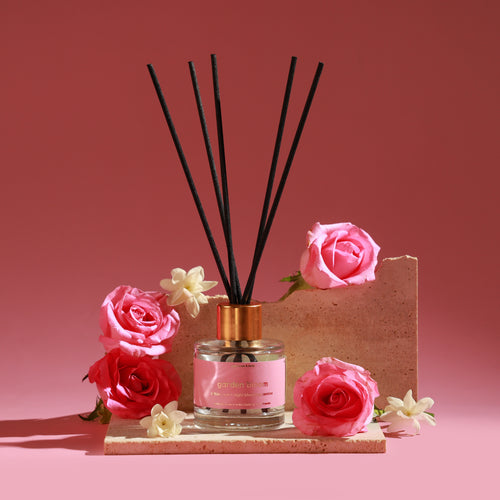
| Entrance and reception desk ★ | Yes, low | Short dwell, fresh noses arriving, no clinical function — unchanged by the interior scheme | Reed from ₹749, or Sukoon ₹1,899 |
| Colourful play and soft-seating zone | No | The most absorbent part of the room, at the lowest height, occupied by children on the floor | Nothing — and no equipment sited in it |
| Parent waiting seating | Only at the floor | Thirty to sixty minutes of exposure; bright walls do not shorten a wait | The reception source at minimum, never a second unit |
| Consultation and examination rooms | No | A mural on the wall does not change what the room is for or what the clinician is using their nose for | Nothing |
| Vaccination and injection rooms | Never | A distinctive scent repeatedly paired with a needle becomes a cue for the needle | Nothing |
| Nebulisation, asthma and neonatal follow-up | Never | Respiratory patients and newborns — the least tolerance for added airborne load in the building | Nothing |
| Before any of this: run the material inventory that a colourful fit-out creates — foam mats, cushions, bean bags, fabric panels, toy baskets — and put every one of them on a written washing and rotation schedule. In a bright clinic that list, not the fragrance, decides what the room smells of by Friday. | |||
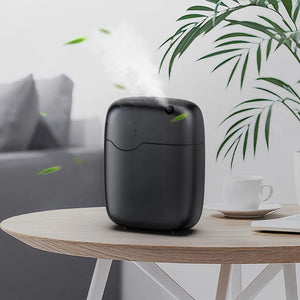
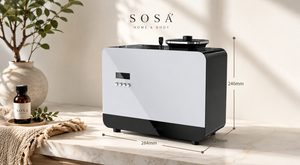
Small reception · no power neededFrom ₹749Shop →  Mid reception · has an off switch₹1,899Shop →
 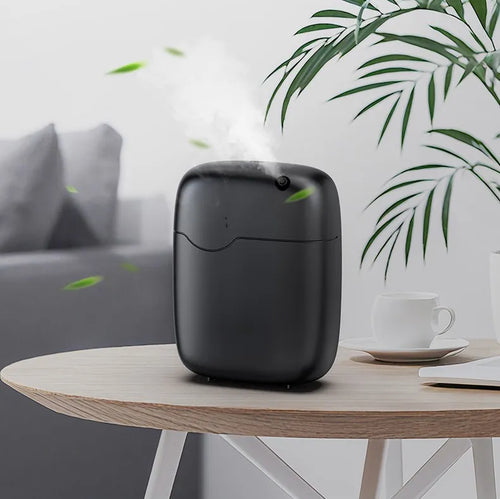 Large lobby · timed, dialable₹11,999Shop →
Setting the level under a loud interior
Set the dose from the occupancy, then ignore the walls entirely. The inputs are the longest sit in the scented zone, the height of the smallest occupant, and whether reception shares air with anything clinical. On a Vaayu that means the shortest on-time and longest off-time the unit offers, scheduled to clinic hours only. On a Sukoon it means three drops rather than six, in intermittent mode. Write the setting down. In a bright, busy reception the level drifts upward more easily than anywhere else, because nothing in the room looks restrained enough to make a high setting feel out of place.
Calibrate with your eyes closed and a nose that has been outside. Olfactory adaptation is essentially complete within about twenty minutes, so staff who arrived at nine cannot judge the level by eleven — and because they cannot smell it, they ask for more. Send someone out for half an hour, bring them back in, and have them stand still just inside the door with their eyes shut for a few breaths. Closing the eyes is not a flourish; a colourful room genuinely biases the judgement, and people asked to assess a cheerful space tend to accept a cheerful intensity. Repeat the exercise a fortnight later, which is when creep usually happens.
Then put the equipment where a child cannot reach it, and the play zone outside the scented one. A bright clinic has children on the floor, moving, curious and at close quarters with anything at their eye level; a diffuser on a low unit in a play corner is a physical problem before it is an olfactory one. Mount high, aim away from seating, keep leads off the floor. Add a plainly worded line at the desk saying reception carries a light fragrance and staff will switch it off on request, and make sure the switch is genuinely five seconds away. Choose direction with the same restraint the interior did not use: Quiet Luxury or White Tea Serenity, never a gourmand. And put the whole decision through your own infection-control and clinical governance leads before it reaches a purchase order.
What we would actually install
Matched to reception size and to the fact that a colourful clinic has small children moving around at floor level. Reach and stability matter here as much as coverage.
| Option | Suits | Control you get | Price |
|---|---|---|---|
| Reed diffuser ★ | A small reception desk — up to about 150 sq ft on three reeds, behind the counter — no lead, no switch, nothing at floor level | Reed count only — no switch, no timer | from ₹749 |
| Sukoon 500ml | A reception up to ~320 sq ft — up to about 320 sq ft, intermittent, three drops, sited high and away from the play zone | On/off, intermittent mode, you control the drops | ₹1,899 |
| Vaayu | A large lobby or a zoned duct — a genuinely large lobby or a reception on its own duct zone; the duty cycle is what lets it run low enough | Duty cycle in seconds, timer, app scheduling | ₹11,999 |
| Aangan | Whole-facility HVAC — a facility of 8,000–10,000 sq ft with zoned ducting, where the clinical zones can be excluded outright | Zone-level control, but only if the ducting is zoned | ₹25,999 |
| Nothing at all | A colourful clinic whose soft furnishings are not yet on a washing schedule, or any practice weighted towards newborn, respiratory or immunocompromised patients | Complete — and the correct answer more often than the trade admits | ₹0 |
Versailles
I like these clinics. A well-designed colourful paediatric practice is a genuinely kind piece of work, and the owners who commission them have usually thought hard about what a frightened five-year-old sees when the door opens. The trouble starts when the same enthusiasm reaches the fragrance brief, because the brief that produced the wall is the wrong brief for the air. You designed the room to be looked at. The air is not being looked at; it is being breathed, continuously, by someone who cannot leave.
When a bright clinic asks me for a scent to match, I ask what the play mats are made of and how often the cushion covers come off. It sounds like a deflection and it is not. A colourful children’s clinic has two or three times the soft, printed, foam-backed surface area of a minimal one, and every square metre of it is holding on to whatever the room smelled of last Tuesday. I have walked into cheerful receptions where the persistent note was not the diffuser at all, it was six years of accumulated everything in a bean bag nobody could work out how to wash.
So my answer to what fragrance suits a modern, colourful paediatric clinic is: the same one that suits a quiet, beige one, run at the same low level, in the entrance and reception only, with the play zone and every clinical room left alone. Dry, low-sweetness, nothing that sounds like a dessert. And if your answer after reading this is to spend the money on a laundry schedule and a second set of cushion covers instead, that is a better purchase than anything on my price list. A portion of every order that does get placed funds a girl’s classroom through Nanhi Kali.
Frequently asked questions
- Which direction actually suits a clinic reception? — dry tea and cedar, and why.
- Should the play area be scented? — no — height and contact decide it.
- Do soft furnishings hold odours? — yes, and they give them back.
- And if the interior is minimal instead? — the one style whose logic matches.
- Brand: the SOSA founder story.
SOSA products & prices (verified August 2026): Hotel Collection water-based ultrasonic diffuser fragrance 15ml ₹299 · 100ml ₹999 · 300ml ₹1,799 · Pack of 7 (15ml, all fragrances) ₹1,799; refills 100ml from ₹999. Seven scents: The Ritz-Carlton-inspired (white tea · bergamot · cedar), Westin-inspired (white tea · aloe · cedar), 1 Hotels-inspired (cedarwood · vetiver · green leaves), The St. Regis-inspired (amber · violet · woods), Shangri-La-inspired (jasmine · green tea · white tea), Four Seasons-inspired (citrus · floral · sandalwood), W Hotels-inspired (citrus · pepper · amber). Diffusers: Boond 300ml ₹899 · Sukoon 500ml ₹1,899 · Megh 6L ₹3,499. Water-based, phthalate-free, composed to IFRA standards for home diffusion; 3–6 drops per tank. Made in India, Pune. The Hotel Collection scents are SOSA's own interpretations inspired by the world's finest hotels; all hotel names are trademarks of their respective owners and are used only to describe the scent style — SOSA is an independent Indian fragrance house, not affiliated with or endorsed by any hotel brand. Prices and availability subject to change — see the live product pages.