
 Console 2–3m in ₹1,299 Small lobby ₹799
 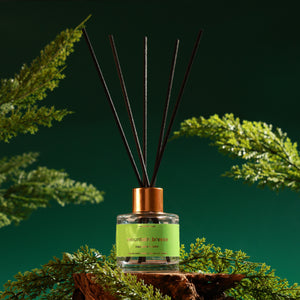 Alt: pine & cedar ₹849
 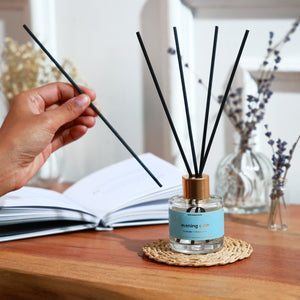 Alt: quieter entrance ₹799
 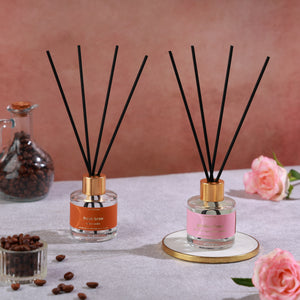 Refills ₹2,399
Two exceptions where beside is fine: a genuine vestibule with its own inner door, and a house door that opens onto a private garden or verandah rather than a shared corridor.
No foyer at all? Most 1BHK and 2BHK doors open straight into the living room. Don't buy a separate bottle — stand your living-room bottle on the entrance side, six feet in, for ₹0 extra.
2. A door is a piston. Every open and close pushes a slug of air out and pulls one in. A bottle within arm's reach of the hinge or the leading edge gets that stroke several times a day, and a real share of its output leaves with it — into a shared corridor or a lift lobby, not into your home.
3. A front door is the dirtiest air inlet you have. It admits stairwell air, lift-lobby air, a neighbour's cooking, street dust, and in a fair number of buildings the rubbish chute. A bottle sited directly in that stream spends its output competing with all of that rather than establishing anything.
4. Keep it off the shoe rack, full stop. Fragrance sitting on top of shoe odour produces something worse than either smell alone. If the only console you have is above the shoe rack, close the rack or move the bottle — never run both open in the same two feet.
5. If your door opens straight into the living room, don't buy a separate bottle at all. Most 1BHK and 2BHK layouts have no true foyer. Stand the living-room bottle on the entrance side of the room instead, and you've bought an entrance scent for ₹0 extra.
Alcohol-free, IFRA-compliant, composed by an ISIPCA Versailles-trained perfumer and handmade in small batches in Pune — and every purchase funds a girl's education through Nanhi Kali.
Why a front door is different air from the rest of the flat
Every other placement question in this series is about a room you occupy — a bed you lie in for eight hours, a bathroom you stand in for ten minutes, a sofa you sit on all evening. We've worked through how many bottles that logic needs for a bedroom on its own, and the answer there is about occupancy: how many reed diffusers a bedroom needs. A front door follows a completely different logic, because nobody occupies a front door. You cross it in about two seconds, twice a day if you're lucky and considerably more if you're not, and the rest of the time it just sits there being a hole in the wall that moves air and admits it.
That's the part almost every placement guide skips. "Put it near the entrance" is technically correct and practically useless, because near covers everything from six inches to six feet, and those two distances behave completely differently. Six inches from the hinge, the bottle is inside the door's own airflow. Six feet in, it is inside the room instead. The gap between "near" and "beside" is exactly the gap between a fragrance that greets a guest and a fragrance that has been quietly handing itself to the stairwell for months.
The good news is that this is a placement problem, not a budget problem. Getting the distance right costs nothing extra — it's the same bottle, the same reeds, moved two metres along the same wall. What follows are the three mechanics that make that distance non-negotiable, and after that, the actual number to work to.
The three mechanics nobody thinks about
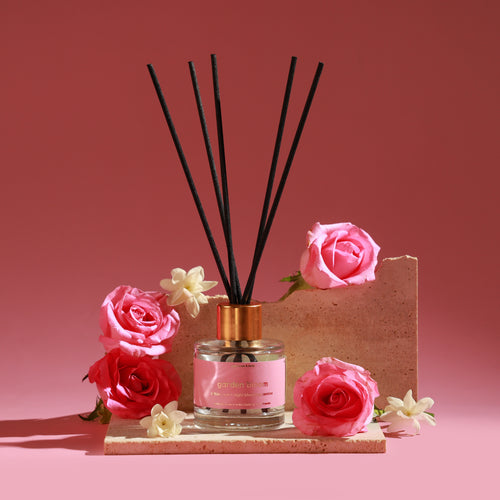
 Garden Bloom 130ml₹1,299Every time a door opens and closes it displaces a slug of air roughly its own volume — out on the swing open, in on the swing shut, and a burst of turbulence either side of both. A bottle within arm's reach of the hinge or the leading edge sits directly in that stroke and takes it several times a day, every day. In a flat, that stroke runs both directions: some of your fragrance leaves with the door on the way out, and the corridor's air arrives with it on the way in. You are not scenting your hallway. You are scenting a shared lift lobby, one door-swing at a time.
Distance from the door: what actually happens
The table below is the whole argument in one place. Every row assumes a standard flat door of roughly 0.9m width and a normal swing arc, with the bottle on a shelf or console rather than the floor.
| Distance from the door | What happens | Verdict | |
|---|---|---|---|
| 0–0.5m, within the swing arc | Takes the piston stroke on every open and close; output leaves with the door | Do not | |
| 0.5–1m, arm's reach of the frame | Still inside the door's own airflow; often also where the shoe rack sits | Do not | |
| 1–2m in | Partial shelter, but still catches the draught on a windy day or with a window open opposite | Marginal — push it further if the wall allows | |
| 2–3m in, side console ★ | Outside the swing arc, outside the draught line to any window or balcony | The rule | |
| Vestibule with its own inner door | Outer corridor air never reaches the console at all | Exception — beside the outer door is fine | |
| House door onto a private garden or verandah | No shared corridor to lose the fragrance to; the outside air is yours | Exception — beside the door is fine | |
| No foyer — door opens straight into the living room | Most 1BHK and 2BHK flats. Reposition the living-room bottle to the entrance side, six feet in | ₹0 — no new bottle needed | |
| Note: the two-to-three-metre rule is about the door's own mechanics, not about being close enough for a guest to smell it — that's a separate, narrower question we've answered in full on placement across the whole foyer. Here it's simply: two metres is far enough to escape the piston, close enough to still be inside the four-second window a guest actually notices in. | |||
Garden Bloom · the console130ml ₹1,299Shop → Garden Bloom · the small lobby50ml ₹799Shop → 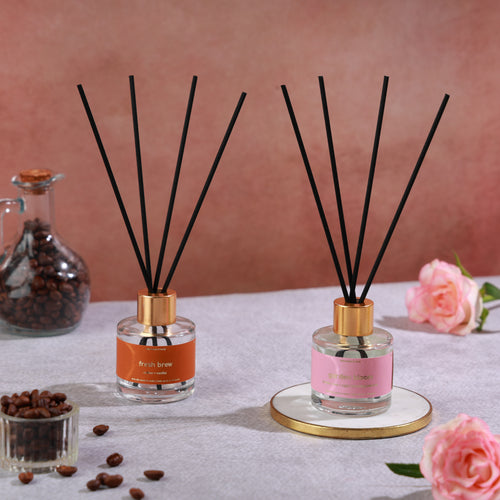 Refills · for year twofrom ₹2,399Shop →
Reeds, height and the draught line
A console setup takes four reeds — more than a bedroom's three because a hallway is a semi-transit space that has to register on arrival, fewer than a living room's full six because it is, in the end, still a narrow strip of a room rather than one people sit in. A small lobby on a 50ml runs three reeds for the same reason a small bathroom runs two: less enclosed volume needs less exposed reed surface to fill it. Flip whichever count you settle on saturated-end up every three to five days — that flip is the entire maintenance routine, and it matters more here than in a room you pass through slowly, because a hallway is where reeds get knocked, brushed by coats, or forgotten.
Height and position do real work. About a metre off the floor, on a side wall rather than the wall the door itself is set into, keeps the bottle out of the direct line the door sweeps through. The second line to watch is the draught line — the straight run of air between the front door and any window or balcony door that gets left open, which in a cross-ventilated flat can be stronger than the door's own piston stroke. If your entrance sits between the front door and an opposite window, move the console off that line even if it means giving up a metre or two of the "near" distance; a bottle in a crosswind loses its fragrance to the wind before anyone reaches the console at all.
One more placement note specific to entrances: keep it off any surface where a spilled reed or a knocked bottle would mark something you care about, and above the reach of children and pets, who tend to congregate exactly at door height when someone's coming or going. A console shelf solves both problems at once — it's higher than a side table and further from the floor traffic than anything at knee height.
What a front-door bottle actually costs
This is a single-room decision, not a whole-flat one — the number below is one bottle's price, sized to the console you actually have. For context, the whole-flat kits elsewhere in this series run ₹2,847 for a 1BHK, ₹3,696 for a 2BHK, ₹4,445 for a 3BHK and ₹5,244 for a 4BHK; a front-door bottle is one line inside whichever of those you're building toward, not an addition on top of it.
| Setup | What you get | Suits | Total |
|---|---|---|---|
| Small lobby | One Garden Bloom 50ml, three reeds | A narrow entry, up to about 150 sq ft | ₹799 |
| The console ★ | Garden Bloom 130ml, four reeds, 2–3m in from the door | A proper foyer or hallway console, above 150 sq ft | ₹1,299 |
| Vestibule / private entrance | Same 50ml, positioned right by the inner or outer door — the one exception to the two-metre rule | A sealed vestibule, or a house door onto a private garden | ₹799 |
| No foyer at all | Nothing new — reposition your living-room bottle to the entrance side, six feet in | Most 1BHK and 2BHK flats, door opens into the living room | ₹0 |
| Running cost | A 300ml refill ₹2,399, or 500ml ₹3,499 (₹7/ml) | 500ml is ten 50ml fills — roughly ₹350 a fill | from ₹2,399 |
Versailles
Of every placement question we get, this one produces the most confident wrong answers, because "near the door" sounds like it can't possibly be wrong. It can — by exactly the distance most people are willing to walk before deciding a shelf is good enough. I've stood in enough Indian entryways to know the shelf right by the hinge is almost always the first flat surface anyone sees, which is precisely why it's the wrong one: it's also the first surface the door's own air reaches.
Two to three metres solves it completely, and it costs nothing beyond the walk. If your flat has no foyer at all — and most of the 1BHKs and 2BHKs I've measured don't — there is nothing to buy. Move the bottle you already own to the entrance side of the living room and you're done.
The shoe rack rule surprises people more than the distance rule does, but it shouldn't. We spend a great deal of care composing a fragrance that behaves well against a room; it was never designed to behave well against a shoe rack, and no fragrance is. Every purchase funds a girl's education through Nanhi Kali — not a percentage, not a quarterly cheque. Every one.
Frequently asked questions
- Where to place a reed diffuser in an entrance foyer — the full placement rules beyond the door itself.
- How many reed diffusers for a large foyer? — when one console bottle genuinely isn't enough.
- Is a reed diffuser good for a home entrance? — the case for and against, honestly weighed.
- Building a signature entrance scent — choosing a fragrance that reads as "considered" on arrival.
- Brand: the SOSA founder story.
SOSA reed diffusers & prices (verified August 2026): Morning Freshness (Malabar lemon · peppermint · eucalyptus) 50ml ₹749 · 130ml ₹1,249 · Evening Calm (lavender · chamomile) 50ml ₹799 · 130ml ₹1,299 · Garden Bloom (British rose · night-blooming jasmine) 50ml ₹799 · 130ml ₹1,299 · Fresh Brew (Coorg coffee · Kerala vanilla) 50ml ₹849 · 130ml ₹1,349 · Mountain Breeze (Himalayan pine · sage · cedar) 50ml ₹849 · 130ml ₹1,349. Duo sets: Day & Night 2 × 50ml ₹1,498 · 2 × 130ml ₹2,498; Fresh & Grounded 2 × 50ml ₹1,548 · 2 × 130ml ₹2,548; Warmth & Bloom 2 × 50ml ₹1,598 · 2 × 130ml ₹2,598. Refills 300ml ₹2,399 · 500ml ₹3,499. Six fibre reeds included with every bottle; refillable glass. 50ml suits rooms up to 150 sq ft and lasts 6–8 weeks; 130ml suits rooms above 150 sq ft and lasts 14–18 weeks. Fractionated coconut oil (CCT) carrier, alcohol-free, phthalate-free, paraben-free, IFRA-compliant, low VOC; tested through 45°C heat and 85% monsoon humidity. Composed and handmade in small batches in Pune. Ultrasonic machines quoted for comparison: Boond ₹899 · Sukoon ₹1,899 · Megh ₹3,499, which run the separate water-based Hotel Collection fragrances (15ml ₹299 · 100ml ₹999 · 300ml ₹1,799) — the two lines are not interchangeable. Every purchase funds a girl's education through Nanhi Kali. Prices and availability subject to change — see the live product pages.