



Who decides: a visitor, or you on the first breath after half an hour out of the flat. Not you sitting in the room.
The calendar's job: a reminder at the bottom of the range — week 14 for a 130ml, week 6 for a 50ml — that tells you to go and check, not to buy.
2. A schedule buys early, and the cost is measurable. A 130ml is rated 14–18 weeks. Set a hard reorder at fourteen and you buy 52 ÷ 14 ≈ four bottles a year; let each one run its length and you buy 52 ÷ 18 ≈ three. That is ₹4,996 against ₹3,747 in one room, and across three rooms ₹14,988 against ₹11,241 — a difference of ₹3,747 a year for an identical result.
3. Waiting for empty buys late, and the cost is a dead room. The last stretch of a reed diffuser is usually its worst. Throw drops first, and it drops for a reason that has nothing to do with the liquid running out — the fibre clogs. Sitting it out until the glass is dry means five or six weeks of paying nothing and receiving nothing, and it also guarantees a gap, because you only start thinking about a replacement on the day you no longer have one.
4. Use the calendar as a prompt to check, never as a prompt to buy. Put a reminder at the bottom of the range — week 14 for a 130ml, week 6 for a 50ml. When it fires, the instruction is not "order a bottle". It is "stand in the doorway and see". Roughly half the time the answer is that the room is fine and you push the reminder out three weeks. A proxy you are willing to overrule is a good tool; one you obey is an expensive one.
5. When the check says the room is flat, change the reeds before you change the bottle. Six fibre reeds come in every box. If throw has dropped while the liquid level has more or less stalled, that is clogged fibre and a fresh set costs nothing. Only when clean reeds in the remaining liquid still do nothing after forty-eight hours is a replacement genuinely due.
Made in India, composed by an ISIPCA Versailles-trained perfumer — and a portion of every order supports girl-child education through Nanhi Kali.

Why the interval is a range, and why that kills the schedule
Every longevity figure on this site is a range for a reason. A 130ml runs 14–18 weeks and a 50ml 6–8, and where a particular bottle lands inside its range is decided by three things you control and one you do not. Reed count is the biggest: six reeds is full strength and burns through the bottle fastest, four is a bedroom setting that can push a 130ml past eighteen weeks. Heat is the second — evaporation rises with temperature, so the identical bottle finishes sooner in a hot west-facing hallway than in an air-conditioned bedroom. Airflow is the third: a fan or an open balcony door carries away what has evaporated and pulls more up the wick. The fourth is simply the season you are in.
Put a number on that spread and the case against a schedule makes itself. At fourteen weeks a ₹1,249 bottle has cost about ₹89 a week; at eighteen weeks the same bottle has cost about ₹69. That is nearly a third of the price, decided by how the bottle was run and where it stood — and no reorder date set in advance can know which of those two homes you have. The same logic disposes of the opposite policy. Waiting for a dry bottle assumes that liquid and performance run out together, and they do not: reeds clog over months as heavier fragrance molecules saturate the fibre, so a bottle frequently stops throwing while a third of it is still in the glass. Both policies are attempts to avoid making a judgement. The judgement is not hard — it just cannot be made by the person sitting in the room.
The three policies, priced
 130ml₹1,249Reorder every fourteen weeks and you will never have a flat room. You will also buy four bottles a year where three would have done — ₹4,996 against ₹3,747 — and you will throw away bottles with usable liquid in them. The deeper problem is that a schedule is blind to reed count. Run four reeds instead of six and your 130ml may be good for nineteen or twenty weeks, at which point a fourteen-week reorder is not slightly early, it is a third of a bottle wasted every cycle.
What to do, room by room, when the reminder fires
The reminder has gone off. Here is what each room actually needs, and how often the honest answer is to close the app and do nothing.
| Space | What it needs | How many | Cost |
|---|---|---|---|
| 130ml in a living room at week 14, visitor still notices it from the doorway ★ | Working. Push the reminder out three weeks and check again — this is roughly half of all checks | Nothing | ₹0 |
| 130ml at week 12, room flat, liquid level has stalled | Clogged fibre, not a finished bottle. Fresh reeds from the box, then judge again in forty-eight hours | Nothing. Change reeds | ₹0 |
| 130ml at week 17, room flat, fresh reeds changed nothing | Genuinely due. Refill rather than rebuy — the glass and collar were always the durable part | Refill | ₹2,399 for 300ml |
| 50ml in a bathroom at week 6 on two reeds | Almost certainly early. A low reed count stretches a 50ml past its rated window — check, do not assume | Check, usually nothing | ₹0 |
| A bottle in a guest room used four nights a year | Nothing, ever. Do not put it on a replacement cycle at all — move it to a room somebody sits in and let that room have the schedule | None | ₹0 |
| Two bottles that went in on the same day and are both flat | Replace one now and one in three weeks, so the next pair does not land together and turn into one large bill | One now, one later | from ₹1,249 each |
| A note on all of the above: the 14–18 and 6–8 week windows assume six reeds in a closed room of standard ceiling height. Fewer reeds, air-conditioning and a shaded position all push a bottle towards the long end; heat, sunlight and a running fan pull it towards the short one. That spread is exactly why the date is a prompt and the doorway is the decision. | |||
One room · the unitFrom ₹749Shop → 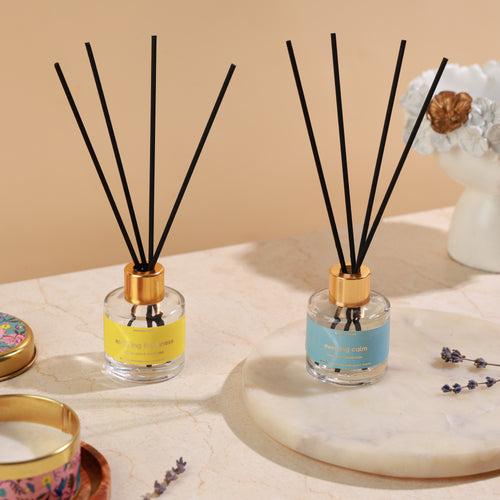 Two rooms · better value₹1,498Shop →
  Large room · a switch₹1,899Shop →
Building the habit that actually works
Write the date on the bottle, not just in your phone. A small label on the base with the day the reeds went in turns a vague impression into a fact, and it is the single cheapest thing you can do to stop over-buying. If you run more than one bottle, write the reed count on the label too — a 130ml on four reeds and a 130ml on six are two different products with two different lifespans, and you will not remember which is which by week eleven. Then set one reminder per bottle at the bottom of its range: week 14 for a 130ml, week 6 for a 50ml.
When the reminder fires, run the doorway check before you look at any prices. Leave the flat for half an hour — a walk, the shops, anything — and pay attention only to the first breath as you come back in. If somebody is visiting that week, that is better still: say nothing, and see whether they remark on it. If the room registers, push the reminder out three weeks and go and do something else. If it does not, the order of fixes is fresh reeds first, then moving the bottle somewhere with a little more air movement and out of direct sun, and only then a replacement. The first two are free.
Offset the second bottle so your reorders do not land together. If two 130ml bottles started on the same day, they will finish within a fortnight of each other and every replacement cycle after that will be a single ₹2,498 event rather than two ₹1,249 ones. The fix is a one-off: when the first pair ends, replace one immediately and the other three weeks later, and the offset holds from then on. When bottles do come due, a 300ml refill at ₹2,399 fills a 130ml roughly twice and is also the natural moment to fit fresh reeds — refill day and reed day should be the same day.
What to buy
Assuming the doorway check actually failed and fresh reeds did not rescue it, this is the ladder. If the check passed, none of it applies this month.
| Buy | What it covers | Lasts | Price |
|---|---|---|---|
| One 50ml | A single reed diffuser — a room where you would rather change blend often than stretch the interval | 6–8 weeks | from ₹749 |
| One 130ml ★ | The value size — the size that makes this whole question rarer — three purchases a year instead of seven | 14–18 weeks | from ₹1,249 |
| The duo | Day & Night duo — two rooms coming due together, if you would rather solve both in one order | 6–8 weeks each | ₹1,498 |
| Sukoon | 500ml ultrasonic — a large room where reed count was never the variable that would fix it | Runs when you switch it on | ₹1,899 |
| 300ml refill | The running cost — the cheaper end of a bottle — about ₹8.00 a millilitre against ₹9.61 in a new bottle | Roughly 2 × 130ml fills | ₹2,399 |
Versailles
I am often asked for a subscription, and I have not built one, because a subscription is a schedule and a schedule is the expensive policy. A 130ml can run fourteen weeks or nineteen depending on how many reeds are in it and how hot the room is, and a box arriving every fourteen weeks regardless would quietly sell you an extra bottle a year per room. Across three rooms that is three bottles and ₹3,747 you did not need to spend.
The opposite habit is not better. People who wait for the glass to run dry spend a month of every cycle in a room that has stopped working, because the reeds clog before the liquid goes, and then they conclude that reed diffusers do not last. They lasted. Nobody was measuring the right thing.
So: a note on the bottle with the date and the reed count, one reminder at the short end of the range, and when it fires you go and stand in your own doorway after half an hour outside. Half the time you will spend nothing. That is not me being modest about the product — it is the difference between three bottles a year and four. A portion of every order supports girl-child education through Nanhi Kali.
Frequently asked questions
- When is a bottle genuinely finished? — the free test with fresh reeds.
- Staggering your purchases — so they do not all land at once.
- Reordering with five bottles — what the calendar actually looks like.
- Does a bigger bottle mean fewer decisions? — three a year against seven.
- Brand: the SOSA founder story.
SOSA products & prices (verified August 2026): Hotel Collection water-based ultrasonic diffuser fragrance 15ml ₹299 · 100ml ₹999 · 300ml ₹1,799 · Pack of 7 (15ml, all fragrances) ₹1,799; refills 100ml from ₹999. Seven scents: The Ritz-Carlton-inspired (white tea · bergamot · cedar), Westin-inspired (white tea · aloe · cedar), 1 Hotels-inspired (cedarwood · vetiver · green leaves), The St. Regis-inspired (amber · violet · woods), Shangri-La-inspired (jasmine · green tea · white tea), Four Seasons-inspired (citrus · floral · sandalwood), W Hotels-inspired (citrus · pepper · amber). Diffusers: Boond 300ml ₹899 · Sukoon 500ml ₹1,899 · Megh 6L ₹3,499. Water-based, phthalate-free, composed to IFRA standards for home diffusion; 3–6 drops per tank. Made in India, Pune. The Hotel Collection scents are SOSA's own interpretations inspired by the world's finest hotels; all hotel names are trademarks of their respective owners and are used only to describe the scent style — SOSA is an independent Indian fragrance house, not affiliated with or endorsed by any hotel brand. Prices and availability subject to change — see the live product pages.