


Why lowering it does not help: an association forms on consistency and distinctiveness, not on strength. A light, memorable signature is the most learnable one.
Why the waiting area counts: in this clinic type the wait is the anticipation, and that is where the pairing is laid down.
What to do instead: housekeeping, ventilation, and everything about the visit that is not a smell.
2. Because the whole model of this clinic is repetition. An immunisation schedule brings the same child back at intervals through the first years of life, and often to the same room with the same staff and the same layout. That repetition is a virtue clinically and it is the precise condition under which a background cue is learned. A general paediatric clinic sees a child a handful of times a year for varied reasons; a vaccination clinic sees them on a defined schedule for one reason. Consistency of context is the design feature and the hazard at the same time.
3. And turning it down is not a mitigation. This is the part that surprises owners, because in every other article here the answer to a difficult room is a lower setting. Association does not work on strength. It works on a signal being present, distinguishable and consistently paired with the event, and a faint but unmistakable house note ticks all three. If anything, a light signature is more learnable than a heavy one, because it is pleasant enough to go unchallenged and therefore stays unchanged for years. There is no duty-cycle setting that answers this objection, which is why the answer is a refusal rather than a number.
4. The waiting area is inside the boundary, not outside it. In a general clinic the waiting area is a neutral space where the appointment has not yet happened. In a vaccination clinic it is the queue for an injection, and every child in it knows what is coming. That is the anticipation phase, and it is where a great deal of the pairing is laid down — the smell of the room is present while the child is already apprehensive. The desk is in the same position, because it is the last place before the room. So the fragrance-free boundary in this clinic type is the front door.
5. And the cue does not stay in your building. This is the argument that ought to settle it for anyone still weighing a signature. A learned association travels with the child. They will meet the same note in a lift lobby, a car, a hotel corridor, a relative’s living room — and, most awkwardly, in the next clinic that has bought the same popular commercial fragrance. A signature you install today can be delivered to a child by somebody else’s diffuser in three years, and neither you nor they will know why the child reacted.
Made in India, composed by an ISIPCA Versailles-trained perfumer — and a portion of every order supports girl-child education through Nanhi Kali.
Why the association argument outranks every other consideration here
Every other objection in this cluster can be answered with a number. Dwell time too long? Lower the duty cycle. Breathing zone too close? Mount it higher and aim it away. Respiratory attendances? Keep the fragrance out of those rooms and off that stream. Each of those is a design problem with a setting attached to it, and a careful clinic can solve it. The association objection has no equivalent lever. It is not about how much of the fragrance reaches the child; it is about whether a distinguishable smell is reliably present while something unpleasant happens. Reduce the concentration and you still have a scent that is present, distinguishable and consistently paired — you have simply made it subtler, which is not the same as making it absent. An objection that cannot be answered by any available control is an objection that ends the purchase rather than shapes it.
The second reason is that a vaccination clinic has an unusual relationship with its own memorability. Most commercial scenting is bought precisely so that a space is remembered — that is the entire proposition, and in a hotel or a showroom it is a reasonable one. Here the thing being remembered is a needle. The commercial logic and the clinical interest point in exactly opposite directions, and the better a supplier does their job — a distinctive, consistent, well-diffused signature applied across every branch — the more precisely the cue is delivered. It is also worth noting who bears the consequence. The parent who chose the clinic experiences the fragrance for the twenty seconds they stand at the desk. The child experiences it while waiting for an injection, several times over several years, and is the one who may later baulk at a corridor that smells faintly of the same thing. That asymmetry is the whole cluster in one room.
Three things to check instead of choosing a fragrance
 Not in this clinicElsewhere onlyA vaccination clinic that smells of nothing describable has achieved the correct outcome, and that is a housekeeping and ventilation job rather than a fragrance one. Work the list: which disinfectant and at what dilution, whether the clean happens with windows open or shut, sharps and general bin type and emptying frequency, the alcohol rub at the desk, basin traps, the AC filter and drain pan, and whether the space is aired before the first appointment. The clinic that smells of nothing has removed the cue as well as the odour — there is no stable distinctive background left for a child to attach anything to.
Zone by zone, in a dedicated vaccination clinic
Every row in this table says the same thing, which is unusual even for this cluster. It is printed in full because a policy works by naming areas explicitly rather than by asking staff to infer a principle.
| Area of the clinic | Scented? | Why | What we would use |
|---|---|---|---|
| Injection and vaccination room ★ | Never | The event itself — a distinctive background here is the cue in its most direct form | Nothing |
| Waiting area and queue | No | In this clinic type the wait is the anticipation, which is where much of the pairing is laid down | Nothing |
| Reception and registration desk | No | The last space before the room, on the same air, and reached by every child on every visit | Nothing |
| Observation area after the dose | Never | Children wait here immediately after the injection, which is the other half of the pairing | Nothing |
| Cold-chain, preparation and clinical store | Never | Clinical working areas where staff need their own senses and nothing should be added to the air | Nothing |
| Staff room or back office on separate air | Reviewable | No child enters it and it has its own return path — the only row that is even a question | A reed at three reeds, if governance agrees |
| Before any of this: the housekeeping and ventilation baseline is not the first step here, it is the entire programme. Disinfectant choice and dilution, sharps and general bin type and emptying, alcohol rub at the desk, basin traps, AC filter and drain pan, and a genuine airing window before the first appointment. | |||
Small reception · no power neededFrom ₹749Shop →  Mid reception · has an off switch₹1,899Shop →
 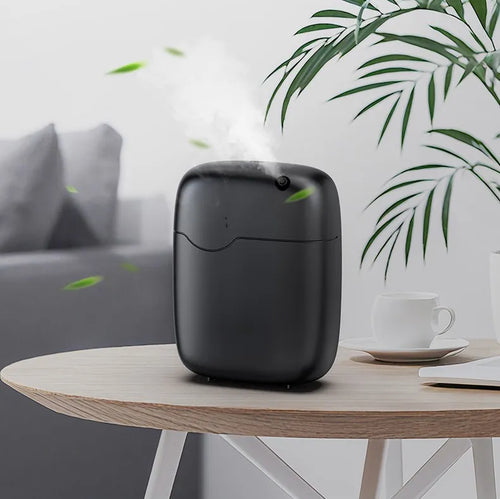 Large lobby · timed, dialable₹11,999Shop →
What replaces the fragrance decision
Aim for nothing describable, and verify it the same way you would verify a setting. Send someone who has been outside for thirty minutes into the waiting area, the observation area and the injection room, at standing height and again at about a metre, first thing in the morning and last thing in the evening, and write down anything they can name. Phenolic, alcohol, damp, drain, bin, closed air: each is a source with an owner and a fix. A closed clinic sits at roughly 0.2 to 0.5 air changes an hour overnight against three to eight when genuinely ventilated, so a real airing window before the first appointment does more for the morning reading than anything you could buy.
Then deal with the sorptive surfaces, because they hold whatever the room has met. A vaccination clinic waiting area accumulates the same soft inventory as any other paediatric space — cushions, a rug, cloth toys, curtains, upholstered seating — and those absorb odour and release it slowly afterwards. That is a reason to specify wipeable seating and washable covers with a named owner and a real rota, and it is a second reason not to introduce a fragrance in the first place: an added scent that has soaked into the furnishings cannot be switched off for the family who asks about it, and it persists as a stable background long after any machine has been unplugged.
And say plainly that the clinic uses no added fragrance. One line at the desk and on the appointment confirmation. It costs nothing, it gives desk staff a script when a supplier or a well-meaning landlord arrives with a plug-in, and it tells parents something specific about how the place is run. The decision itself is not ours and not the supplier’s: it belongs to the facility’s clinical governance, infection-control and housekeeping leads, and everything in this article is a view about air and fragrance offered for them to accept or reject.
What we would install — and what we would not
The starred row is the recommendation for this clinic type, and it is the last row. The rest of the ladder is printed so an owner comparing a vaccination service with a general practice can see exactly where the two part company.
| Option | Suits | Control you get | Price |
|---|---|---|---|
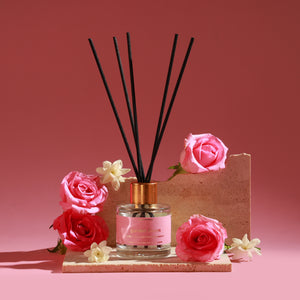
| Reed diffuser | A small reception desk — a staff room or back office on separate air that no child enters — never a patient area, at any level | Reed count only — no switch, no timer | from ₹749 |
| Sukoon 500ml | A reception up to ~320 sq ft — a general paediatric reception elsewhere in the group, where injections are an occasional part of a wider list | On/off, intermittent mode, you control the drops | ₹1,899 |
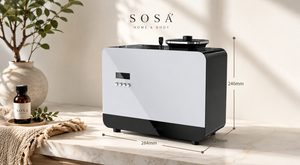
| Vaayu | A large lobby or a zoned duct — a large general front-of-house on its own duct zone — not an immunisation service of any size | Duty cycle in seconds, timer, app scheduling | ₹11,999 |
| Aangan | Whole-facility HVAC — a multi-speciality facility with zoned ducting where the immunisation suite is excluded at the duct | Zone-level control, but only if the ducting is zoned | ₹25,999 |
| Nothing at all ★ | A dedicated children’s vaccination clinic — reception, waiting, observation and injection rooms alike, and this is the row we would star | Complete — and the correct answer more often than the trade admits | ₹0 |
Versailles
I have argued in most of this cluster that a light note at a paediatric reception is a defensible detail. I will not argue it for an immunisation clinic, and the reason is one I would rather state plainly than dress up. The thing a scenting supplier sells is memorability, and in this room the thing being remembered is a needle. I do not want a child three years from now flinching at a corridor because it smells like the place they were injected.
What makes this different from every other refusal I write is that I cannot offer a lower setting as a compromise. Usually I can: run it at the shortest duty cycle, mount it high, schedule it to clinic hours, and a difficult room becomes a workable one. Here the objection is not about how much reaches the child. A quiet, consistent, well-liked house note is the most learnable version of the problem, so the more competently I do my job the worse the outcome is.
So the honest recommendation is nothing, and the useful conversation is about the things that are not fragrance: the bins, the disinfectant dilution, the morning airing, the wait, the noise, the seating and the lighting. Put the decision to your own clinical governance and infection-control leads, and let their answer stand over mine. A portion of every SOSA order funds a girl’s classroom through Nanhi Kali, and I am perfectly content for this one not to be an order.
Frequently asked questions
- Which areas stay fragrance-free? — the seven zones, and why.
- Examination rooms — why the clinician’s nose matters.
- Should a children’s clinic have a signature? — the case against memorability.
- The most conservative strategy — default off, one exception.
- Brand: the SOSA founder story.
SOSA products & prices (verified August 2026): Hotel Collection water-based ultrasonic diffuser fragrance 15ml ₹299 · 100ml ₹999 · 300ml ₹1,799 · Pack of 7 (15ml, all fragrances) ₹1,799; refills 100ml from ₹999. Seven scents: The Ritz-Carlton-inspired (white tea · bergamot · cedar), Westin-inspired (white tea · aloe · cedar), 1 Hotels-inspired (cedarwood · vetiver · green leaves), The St. Regis-inspired (amber · violet · woods), Shangri-La-inspired (jasmine · green tea · white tea), Four Seasons-inspired (citrus · floral · sandalwood), W Hotels-inspired (citrus · pepper · amber). Diffusers: Boond 300ml ₹899 · Sukoon 500ml ₹1,899 · Megh 6L ₹3,499. Water-based, phthalate-free, composed to IFRA standards for home diffusion; 3–6 drops per tank. Made in India, Pune. The Hotel Collection scents are SOSA's own interpretations inspired by the world's finest hotels; all hotel names are trademarks of their respective owners and are used only to describe the scent style — SOSA is an independent Indian fragrance house, not affiliated with or endorsed by any hotel brand. Prices and availability subject to change — see the live product pages.