

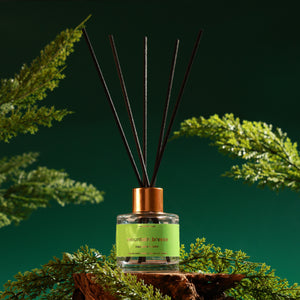

What a reed costs, exactly: ₹749–₹849 for 50ml lasting six to eight weeks and covering up to about 150 sq ft, or ₹1,249–₹1,349 for 130ml lasting fourteen to eighteen weeks. Refills are published too, at ₹2,399 for 300ml and ₹3,499 for 500ml. Both the capital and the consumable are on the shelf with a price on them.
What a machine costs: Vaayu ₹11,999 for up to 1000 m³, roughly 2,000–3,000 sq ft; Aangan ₹25,999 for up to 3,000 m³ when it is connected to the air system; Meenar ₹38,500 as the larger-property option, specified on enquiry. Those are capital figures, published to the rupee.
The asymmetry a budget line has to absorb: on the reed side both halves of the cost are published. On the machine side only the capital half is. SOSA lists no purchasable refill oil for the waterless commercial machines, so the fragrance line is specified and quoted per property through the contact page. A committee paper should say that in those words rather than leave a blank in the running column.
Where each genuinely wins: reeds win in cloakrooms, washrooms, a secretary’s office, a console by a lift landing and a small reading alcove — anywhere a two-metre zone is in fact the brief. Machines win in the lobby, the corridor network and the members’ lounge, where the brief is a volume and nine bottles would only produce nine small zones with valleys between them.
2. More bottles do not add up to a room. This is the arithmetic that fails in almost every large club we are asked to look at. Two passive sources in one lounge do not produce a plateau across the lounge; they produce two hills with a valley between them, and the valley is reliably where the armchairs are. Ten bottles produce ten hills. The total fragrance in the building goes up, the cost goes up with it, and the member sitting in the middle of the room still reports that the club does not smell of anything. The failure is not in the oil and it is not in the bottle count. It is in asking a passive device to perform a transport function it has no mechanism for.
3. On the reed side, both halves of the cost are published — so model it exactly. A 50ml bottle is ₹749–₹849 and gives six to eight weeks over an area of up to about 150 sq ft. A 130ml bottle is ₹1,249–₹1,349 and gives fourteen to eighteen weeks. Refills are listed as well, at ₹2,399 for 300ml and ₹3,499 for 500ml, which is how a club with fifteen reed positions should actually buy. Every number a finance committee needs for the reed line is on a product page, and the reed line is therefore the one part of a club scenting budget that can be forecast to the rupee without anyone being consulted.
4. On the machine side, the capital is published and the fragrance is quoted — and that is the normal shape, not an evasion. Vaayu is ₹11,999, Aangan is ₹25,999 and Meenar is ₹38,500, each to the rupee. But SOSA lists no purchasable refill oil for the waterless commercial machines and publishes no consumption rate, so there is no honest way to print a running figure on a page: it depends on the intensity setting and the scheduled hours, both of which are properties of your building rather than of the machine. The fragrance is specified and quoted per property through the contact page. Say that plainly in the committee paper and the paper is stronger for it.
5. In a large club the correct answer is a split, and the split follows the floor plan. Buy machines for the connected volumes — lobby, corridor network, lounge — and reeds for the small enclosed rooms where two metres is genuinely the brief. A closed door is a real boundary, so a cloakroom with a door is a two-metre problem no matter how large the club is. Everything SOSA makes is alcohol-free, phthalate-free, paraben-free, IFRA-compliant and 0 ppm formaldehyde, composed in Pune, with free shipping above ₹499 and a portion of every order supporting girl-child education through Nanhi Kali.

What each device physically does
It is worth being slow about this, because the whole procurement decision rests on it and because the language in the market actively confuses it. Both products are sold as “diffusers”, which implies that they differ in size or quality. They do not. They differ in whether anything in the device does work on the air.
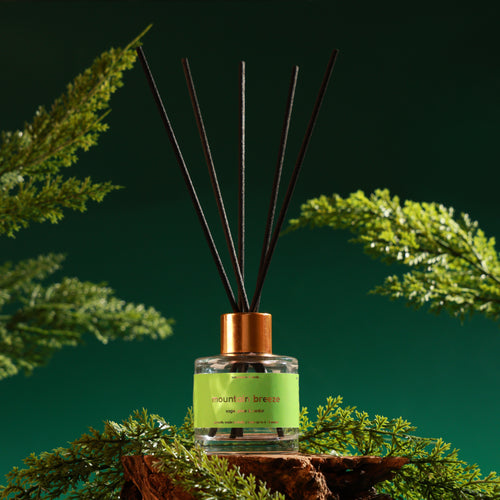
 Mountain Breeze₹849Oil in a glass bottle climbs six fibre reeds, spreads across the greater surface area the reeds provide, and evaporates. Evaporation is the only transport mechanism available, and it is driven by the air at the mouth of the bottle being drier and less saturated than the oil. The moment the air within a metre or two of the bottle reaches equilibrium, the rate slows. In still air the result is a stable, pleasant, local cloud — which is exactly what a product priced at ₹749 for six to eight weeks ought to deliver, and exactly what a club wants beside a basin or on a side table in a small office. What it cannot do is reach the other end of a room, because nothing in it is capable of pushing anything anywhere. Treat that as a specification, not a shortfall.
 Aangan₹25,999A small compressor drives air across a nozzle and shatters undiluted oil into droplets fine enough to stay airborne. No water is involved, so nothing is diluted, no humidity is added and no residue is left behind. The mist is then carried by whatever air the building is already moving — which is why the position of the machine relative to an air path matters far more than its position relative to a sightline, and why the best-scented interiors have no findable source at all. Undiluted oil also delivers far more fragrance per unit of mist than the same oil diluted in water, which is the entire reason commercial scenting went waterless in the first place. What you are buying with a machine is transport, not a better smell. The composition can be identical to what is in a bottle on a console; what the ₹11,999 pays for is getting it to the far side of the room.
Vaayu₹11,999Air that leaves a space takes the fragrance with it. A club lobby with automatic doors and a hardworking air system has a high air-change rate, which means fragrance must be replaced continuously to stay at a stable level; a closed card room used twice a week accumulates whatever is put into it. The same device therefore behaves oppositely in the two rooms. A reed in the sealed card room will eventually scent it perfectly well and may even over-scent it; the identical reed in the lobby is being stripped out faster than it can evaporate and will never register. An active machine handles the first case with a short scheduled cycle and the second with continuous low output. This is why “which device” is really a question about the room, and why a supplier who asks about your air system before asking about your fragrance is doing the job properly.
Aangan₹25,999A small compressor drives air across a nozzle and shatters undiluted oil into droplets fine enough to stay airborne. No water is involved, so nothing is diluted, no humidity is added and no residue is left behind. The mist is then carried by whatever air the building is already moving — which is why the position of the machine relative to an air path matters far more than its position relative to a sightline, and why the best-scented interiors have no findable source at all. Undiluted oil also delivers far more fragrance per unit of mist than the same oil diluted in water, which is the entire reason commercial scenting went waterless in the first place. What you are buying with a machine is transport, not a better smell. The composition can be identical to what is in a bottle on a console; what the ₹11,999 pays for is getting it to the far side of the room.
Vaayu₹11,999Air that leaves a space takes the fragrance with it. A club lobby with automatic doors and a hardworking air system has a high air-change rate, which means fragrance must be replaced continuously to stay at a stable level; a closed card room used twice a week accumulates whatever is put into it. The same device therefore behaves oppositely in the two rooms. A reed in the sealed card room will eventually scent it perfectly well and may even over-scent it; the identical reed in the lobby is being stripped out faster than it can evaporate and will never register. An active machine handles the first case with a short scheduled cycle and the second with continuous low output. This is why “which device” is really a question about the room, and why a supplier who asks about your air system before asking about your fragrance is doing the job properly.
The two cost shapes, side by side
Here is the part a budget line actually needs, and it is worth stating the asymmetry before the table rather than letting a reader discover it halfway down a column. The reed line can be modelled completely from published prices. The machine line cannot, and no supplier can honestly complete it for you from a page.
Take the reed side first, because it is simple. A 50ml bottle at ₹749–₹849 lasts six to eight weeks; a 130ml bottle at ₹1,249–₹1,349 lasts fourteen to eighteen weeks. Both the price and the life are published, so a committee can count its reed positions, choose a size per position, and divide. A club with a dozen washrooms, cloakrooms and small offices will generally find that buying 130ml bottles and then maintaining them from the 500ml refill at ₹3,499 is the cheaper way to run the same number of positions, because the refill is the same oil without a second glass bottle attached to it. That calculation is yours to do and it will be right, because every input in it is on a product page. No part of the reed line is quoted, estimated or conditional.
Now the machine side. The capital is equally firm: ₹11,999, ₹25,999 or ₹38,500, with no installation charge, annual maintenance figure or service contract published — because none exists, not because it is being withheld, and a club that is quoted one by anybody should ask what it covers. The fragrance, though, is a genuine blank. SOSA publishes no millilitres-per-hour consumption rate for any machine in the waterless range, and lists no refill oil for them as a purchasable product. What the Aangan page will say is that oil is supplied in bulk with a standing-order option; what it will not say is at what rate your particular building will get through it, because that depends on the intensity you settle on and the hours you schedule, and those are decided by your ceiling heights, your air changes and your opening times. So the running figure is quoted per property, and the only way to make it precise is to measure it in your own building. The method for that is set out on the monthly cost page, and it takes one zone, one fixed setting and one measured period.
The comparison, line by line
This is the table I would hand to a general manager to take into a board meeting. It compares the two mechanisms on the things a budget paper has columns for, and the last two rows are the ones a supplier usually leaves out.
| The line in your paper | Reed diffuser (passive) | Commercial waterless machine (active) |
|---|---|---|
| Mechanism ★ | Capillary evaporation up six fibre reeds. No energy. No air moved | Pressurised air shatters undiluted oil into a dry nano-mist, carried by the building’s own airflow |
| What it produces | A fragrant zone of roughly a couple of metres | A fragranced volume, stated in m³ |
| Published reach | Up to about 150 sq ft for the 50ml bottle | Up to 1000 m³ ≈ 2,000–3,000 sq ft for Vaayu; up to 3,000 m³ ≈ 8,000–10,000 sq ft for Aangan on HVAC |
| Capital, published | ₹749–₹849 for 50ml, ₹1,249–₹1,349 for 130ml | ₹11,999 for Vaayu, ₹25,999 for Aangan, ₹38,500 for Meenar |
| Consumable, published | Yes, fully — 300ml refill ₹2,399, 500ml refill ₹3,499, and the bottle life is published too | No. No refill SKU and no consumption rate is published; the fragrance is specified and quoted per property |
| Known life per fill | Six to eight weeks at 50ml, fourteen to eighteen at 130ml | Vaayu: up to about 90+ days on a 400ml tank, depending on intensity and hours. Aangan: weeks between refills on business-hours schedules |
| Electrical provision | None. It is a bottle | A low-voltage point at the mounting position — DC 12V / 1A at 5W for Vaayu, DC 12V at 14W for Aangan |
| Noise | Silent | Under 38 dB for Vaayu, under 42 dB for Aangan |
| Control over intensity | Add or remove reeds. Coarse, and anyone can do it | Adjustable intensity, scheduled hours, and on Vaayu a key-lock so the agreed setting holds |
| Humidity and residue | Neither | Neither — no water, no dilution, sealed residue-free tank |
| Mounting and concealment | On a surface, visible, and a glass object on a console in its own right | Freestanding, wall-mounted or into an HVAC return, which is how a source becomes unfindable |
| Where it genuinely wins | Cloakrooms, washrooms, a secretary’s office, a lift landing console, a small reading alcove — rooms with doors | Lobby, corridor network, members’ lounge, a whole floor on one air system — connected volumes |
| Where it will disappoint you | Any large or high-ceilinged connected volume. Ten bottles give ten zones, not one room | A single small closed room, where it is more machine than the brief needs and harder to dose down than a bottle is |
The third mechanism, and why it rarely suits a club
A procurement exercise will usually turn up a third option, because it is cheap and it looks like a machine. An ultrasonic diffuser vibrates a plate under water in which oil has been dispersed, and throws the mixture out as a visible wet mist. It does cover a genuine room: Sukoon at ₹1,899 is published at 270–320 sq ft with a 500ml tank and sixteen to eighteen hours of runtime on low, and three 15ml scents are included with it; Boond at ₹899 holds 300ml and covers up to about 150 sq ft. For a committee room used occasionally, or a manager’s office, they are sensible and inexpensive purchases.
Two things stop them being the club answer. The first is dilution: what reaches the room from an ultrasonic machine is mostly water, with the fragrance as a minority passenger, so the fragrance delivered per unit of mist is a fraction of what a waterless nebuliser achieves with undiluted oil. The second is that the water itself is a liability in an Indian club. It adds humidity to a building where humidity is usually the thing you are fighting, it can leave a fine pale mineral deposit on dark joinery and polished surfaces, and it asks a steward to refill a tank with water daily rather than top a reservoir up every few weeks. And tank size is not coverage. Megh at ₹3,499 holds six litres and runs for around a hundred hours, which sounds like the large commercial option in the ultrasonic range, but its published coverage is only about 215 sq ft — less than the ₹1,899 Sukoon. Buying the bigger tank buys runtime, not reach, and that distinction is worth more to a procurement committee than almost anything else on this page.
One further point that saves an expensive mistake: the carrier decides the machine, and the three families of oil are not interchangeable in any direction. Reed oil cannot go into an ultrasonic machine. The water-based Hotel Collection fragrance oils — three to six drops in a water tank — go only into the ultrasonic machines, which is to say Boond, Sukoon and Phuhaar, and they are not for reed diffusers and not for neat waterless nebulising. And thick undiluted essential oils are not recommended in a waterless nebuliser at all, because they will clog a fine nozzle over time. There is also no hotel-inspired reed diffuser at SOSA, and there cannot be one, because those oils are water-based and reeds cannot carry water. If a specification sheet mixes these up, the machine will not fail dramatically; it will simply underperform in a way nobody can diagnose for a year.
Where each one wins in the same building
The useful conclusion for a large club is not a winner. It is a split, and the split is decided by doors and connected volume rather than by the size of the club as a whole. Below is how I would allocate a budget across the two mechanisms, in the order I would spend it.
| Order | What to buy | Why it sits here | Cost |
|---|---|---|---|
| 1. Nothing, until the building is right ★ | Air change before opening, dried carpets, serviced drain traps, relative humidity down | Both devices add fragrance to whatever is already there, and a mixture reads as a cover-up | No purchase |
| 2. Vaayu at the arrival volume | Up to 1000 m³, in the airflow path or an HVAC return, intensity set once and key-locked | The threshold is the one place a club may be legible, and it is where a passive device fails hardest | ₹11,999 |
| 3. Reeds in every small room with a door | Mountain Breeze or Morning Freshness, 130ml for the longer life | Cloakrooms, washrooms, the secretary’s office, a lift landing — genuinely two-metre problems, and far cheaper to solve passively | ₹1,249–₹1,349 each |
| 4. A second machine for the corridor network | A zone unit shared across corridors and the lounge approach, set lower than the lobby | Corridors are the connective tissue a member walks repeatedly, and often the best value in the scheme | ₹11,999 |
| 5. Aangan only if the air system genuinely serves those zones | Up to 3,000 m³ on HVAC, 800ml, programmable cycles and daily schedules, metal body | A building machine is worth its capital only where the AHU actually reaches the rooms you want scented | ₹25,999 |
| 6. Reed refills as a standing habit | 300ml at ₹2,399 or 500ml at ₹3,499 rather than new bottles each time | The same oil without a second glass bottle attached to it, which is how a multi-position reed line gets cheap | ₹2,399–₹3,499 |
| The two gaps, said plainly: ask us | No refill oil is listed as a purchasable product for the waterless commercial machines and no consumption rate is published, so the fragrance line for a machine cannot be costed from this page. SOSA also publishes no leather, tobacco or smoky fragrance for any diffuser | Named here rather than buried, because a committee will check both — and because a quoted fragrance line is the ordinary shape of commercial scenting rather than an evasion | Quoted |
Versailles
A club secretary once showed me an invoice file before he showed me the building. Eleven reed diffusers a quarter, every quarter, for three years, in a lounge and a lobby that opened into one another under a galleried stair. He wanted to know whether a stronger fragrance existed. What existed was a mechanism problem: he had bought a device that evaporates oil where it stands, eleven times over, and asked it to cross a volume that a square-foot figure had already understated because of the stair.
The money he had spent on three years of bottles would have bought him two machines outright. I say that carefully, because it is not an argument that reeds were the wrong product — four of those eleven positions were washrooms and a secretary’s office, and reeds were exactly right there and still are. It is an argument that seven of them were trying to do a job no passive device can do, and that nobody had told him the difference. He had been shopping for strength when he should have been shopping for transport.
The other thing I would say to anyone reading this with a budget line open is that the blank in the running column is real and I would rather you saw it here. We publish the capital for every machine to the rupee, and we publish the entire reed line, price and life both, so that half of your paper can be exact. We do not publish a consumption rate for the waterless machines and we do not list a refill oil for them as a product, so the fragrance line for a machine is quoted for the property. The way to make that figure solid is to run one zone at a fixed setting for a measured period and record what it actually used — your building, your hours, your number. Everything we make is composed in Pune, and a part of every order funds a girl’s classroom through Nanhi Kali.
Frequently asked questions
- Is a machine worth buying at all — including the two conditions under which the honest answer is no.
- What professional scenting costs in India and how to calculate the monthly figure — the published half and the quoted half.
- The questions to ask a supplier — the list a general manager should take into the meeting.
- Scenting in a renovation plan and what the architect should draw — the provisions that cost nothing at drawing stage.
- One scent across several clubs, standardising across locations, and writing the scenting SOP.
- Brand: the SOSA founder story.
SOSA commercial scenting — facts verified August 2026: Vaayu ₹11,999, waterless cold-air nebulising, coverage up to 1000 m³ ≈ 2,000–3,000 sq ft, 400ml refillable sealed tank lasting up to about 90+ days depending on intensity and hours, Bluetooth app plus onboard buttons, run windows of 1h / 4h / 8h / 24h, day selection, adjustable intensity, auto-stop and key-lock, under 38 dB, freestanding, wall-mounted or HVAC-return mounting, DC 12V / 1A at 5W, CE, RoHS and SGS, black and white. Aangan ₹25,999, HVAC or AHU connection or standalone wall-mount or lay-flat, coverage up to 3,000 m³ ≈ 8,000–10,000 sq ft, 800ml reservoir, under 42 dB, DC 12V at 14W, intelligent PCB with programmable work and pause cycles and daily schedules, metal body 3.9 kg at 284 × 125 × 246 mm, black or white, one-year warranty, imported; it has no app and no Bluetooth, and no certifications are published for it. Meenar ₹38,500 is the larger-property option and is specified on enquiry; no coverage figure is published for it here. Ultrasonic machines: Sukoon ₹1,899 at 270–320 sq ft with a 500ml tank and sixteen to eighteen hours on low, Boond ₹899 at up to about 150 sq ft, Megh ₹3,499 with a six-litre tank and around 100 hours of runtime but only about 215 sq ft of coverage. Reed diffusers ₹749–₹849 for 50ml lasting 6–8 weeks and ₹1,249–₹1,349 for 130ml lasting 14–18 weeks, refills 300ml ₹2,399 and 500ml ₹3,499, six fibre reeds, alcohol-free, phthalate-free, paraben-free, IFRA-compliant, 0 ppm formaldehyde, heat-stable CCT carrier, refillable glass bottle, tested at 45°C and 85% RH, composed in Pune. The Hotel Collection fragrance oils are water-based and ultrasonic-only at 15ml ₹299, 100ml ₹999 and 300ml ₹1,799; they are not for reed diffusers and not for the waterless commercial machines. No purchasable refill oil is listed for the waterless commercial machines — that fragrance is specified and quoted per property. SOSA publishes no leather fragrance in any format and no tobacco or smoky fragrance for any diffuser. SOSA sells no air purifier, no dehumidifier and no room spray for interiors — every SOSA spray is a car perfume — and makes no health, air-quality, VOC or mould claim. No dealer programme, reseller margin, trade price, territory, minimum order or service contract is published, and no installation or annual maintenance figure exists. Free shipping above ₹499. A portion of every order supports girl-child education through Nanhi Kali. SOSA is an independent Indian fragrance house; the Hotel Collection scents are SOSA’s own interpretations inspired by the world’s finest hotels, and SOSA is not affiliated with or endorsed by any hotel brand. Prices subject to change — see the live product pages.