



Wet reeds and oil in the bottle are good news. They mean the diffuser is doing its job — releasing fragrance into the air right now. So when you still can't smell it, the answer is almost never the bottle. Nine times out of ten it is your own nose, quietly tuning the scent out. There is a ten-minute test that proves it.
Wet reeds, oil left, no smell — why? Most likely nose habituation: your brain adapts to a steady scent and stops noticing it, even though it is still there.
Prove it: leave the room for ten to fifteen minutes, then walk back in. If it greets you at the door, the reed is fine.
If it really has faded: flip or replace the reeds; check the room isn't too airy. Still too gentle for you? That's an active diffuser's job.
Let me reassure you before anything else: the two things you have described — oil still in the bottle, reeds visibly wet — are exactly what a healthy reed diffuser looks like. If it had run dry or the sticks had gone bone-dry, that would be a real problem. Wet reeds mean fragrance is being drawn up and evaporating into your room as we speak. So the puzzle isn't "why has it stopped working." It is "why can't I smell something that is genuinely happening." And that shift — from blaming the bottle to checking the nose — is where the answer almost always lives.
Your nose is designed to notice change, not constancy. Sit in a room with a steady, gentle fragrance and within about twenty minutes your brain files it under "background" and simply stops reporting it. This is olfactory adaptation — nose-blindness — and it is completely normal. It is also why the person who lives with a scent smells it least, while a guest walking in for the first time notices it straight away. You are not imagining the fragrance being gone; your brain has genuinely stopped flagging it.
1. Leave the room. Step outside for a short walk, or spend ten to fifteen minutes in a different, unscented room — the kitchen or balcony is fine.
2. Reset your nose in fresh air. This clears the adaptation that has built up.
3. Walk back into the room with the diffuser, and pay attention to the very first breath as you cross the threshold.
4. Read the result. If the scent greets you at the door, your reed is working perfectly — you had simply gone nose-blind. If you return and still smell almost nothing, then it's worth checking the reeds and the room.
In my experience, the great majority of "wet reeds but no scent" messages resolve right here. People do the test, smell the fragrance clearly on returning, and realise nothing was ever wrong. If that is you, you can stop reading and enjoy your reed — perhaps just move it a little closer to where you sit, so you meet it more often through the day and re-notice it.
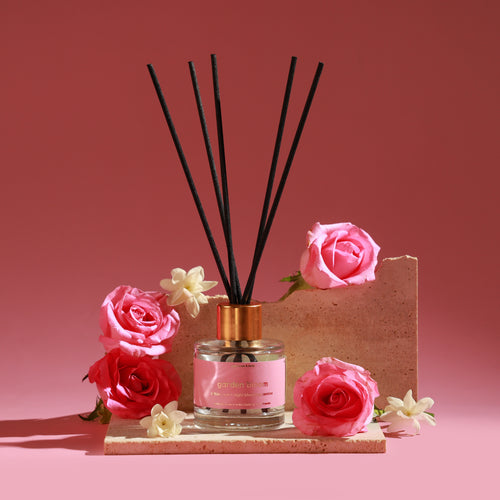 Garden Bloom Reed₹799
After several weeks, reeds can partially clog. Thickened oil, dust and the heavier fragrance molecules build up in the fibres, so the sticks carry less fresh scent to the top even while looking wet. The fix is simple: flip the reeds so the drier ends sit down in the oil, or swap in fresh sticks. Fresh reeds in the same bottle often revive the throw more than people expect — it is the cheapest thing to try, so try it first.
A reed is low-energy — it has no fan to push scent out, so it depends on still-ish air to build up a presence. A ceiling fan on high, an open window, or the strong cross-ventilation many Indian bedrooms are designed for will carry the fragrance away faster than it accumulates, and the room ends up smelling of very little even with wet reeds. An air-conditioned room with the door shut does the opposite and concentrates it. If your space is airy, that alone can explain a faint reed.
A reed's scent is densest right around it and thins fast with distance. If it lives on a far shelf and you spend your time across the room, you may rarely enter its zone. Move it within a few feet of where you actually sit, read or sleep, and near a spot you pass often, so gentle air movement carries a little towards you each time. Proximity is not a trick — it is simply how a passive scent is meant to be used.
One honest caveat to close on. If you run the come-home test, refresh the reeds, calm the airflow, move it closer — and it is giving a clear, gentle scent, but that gentle level is simply not enough for you — then nothing is broken; the tool is just quieter than your taste. That is a perfectly fair thing to want more of. But it is not a fault to fix; it is a category to change. A reed is passive and close-range by design, and if you want a stronger, room-wide presence, the honest move is up to active diffusion — a Sukoon for the whole room, or the waterless SOSA Safar for a strong, dry burst on demand in a small space.
- Why Does My Reed Smell Strong Only When I Walk Directly Past It? — falloff and adaptation
- How Strong Should a Good Reed Smell From 6–10 Feet Away? — an honest benchmark
- My Reed Isn't Defective — I Just Want More Projection. What Should I Buy? — the upgrade path
- Shop the reed diffuser collection