



The move that actually answers the brief: choose “Hanging (Mild scent-throw)” rather than “Spray (Strong scent-throw)”. SOSA has already told you which is quieter in the name of the option, and the two are the same price on every scent, so this is not a downgrade and the spray is not a premium tier. It is a choice of scent-throw.
If you want a dial instead of a fixed setting: Safar at ₹3,999 has 3 speed settings described as light to intense and a 1 / 2 / 3-hour auto shut-off, runs up to 10 hrs continuous or up to 30 hrs intermittent per charge, and stands about 6.9 cm so it sits in a cup-holder.
Size is not the variable: a large cabin does not want more fragrance. It wants the fragrance put further from the people in it. Total exposure time decides the dose.
The honest gap: no coverage figure of any kind is published for Safar — no floor area, no volume, no passenger count — so anybody quoting you one has invented it, and I will not. And Mysore Orange Blossom at ₹549 for 10 ML or ₹1,499 for 50 ML is spray only with no hanging form, and sits closer to floral than to citrus, so it is an adjacent option rather than the answer here.
2. Your real requirement is a delivery rate, and SOSA has already named it for you. Read the option values again as specifications rather than as marketing: one says strong scent-throw, the other says mild. You are asking for mild. The hanging form is not the compromise version of the spray — it is the same fragrance released slowly instead of in a burst, at the same price on every scent. If somebody tells you to upgrade to the spray, they have misread the range.
3. Citrus suits the daytime brief because of how it behaves, not because of a season label. A citrus accord leads with its lightest, most volatile materials. In a warm cabin those announce themselves early and then subside, which is exactly the shape you want for a commute that starts hot and settles once the air conditioning catches up. It is the opposite shape from a dense, sweet register, which keeps arriving all afternoon in a volume that has nowhere to put it.
4. A bigger cabin is not a bigger dose. This is the single most expensive misunderstanding in car scenting, and large SUVs are where it does the most damage. Distance from the source does the work and the cabin's own airflow is the transport, so a three-row vehicle wants the source moved away from faces rather than turned up. Dose for the last hour of the journey, never for the first five minutes.
5. Judge it with somebody else's nose. You sit nearest the source for the entire drive, which makes you the least reliable judge in the vehicle. The only trustworthy test is the face of a passenger who has just opened the door and sat down. Everything SOSA composes is alcohol-free where applicable, phthalate-free, paraben-free and IFRA-compliant, composed in Pune by an ISIPCA Versailles-trained perfumer. Free shipping above ₹499, and a portion of every order supports girl-child education through Nanhi Kali.

Why the format answers your brief and the fragrance does not
I want to spend the middle of this page on the thing that will actually change your outcome, because the family question is the easy half. Nearly every reader who describes your brief — fresh, clean, definitely not perfumed — has already chosen a fresh scent. What has gone wrong, when something has gone wrong, is almost never the choice of lemon over sandalwood. It is that the scent is arriving faster than a sealed cabin can disperse it. And the fix for an arrival rate is a format, which is why SOSA puts the words strong and mild inside the option values rather than hiding them in a description.
 Safar₹3,999A spray puts a quantity of fragrance into the cabin all at once and the level then falls away for the rest of the journey. A hanging unit releases a small amount continuously and the level sits more or less flat. Here is the part that surprises people: those two can deliver a broadly similar amount of fragrance across a working day and still be described completely differently, because a high output on a short cycle produces peaks, and people call peaks “too strong” even when the daily total is identical to a steady low output nobody complained about. Your brief — freshness, no heaviness — is a description of the plateau. The published name for the plateau is “Hanging (Mild scent-throw)”.
 Malabar Lemon₹1,049This is the question nobody puts to a perfumer and everybody should. When you turn a composition right down, the first thing you lose is the top — the lightest, fastest materials, which in a citrus are the very ones carrying the brightness you chose it for. What remains is mostly heart and base. With a sweet or powdery accord that remainder loses its outline and reads as a vague smell of perfume, which is the worst of both worlds. Dry, structured registers survive the reduction with their character intact, and this is the quiet technical reason a lemon or a vetiver behaves so well at a low setting while other families need to be louder to be recognisable. Citrus is unusual in that it is both the brightest family and one that still reads as clean when it is barely there.
 Safar₹3,999Air that leaves a space takes the fragrance with it. A volume with a lot of air change needs the fragrance replaced continuously, because it is constantly being carried away; a sealed volume keeps nearly everything you put into it. The same source therefore behaves in opposite ways depending on one switch on your dashboard. On a hot daytime commute with the system on recirculation, you are running the accumulating case, and the level you set while the windows were open in the first minute is not the level you will be living with forty minutes later. Air conditioning also works both ways in your favour and against it: it distributes the fragrance evenly around a large cabin, and it removes it faster than still air would.
Hot weather, a large cabin, and what actually changes
Let me separate the things your question bundles together, because only one of them is really about heat. Season is not a scent category. What people mean by summer, as far as a fragrance is concerned, is a particular combination of temperature, humidity, how much the vehicle is ventilated, where it is parked and how the passengers behave — windows down at the gate, air conditioning on recirculation for the next hour, a vehicle that has stood in the open. Those are five separate variables and they do not move together, which is why “citrus for summer” is an aesthetic association rather than a performance fact. It is a perfectly respectable preference. It is simply not a specification.
The genuine effect of a warm interior is that volatile materials leave a surface faster, so the early part of a composition is more pronounced and arrives sooner. In a citrus that means the brightest part of what you bought is front-loaded on a hot afternoon. This is useful to know for one practical reason: it means the first impression of your own car on a hot day is systematically misleading, in the direction of being stronger than the journey will be. If you judge the level then, you will set it too low. If you judge it after a heat-soaked vehicle has been standing in the sun all afternoon, you will have the opposite problem, because the cabin is at its most intense and adding anything to it is the wrong instinct. Wait until the interior has reached ordinary driving conditions and judge it there.
As for the size of the cabin, I will be blunt, because this is where money gets wasted. Total exposure decides the dose, not volume. A large three-row vehicle used for a forty-minute daytime commute is a milder problem than a compact car used for a six-hour drive, and the big vehicle does not need a stronger product. What it needs is the source placed further away from the people — and if the front row says it is strong while the back of the cabin says it is faint, that is a distribution question to investigate in the air-conditioning mode and which rows are occupied, not a reason to buy something louder. I am not going to publish a figure for any of this: no coverage number, no per-row concentration, no air-change rate. None is published and none would survive contact with your particular vehicle.
| Published value | What it does in a cabin | Who it suits | Price |
|---|---|---|---|
| “Hanging (Mild scent-throw)” ★ | A continuous low-level source; the level sits roughly flat for the journey | Exactly your brief — freshness with no perceptible perfume event. The default I would recommend for a daily commute | Lemon ₹499 · 15 ML refills ₹399–₹449 |
| “Spray (Strong scent-throw)” | A peak on application, then a decline across the drive | Someone who wants a clear, deliberate freshening before guests get in, and accepts the first few minutes being the loudest part | Lemon ₹499 — the same price, not an upgrade |
| “50 ML Car Perfume Spray” | The same peak shape in a larger bottle | Heavy users of the spray form who are tired of replacing it | ₹1,499 |
| Car Perfume Sprays Discovery Set | Lets you test scents on your real commute rather than on a blotter or in a shop | Anyone unsure whether they want lemon, mint or a marine note — and a bottle sniff will not tell you | Trios ₹699–₹899 · pack of 9 ₹2,999 |
| Safar with Malabar Lemon | 3 speed settings described as light to intense, plus a 1 / 2 / 3-hour auto shut-off — an adjustable rate rather than a fixed one | Someone whose journeys vary a great deal, or who carries passengers some days and not others | ₹3,999 · ₹4,499 hotel-inspired · oil ₹1,049 / ₹1,849 |
| Mysore Orange Blossom: the adjacent option, not the citrus answer | Published spray only — there is no hanging form for it at all | Someone who actually wants a floral. It is named after an orange but it sits closer to the floral register, and I would not sell it to you as the citrus choice | ₹549 for 10 ML · ₹1,499 for 50 ML |
The dial · Safar₹3,999See it → 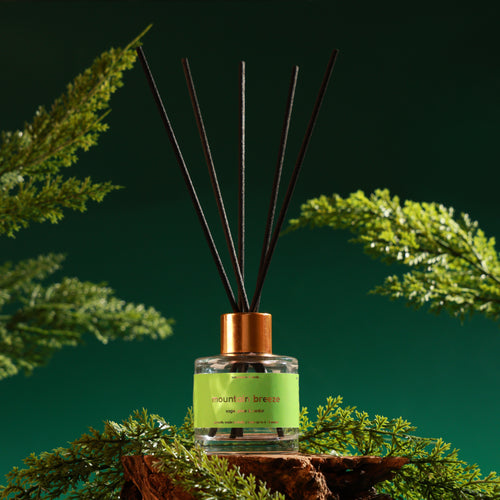 The oil · Malabar Lemon₹1,049See it →
  Unsure · ask usContactWrite to us →
When a dial is worth ₹3,999 and when it is not
I would rather talk you out of the more expensive product where it does not earn its place, so here is the test I use. Buy a fixed-rate format if your journeys are similar to each other, and buy an adjustable one if they are not. If your week is a daytime commute of roughly the same length each day, in the same vehicle, usually alone or with one other person, then a Lemon ₹499 hanging unit set and forgotten is the correct purchase and the ₹3,999 machine is a luxury you do not need. The dial is worth paying for when the same cabin has to serve genuinely different briefs — short runs and long drives, an empty vehicle and a full one — because then no single fixed rate is right for all of them.
If you do buy it, buy it for the published mechanics rather than for the idea of it. Safar is ₹3,999 for the three house trios and ₹4,499 for the three hotel-inspired trios, which are SOSA's own interpretations and not supplied by any hotel. It has 3 speed settings published as light to intense, a 1 / 2 / 3-hour auto shut-off, up to 10 hrs continuous or up to 30 hrs intermittent per charge from a 2000 mAh rechargeable lithium cell, Type-C charging with the cable included, no cord in use at all, a height of approximately 6.9 cm that puts it in a cup-holder, and a 20 ml bottle you fill with pure undiluted oil — Malabar Lemon at 100 gm ₹1,049 or 300 gm ₹1,849 for this brief. Note that those refill sizes are in grams rather than millilitres, which catches people out when they compare them against a spray. In the box: the diffuser, the 20ml bottle, the cable and a manual.
Two things I will not give you about it. First, no coverage figure is published for Safar in any unit at all, so there is no floor area, no volume and no passenger-count rating to quote, and if a listing elsewhere offers you one it has been made up. The variables you can genuinely set are the speed, the timer, the runtime you need between charges and where in the cabin the unit sits, and those four are enough. Second, three values marked “Refill” appear in the product's own option list with no live variant and no price attached, so none of those is buyable; the waterless refills are the separate product, shared with the Vaayu machine, in 100 gm and 300 gm. If a reader wants an oud or a lavender in a vehicle, incidentally, the refill range contains neither — that answer is the spray or the hanging unit instead.
What I would buy, in order — and the gap
If you handed me the keys and your brief, this is the sequence I would work through. The first line costs nothing, and the last row of the table is the one I would most like you to read.
| Step | What it is | Why it comes here | Cost |
|---|---|---|---|
| 1. Empty the vehicle first ★ | Gym kit, yesterday's takeaway, a wet umbrella in the door bin, crumbs in the third row, anything damp in the boot | Because the cargo area shares cabin air, so a wet boot reaches all three rows — and a fragrance laid over an existing odour produces a mixture the nose reads as concealment | No purchase |
| 2. Choose the form before the scent | “Hanging (Mild scent-throw)” for your brief, “Spray (Strong scent-throw)” if you want a deliberate freshening event | This is the decision that delivers “not heavy”, and it is free — both forms are the same price | No extra cost |
| 3. Lemon ₹499 as the citrus choice | The published citrus in the spray and hanging range, in whichever form you chose at step two | It is the family that reads as clean rather than as perfume, which is what your question actually asks for | ₹499 · 15 ML refills ₹399–₹449 |
| 4. Test it on the commute, not in your hand | The Car Perfume Sprays Discovery Set if you want to compare a few scents under real conditions | A scent judged from a bottle tells you almost nothing about how it behaves as a thin vapour across a large cabin an hour later | Trios ₹699–₹899 · pack of 9 ₹2,999 |
| 5. Safar only if your journeys vary | 3 speeds, 1 / 2 / 3-hour shut-off, cordless, cup-holder height, 20 ml bottle, with Malabar Lemon | An adjustable rate earns its price when one cabin serves short runs and long drives; otherwise the ₹499 unit is the better buy | ₹3,999 · ₹4,499 · oil ₹1,049 / ₹1,849 |
| The honest gaps: no coverage figure, and no hanging orange blossom | No coverage figure of any kind is published for Safar — not floor area, not volume, not a passenger count. And Mysore Orange Blossom ₹549 / ₹1,499 is spray only, with no hanging form, and sits closer to floral than citrus | Said plainly because you will otherwise look for both, and because an invented number is worse than an absent one | Not published |
Versailles
I spend most of my working life deciding how much of something a space should receive, and almost none of it deciding which something. In lobbies, in showrooms, in clinics, in cars — the complaint is hardly ever about the fragrance that was chosen. It is about the rate at which it arrives. So when a reader writes to me with your exact sentence, freshness without a heavy cabin scent, I have learned not to answer with a scent name first. The scent name is the easy part and lemon is a fine answer to it.
What I want you to take from this page is that SOSA has already done the hard part of the explaining for you, in the dullest possible place: a product drop-down. “Spray (Strong scent-throw)”. “Hanging (Mild scent-throw)”. Those are not two product tiers, they are two delivery rates at one price, and I argued for them being written that way precisely so that a buyer with your brief would not have to guess. If you take nothing else away, take the drop-down.
The last thing I would say is about who gets to judge it. You sit closest to the source, for the whole journey, every day, and your nose reports change rather than constancy — so it stops telling you about a steady fragrance while that fragrance is still physically arriving. That makes the driver the least reliable instrument in the vehicle and, awkwardly, the one person holding the dial. Set the level once, write it down, and check it by asking the next person who gets in. Everything we make is composed in Pune, and a part of every order funds a girl's classroom through Nanhi Kali.
Frequently asked questions
- Alone in the week, six of you at the weekend — one scent, two settings, and why the weekend is the binding constraint.
- Bright at the start, softer later — how to tell the character of the fragrance from your own adaptation to it.
- Does a premium SUV have to smell woody — no, and the stereotype is worth naming as one.
- Four hours versus twenty minutes and when to judge a vehicle that has stood in the sun — the two exposure pages.
- Client-facing cabins — citrus reads as clean rather than as perfumed, which is usually the actual brief.
- Genuinely too weak, or simply accustomed to it and the shared-vehicle question.
- The pillar page for this family — all seven variables resolved into a single method.
- Brand: the SOSA founder story.
SOSA car scenting — facts verified August 2026: the published citrus options for a car are Lemon ₹499 in the spray and hanging range, and Malabar Lemon as a waterless oil for Safar. The published product option is “Car freshener form” with the values “Spray (Strong scent-throw)” and “Hanging (Mild scent-throw)” at the same price on every scent, plus “50 ML Car Perfume Spray” at ₹1,499; hanging units are 12ml and the Car Hanging Freshener Refills are 15 ML at ₹399–₹449; the Car Perfume Sprays Discovery Set is ₹699–₹899 for trios and ₹2,999 for a pack of 9. The wider spray and hanging range is nine scents — Jasmine ₹449, Lavender ₹479, Sandalwood ₹479, Icy Mint ₹489, Lemon ₹499, Sea Breeze ₹509, Vetiver (Khus) ₹509, Oud Car Perfume (Assam Oudh) ₹509 and Mysore Orange Blossom ₹549 for 10 ML or ₹1,499 for 50 ML, the last of which is spray only with no hanging form. SOSA publishes no coffee car fragrance and no gourmand car spray or hanging unit. SOSA Safar waterless car perfume diffuser: ₹3,999 for the three house trios and ₹4,499 for the three hotel-inspired trios, 3 speed settings described as light to intense, a 1 / 2 / 3-hour auto shut-off, up to 10 hrs continuous and up to 30 hrs intermittent per charge, 2000 mAh rechargeable lithium, Type-C USB with cable included, fully cordless, approximately 6.9 cm, 20 ml bottle, cold diffusion of pure undiluted oil with no water, no heat and no residue, supplied with diffuser, 20ml bottle, Type-C cable and manual, imported; the published wording is aroma only — does not humidify, which is a statement about what it adds and not a claim about drying a cabin or correcting damp. No coverage figure of any kind is published for Safar — no floor area, no volume and no passenger count — and three “Refill” values appear in its option list with no live variant and no price, so none of those is buyable. Waterless nebuliser refills are shared with Vaayu and sold in grams at 100 gm and 300 gm across sixteen scents: Vetiver, Neelakurinji, Malabar Lemon, Sage & Cedar, Mahogany, Japanese Cherry Blossom, White Jasmine, Tobacco Vanilla and Mysore Sandalwood at ₹1,049 / ₹1,849, and seven hotel-inspired interpretations at ₹1,099 / ₹1,899. The refill range contains no oud and no lavender. SOSA publishes no claim that any fragrance improves concentration, keeps a person alert, reduces stress, aids sleep or alters a mood, and makes no health, air-quality, VOC or mould claim; SOSA sells no car air purifier, no dehumidifier and no room spray of any kind — every SOSA spray is a car perfume. No adaptation time in minutes is published, no test result or measured figure is reported here, and no dealer programme, trade price, minimum order or bulk rate exists; commercial enquiries are answered individually through the contact page. All fragrances are alcohol-free where applicable, phthalate-free, paraben-free and IFRA-compliant, composed in Pune. Free shipping above ₹499. A portion of every order supports girl-child education through Nanhi Kali. SOSA is an independent Indian fragrance house; the hotel-inspired scents are SOSA's own interpretations and SOSA is not affiliated with or endorsed by any hotel brand. Prices subject to change — see the live product pages.