

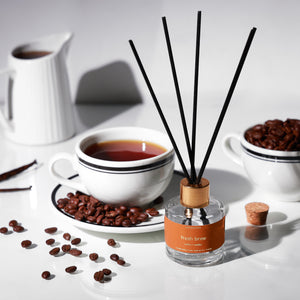
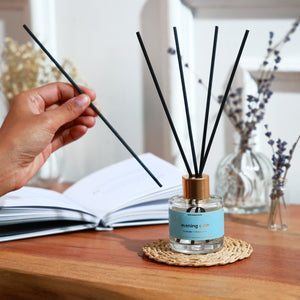
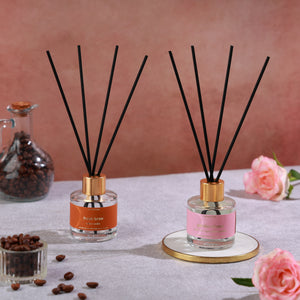

Why fragrance works as an annual line: it finishes. A 50ml reed diffuser runs 6–8 weeks and is gone, so nothing accumulates in a cupboard and nobody has to display anything when you visit.
Enough depth to last: five scents, two sizes, three duo sets and an oil refill. That is several years of genuinely different gifts inside one recognisable category.
The part everyone skips: a note on your phone — name, year, scent, size. Without it, year three collides with year one and the whole point is lost.
2. Fix the price band and hold it. Whatever you spend in year one is what the line costs from then on — ₹749–₹849 is the natural band for a single name. Escalation is the commonest way an annual gift dies, because you cannot come back down without it reading as a reduction. If you want a bigger year, buy a duo at ₹1,498 once and return to the band afterwards, deliberately.
3. Change exactly one variable a year. The scent, the room it is meant for, or the size. Not all three. Changing one keeps the gift recognisable and keeps it from being the same gift twice.
4. Keep a one-line record per person. Name, year, scent, size. On your phone, in a note you can find in October. This is the entire administrative cost of the system and it is the step people skip; without it, year three lands on the same bottle as year one and you will not know until it is opened.
5. Pick a category that finishes. A 50ml runs 6–8 weeks and is done. Nothing has to be displayed, stored or explained, and there is no accumulated shelf of your gifts to walk past. A repeatable gift and a permanent gift are close to opposites.
6. Do not announce it. A ritual you declare is an obligation you have imposed. A ritual you simply keep is a thing that becomes true after the third year, or does not, and either outcome is fine. I cannot tell you anyone will look forward to it; I can tell you it will stop costing you a fortnight of deciding.
7. Know how it ends. If a year comes when the gift plainly is not landing — the bottle was never out, the household has changed, the relationship has cooled — stop without comment and give something else. A line is a convenience for you, not a contract.
Everything is composed and handmade in small batches in Pune, and a portion of every order supports girl-child education through Nanhi Kali.
Part one — what an annual surprise actually costs you
The case for surprising people every Diwali is never argued out loud, because it does not survive being argued. It is simply the default: a gift ought to be a surprise, so each year begins from nothing. What that default hides is that you are paying the full cost of a first-time decision, every year, for the same person. Here is where that cost actually sits.
 Evening Calm₹799 · 50mlFirst, it must finish. Anything permanent accumulates, and by year four the recipient is managing a small collection of your taste. Second, it must have depth — enough genuinely different variants that you are not repeating by year three. Our reed line runs to five scents in two sizes, three duo sets and an oil refill, which is several years without a collision. Third, it must hold a price band without embarrassment in either direction: ₹749–₹849 is unremarkable enough to give a colleague and substantial enough to give an aunt. Categories that fail one of the three make poor lines regardless of how good the individual gift is.
Part two — surprise against recognition, dimension by dimension
Both approaches are defensible and this is not a table with a winner in every row. It is where each one costs you something, so you can decide which cost you would rather carry. The last column is the part that usually settles it.
| Dimension | The annual surprise | The recognised annual gift | What it costs you |
|---|---|---|---|
| October decision time ★ | A fresh choice per name, every year | One lookup and one variant per name | The surprise costs a fortnight you do not have |
| Duplication with other givers | High — surprise usually means the season's popular category | Low, if the category is one few people give | Arriving as the fourth of the same thing |
| Duplication with yourself | Uncontrolled without a record | Controlled by the record, or not at all | Repeating year one in year three, in public |
| What accumulates in their home | Whatever was novel that year, permanently | Nothing — a 50ml runs 6–8 weeks and is gone | Ornaments displayed out of politeness |
| Price drift over five years | Upward, because each year has to top the last | Flat, because the band is the point | A gift you can no longer afford to keep giving |
| The year you are short of time | You buy badly and know it | You buy the next variant in ten minutes | The panic purchase you would rather not make |
| When the relationship changes | Easy to drop — nothing was established | Needs a quiet exit rather than an announcement | A small awkwardness, once |
| The honest caveat: recognition is worth less than this table implies for the two or three people you genuinely enjoy buying for. If choosing for your closest sibling is the good part of Diwali rather than the chore, keep surprising them and run the line for the other eight names. The system exists to protect your attention for the gifts that deserve it, not to standardise every relationship you have. | |||
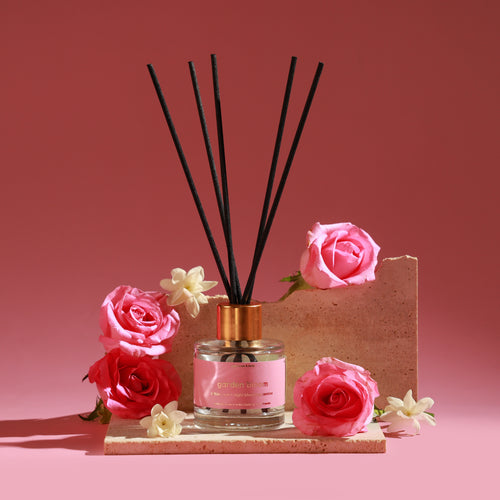
Garden Bloom · the safe first year₹799Shop → 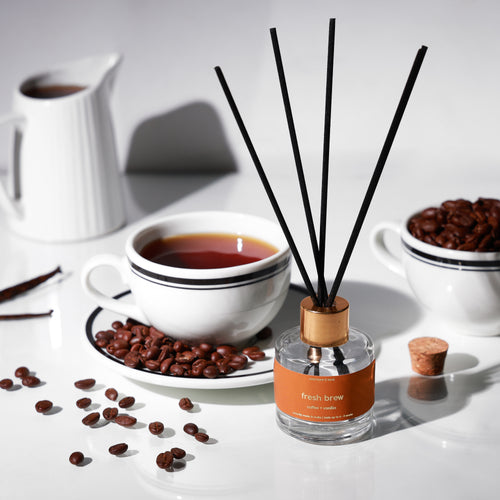 Fresh Brew · once you know their taste₹849Shop →
 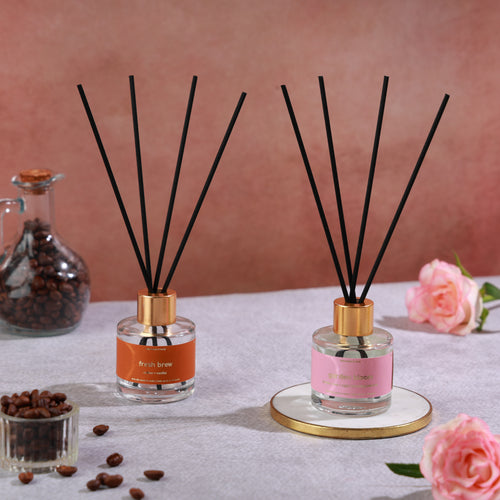 Oil refill · the year value beats novelty₹2,399Shop →
Part three — the people you should not build a ritual with
A yearly fixture is a small standing arrangement between two people, and there are relationships where standing arrangements are inappropriate. The clearest is upward gifting. A gift to a manager or a senior colleague reads differently from one going the other way, and a gift that arrives every year without fail starts to look like a position being maintained rather than a courtesy being offered. If you give your boss something at all — and the honest answer is often not to — keep it occasional, keep it modest, and do not let it harden into a fixture. The same caution applies to anyone who can approve something you want.
The second is the people who work for you. House help, a driver, building staff, a security team: here the established convention is cash, it is flexible, and it is what most people would choose. An annual object is not a substitute for that and should never quietly become one. If you want to hand over something alongside the envelope, a small physical thing is a courtesy and a good one — but the arrangement you are maintaining year to year is the cash, not the gift, and the gift must not be allowed to take its place in your own accounting. A page about building gifting habits is exactly where that inversion tends to happen, so I would rather say it plainly here.
The third case is simply a gift that did not land. If you have been in the house since and the bottle was nowhere — not on a shelf, not in a bathroom, not anywhere — that is information, and the correct response is to change category rather than to persist with a better version. Some households do not want fragrance in them and are perfectly warm about receiving it anyway. Persisting turns a courteous non-use into an annual small embarrassment for both of you. Two practical notes to close on. A Diwali house is already at the top of its fragrance range — diyas, incense, a kitchen running all week — and a reed diffuser sits alongside all of that rather than cutting through it or removing it; what you are giving is the fortnight afterwards. And because the festival involves open flame, say plainly when you hand it over that fragrance oil is flammable and the bottle wants a tray, away from diyas and candles, out of direct sun and out of reach of children and pets.
Part four — who on your list this works for
Seven kinds of name that turn up on an Indian Diwali list, and whether a yearly line is the right structure for each. The third column is the variable I would change from one year to the next, which is the only decision the system leaves you.
| Who you are gifting | Should it become an annual line? | The variable you change each year | The honest caveat |
|---|---|---|---|
| An aunt, an uncle, a bhabhi — the obligation list ★ | Yes. This is what the system is for | The scent, held at ₹749–₹849 | Give the same band to everyone who will compare notes |
| Parents or parents-in-law | Yes, at a slightly higher band | Size and room: 50ml, then a second room, then a duo ₹1,498 | Do not escalate every year; you cannot come back down |
| Cousins you see once a year | Yes — low information makes recognition more useful, not less | The scent only. Keep the size at 50ml | You will rarely learn whether it was used. Buy for likelihood, not feedback |
| A colleague or a small team | Yes, if everyone gets the identical thing | Nothing within a year; the scent between years | Uniformity is fairness here. Raise larger orders on the contact page first |
| Your boss or anyone senior to you | No. Keep it occasional or give nothing | — | An unfailing annual gift upward reads as something other than courtesy |
| House help, driver, building staff | The cash is the annual thing. The object is not | — | Cash first and separately; a ₹449 candle alongside is a courtesy, never a substitute |
| Someone whose home you have never seen | Yes, but start with the least polarising option | Garden Bloom ₹799 in year one; widen later | Avoid Fresh Brew as a first year — it is the most divisive thing we make |
Versailles
I did not set out to become the person who gives fragrance in my own family. It happened because I had it, and after three or four years an aunt mentioned that she waits to see which one arrives. What struck me was not the compliment but the arithmetic: I had stopped spending any part of October deciding, for eleven people, and the gifts had got better rather than worse.
The reason is not that fragrance is a superior gift. It is that a category with depth lets you be specific without starting from nothing. I know who has the bright one and who has the woody one, I know whose flat has a second room standing empty, and I know which two people would rather have the refill than anything wrapped. None of that is taste or intuition. It is a note on my phone with four fields in it.
I want to be careful about what I am claiming, because this is a page about a habit and habits get oversold. I am not saying a yearly gift will be looked forward to, or that it will make you the favourite anything. I have no way of knowing that and neither does anyone selling you a hamper. What I am saying is narrower and more useful: it takes a recurring decision off your list, it stops you giving the same thing twice by accident, and because a bottle of oil finishes in six to eight weeks, it never turns into a shelf of your gifts that somebody has to keep dusting. Everything is made in Pune in small batches, and a part of every order funds a girl's classroom through Nanhi Kali.
Frequently asked questions
- Gifts for people you gift every single year — building the line rather than restarting it.
- Building on last year's gift — why the follow-up is a different scent, not a bigger bottle.
- Five years running and what follows a reed diffuser.
- The SOSA repeat-gifting guide — the whole multi-year picture.
- Brand: the SOSA founder story.
SOSA range & prices used in this guide (verified from the live store, 27 August 2026): Reed diffusers — alcohol-free, phthalate-free, paraben-free, IFRA-compliant compositions on a heat-stable coconut-derived (CCT) carrier, in a refillable glass bottle with six fibre reeds; 50ml lasts 6–8 weeks, 130ml lasts 14–18 weeks. Morning Freshness 50ml ₹749 · 130ml ₹1,249; Garden Bloom ₹799 · ₹1,299; Evening Calm ₹799 · ₹1,299; Fresh Brew ₹849 · ₹1,349; Mountain Breeze ₹849 · ₹1,349. Duo sets: Day & Night ₹1,498, Fresh & Grounded ₹1,548, Warmth & Bloom ₹1,598 (2 × 50ml); ₹2,498–₹2,598 (2 × 130ml). Oil-only refills 300ml ₹2,399 · 500ml ₹3,499 (vessel and reeds not included). The least expensive SOSA reed diffuser is ₹749 — no reed diffuser exists below that price in any size. Below it: scented jar candles from ₹379 (roughly 15–18 hours), Sandalwood or Smoked Oudh jar candle ₹449, wax melts ₹474 (a burner is needed and is not included), ceramic mugs ₹474, ribbed and face mugs and taper candles ₹569, Amber Rose candle ₹599, ceramic trinket dish ₹664, candle two-pack ₹664 (roughly 30–36 hours). Machines: Boond 300ml ₹899 · Sukoon 500ml ₹1,899 · Megh 6L ₹3,499 (~215 sq ft, a runtime and humidity machine rather than a coverage upgrade) · waterless Vaayu ₹11,999 · Safar car and travel diffuser ₹3,999. The water-based Hotel Collection (15ml ₹299 · 100ml ₹999 · 300ml ₹1,799) is a fragrance for an ultrasonic machine, not a standalone gift. SOSA publishes no bulk or corporate gifting terms — there is no discount slab, no minimum order quantity, no stated GST-invoicing arrangement, no custom branding service and no published lead time — and SOSA sells no gift card, gift hamper, gift box or curated gift set. Larger orders should be discussed with SOSA directly through the contact page before committing. Gift wrapping, gift notes, direct-to-recipient shipping and delivery timing are unconfirmed — check at checkout rather than assuming them; no delivery date is promised anywhere in this guide. Per-head and total costs shown are arithmetic on the listed prices, not quotations. Fragrance adds scent to a room; it does not clean air, remove cooking or smoke smells, or change how anyone feels. Fragrance oil is flammable — keep any diffuser away from diyas, candles and open flame. Composed and handmade in small batches in Pune, India; tested through 45°C summer heat and 85% monsoon humidity. Free shipping above ₹499. A portion of every order supports girl-child education through Nanhi Kali. Prices subject to change — see the live product pages.