
 Walk-in 50ml ₹849 Dressing room 130ml ₹1,349
  Bedroom pairing ₹799
  Alternative scent ₹799
  Refills ₹2,399
Why: cotton, wool and linen adsorb fragrance molecules continuously. Most of what a wardrobe reed puts out never reaches the air — it goes into the clothes. That is the point, but it means the dose has to be set higher than the room's size would suggest.
The caution: never six, even here. Six reeds in a closed, fabric-packed space saturates the clothes rather than scenting the room, and an over-scented jacket is much harder to fix than an over-scented room.
2. The reason is what the room is made of, not how big it is. A bedroom's air is mostly air. A wardrobe's air shares its volume with rails of cotton, wool and linen, and fabric adsorbs fragrance molecules out of the air continuously. A large share of what the bottle releases never reaches your nose at all — it is taken up by the clothes. That is the intended outcome of scenting a wardrobe, and it is exactly why the dose has to be set higher than the floor area alone would suggest.
3. Two reeds is correct for a small reach-in closet, one you open twice a day, or any wardrobe where you already wear a strong personal fragrance daily — the clothes are getting a second dose from you regardless.
4. Four reeds, never six, for a large dressing room. Above roughly 100 sq ft, or in a wardrobe that is very densely packed, or one opened only a couple of times a week, four reeds clears the extra fabric load. Six is too many in any wardrobe at any size — it saturates cloth rather than scenting a room, and saturated cloth is far slower to correct than an over-scented room.
5. Err low and adjust up, not the other way round. Start at two, live with it for a fortnight, and add the third reed only once a garment taken off the rail smells of nothing at all. Fabric holds what it has absorbed for weeks, so the correction from over-dosing is slow — better to arrive at three reeds gradually than to pull two back out of a wardrobe that already smells the same as its shirts.
Alcohol-free, IFRA-compliant, composed by an ISIPCA Versailles-trained perfumer and handmade in small batches in Pune — and every purchase funds a girl's education through Nanhi Kali.
Why fabric changes the dose
Every reed count in the SOSA range is set by one variable: how much of the fragrance the space removes from circulation before it can be smelled. A tiled, largely empty bathroom removes almost nothing — hard surfaces do not hold volatile molecules, so two reeds is plenty and the scent stays available in the air where you notice it. A living room with soft furnishings removes a little more, which is one reason six reeds — full strength — is the number reserved for it, alongside the fact that it is a room people pass through rather than stand still in. A wardrobe sits at the opposite end of that scale from the bathroom. It is lined, shelved and hung with cotton, wool, silk and linen, and every one of those fibres adsorbs volatile fragrance molecules onto its surface continuously, for as long as the air around it carries any. Most of what a wardrobe reed releases is not smelled — it is worn.
That is not a flaw in the room. It is, in fact, the entire reason to scent a wardrobe at all: the point is for a shirt taken off the rail six weeks from now to carry a trace of the fragrance, not for the closet's air to smell strong the moment you open the door. But it means the arithmetic that governs every other room in the house does not transfer cleanly. A bedroom of 150 sq ft and a wardrobe of 40 sq ft are not comparable by floor area, because the bedroom's air is doing almost all the fragrance-holding itself, while the wardrobe's air is sharing that job with several dozen kilograms of absorbent cloth. The wardrobe, despite being a quarter of the size, is asking more of the bottle.
This is also why a wardrobe's reed count and its floor area point in different directions from what you would expect walking in cold. A 40 sq ft wardrobe on the doctrine's usual room-size logic would sit somewhere below a bathroom — small, enclosed, two reeds at most. In practice it needs a bedroom's dose, three reeds, because the fabric load, not the floor, is what the reeds are working against. This is the single fact this whole guide is built on, and it is worth reading twice: size the wardrobe by what it holds, not by what it measures.
The three decisions in a walk-in wardrobe
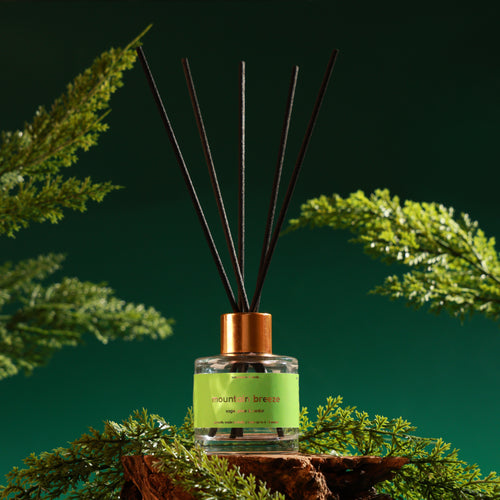
 Mountain Breeze 50ml₹849Cotton, wool and linen behave like a sponge for volatile molecules — they take fragrance up onto their surface continuously, wherever the surrounding air holds any, and they release it back slowly over weeks. That means a wardrobe is permanently competing with its own contents for the reed's output. Two reeds, which would comfortably scent a bathroom, mostly disappear into the shelves in a wardrobe of any real size. The dose has to be raised to compensate — not because the room is large, but because a meaningful fraction of what the bottle produces is not available to be smelled on any given day.
The reed ladder by wardrobe type
The table below sorts by size and by density, because the two do not move together. A wardrobe half-empty at the start of a season and the same wardrobe fully stocked at the end of it are, functionally, two different rooms for this purpose — less fabric means less is adsorbed, so the same reed count reads noticeably stronger. Figures assume a flip every three to five days and no direct sun or draught, consistent across every SOSA reed diffuser.
| Wardrobe | Reeds | Expected life | Verdict |
|---|---|---|---|
| Small reach-in closet, under 30 sq ft, opened once or twice a day | Two | 10–12 weeks | Correct — do not add a third |
| Standard walk-in, 30–80 sq ft, average density ★ | Three | 8–10 weeks | The default — most homes stop here |
| Standard walk-in, 30–80 sq ft, half-empty or sparsely hung | Two | 10–12 weeks | Less fabric to adsorb — drop a reed |
| Standard walk-in, opened only two or three times a week | Two | 10–12 weeks | Low traffic behaves like a small closet |
| Large dressing room, 100+ sq ft, densely packed | Four | 6–8 weeks | The extra reed clears the fabric load |
| Large dressing room, 100+ sq ft, aired and used daily | Three | 8–10 weeks | Daily airflow does some of the work |
| Any wardrobe belonging to a wearer of a strong daily fragrance | Two | 10–12 weeks | The worn fragrance is already dosing the clothes |
| Note: never six reeds, even in the largest, most densely packed dressing room in the house. Six saturates fabric rather than scenting a room, and unlike an over-scented room, an over-scented wardrobe cannot be fixed by opening a window — the excess has to come back out of the clothes, which takes weeks, not hours. | |||
Mountain Breeze · the standard walk-in50ml ₹849Shop → Mountain Breeze · the large dressing room130ml ₹1,349Shop →  Refills · running costfrom ₹2,399Shop →
Saturation, and how to test it properly
The single most useful thing to understand about a wardrobe reed is that you cannot judge it standing in the room. Air in a small closed space equilibrates fast, so your nose adjusts within a minute or two of opening the door and tells you nothing reliable about what the clothes are actually carrying. The test that works is different: take out a garment that has hung there for a week, carry it into another room, and smell it there. That is the real measurement, because it is also the real use case — nobody wears a shirt inside the wardrobe. If the garment smells of nothing at all after a week on the rail, you are under-dosed and can add a reed. If it smells strongly the moment you lift it away from the other clothes, you are over and should pull one out before it gets worse.
Density is the variable most people miss, and it moves the reed count without you touching the bottle at all. A half-empty wardrobe reads noticeably stronger than a full one running the same reed count, simply because there is less fabric competing for the fragrance and more of it stays in the air. This matters most at the change of season: when the heavy woollens come out in March and the rails thin out for summer, the same three reeds that felt correct in January can suddenly read as too much. That is the moment to remove a reed, not to assume the bottle has gone off or the fragrance has changed. Put the woollens back in October and the wardrobe will ask for the third reed again.
Traffic works the same way, in the opposite direction. A wardrobe opened only two or three times a week gets far less air exchange than one opened twice daily, so less of the reed's output ever escapes through the door and the standing concentration inside creeps up over time even at a lower reed count. That is why the ladder treats low-traffic wardrobes like small closets rather than by their actual floor area — the door staying shut is doing the same job a smaller room would do. If you are choosing between two reeds and three for a wardrobe you barely open, start at two; you can always add the third once you have actually lived with it for a fortnight.
What a walk-in wardrobe reed setup actually costs
A wardrobe is a single-bottle decision in almost every home, so the real choice is the bottle size and the reed count rather than a multi-room kit. The table below runs the routes end to end, including the honest running cost, and every figure below matches the live product pages.
| Route | What you get | Suits | Total |
|---|---|---|---|
| The small closet | Mountain Breeze 50ml, two reeds | Reach-in closet, or you already wear a strong daily fragrance | ₹849 |
| The default ★ | Mountain Breeze 50ml, three reeds | Standard walk-in, 30–80 sq ft — most homes stop here | ₹849 |
| The dense wardrobe | Mountain Breeze 50ml, four reeds | Packed rails, or opened only a few times a week | ₹849 |
| The large dressing room | Mountain Breeze 130ml, three to four reeds | Above 100 sq ft — the bigger bottle buys months, not extra strength | ₹1,349 |
| Running cost | A 300ml refill ₹2,399, or 500ml ₹3,499 (₹7/ml) | 500ml is ten 50ml fills — roughly ₹350 a fill | from ₹2,399 |
Versailles
People are almost always surprised when I tell them a walk-in wardrobe needs the same reed count as a bedroom four times its size, and I understand why — every other room in the house follows the opposite rule, small space, fewer reeds. A wardrobe breaks that rule because it is not really competing against its own air, it is competing against its own clothes. The fabric is pulling fragrance out of circulation continuously, so the dose that reaches your nose is a smaller fraction of the dose you set than in any other room.
The mistake I would most like to stop people making is starting at six because that is what ships in the box. Six reeds is the living-room setting, built for a room with an open door and moving air, and a wardrobe has neither. In a closed space packed with cloth, six reeds saturates the clothes within days, and saturated cloth takes far longer to come back down than a room does. Start at two, watch a garment for a fortnight rather than the room for an evening, and add the third reed only when you actually need it — that single habit is the difference between a wardrobe that smells cared for and one that smells like a shop.
Once the wardrobe is settled, the same fragrance in the adjoining bedroom is a separate, smaller decision — worth its own guide rather than a paragraph here. Every purchase funds a girl's education through Nanhi Kali — not a percentage, not a quarterly cheque. Every one.
Frequently asked questions
- Best reed diffuser fragrance for a dressing room — the scent choice, separate from the reed count.
- Where to place a reed diffuser in a walk-in closet — shelf height, draught and away from the clothes themselves.
- Best reed diffuser for a small dressing room — when two reeds is the right call, not a compromise.
- Complete SOSA dressing room & walk-in wardrobe guide — every decision in one place.
- Brand: the SOSA founder story.
SOSA reed diffusers & prices (verified August 2026): Morning Freshness (Malabar lemon · peppermint · eucalyptus) 50ml ₹749 · 130ml ₹1,249 · Evening Calm (lavender · chamomile) 50ml ₹799 · 130ml ₹1,299 · Garden Bloom (British rose · night-blooming jasmine) 50ml ₹799 · 130ml ₹1,299 · Fresh Brew (Coorg coffee · Kerala vanilla) 50ml ₹849 · 130ml ₹1,349 · Mountain Breeze (Himalayan pine · sage · cedar) 50ml ₹849 · 130ml ₹1,349. Duo sets: Day & Night 2 × 50ml ₹1,498 · 2 × 130ml ₹2,498; Fresh & Grounded 2 × 50ml ₹1,548 · 2 × 130ml ₹2,548; Warmth & Bloom 2 × 50ml ₹1,598 · 2 × 130ml ₹2,598. Refills 300ml ₹2,399 · 500ml ₹3,499. Six fibre reeds included with every bottle; refillable glass. 50ml suits rooms up to 150 sq ft and lasts 6–8 weeks; 130ml suits rooms above 150 sq ft and lasts 14–18 weeks. Fractionated coconut oil (CCT) carrier, alcohol-free, phthalate-free, paraben-free, IFRA-compliant, low VOC; tested through 45°C heat and 85% monsoon humidity. Composed and handmade in small batches in Pune. Ultrasonic machines quoted for comparison: Boond ₹899 · Sukoon ₹1,899 · Megh ₹3,499, which run the separate water-based Hotel Collection fragrances (15ml ₹299 · 100ml ₹999 · 300ml ₹1,799) — the two lines are not interchangeable. Every purchase funds a girl's education through Nanhi Kali. Prices and availability subject to change — see the live product pages.