




What oud actually is: a resin that trees of the genus Aquilaria produce only when a particular mould infects them. It is an immune response. An uninfected tree yields nothing at all, which is why genuine agarwood is among the most expensive raw materials on earth by weight and why the genus sits under international trade controls.
What is in almost every "oud" diffuser sold in India: a woody-amber accord — a constructed blend, usually built on synthetic materials, designed to give the smoky, resinous, faintly medicinal impression of oud at a fraction of a per cent of the cost. Some of them are very good. None of them is oud.
If you want depth from SOSA anyway: Mountain Breeze ₹849 is the deepest woody reed we make, and Fresh Brew ₹849 at 9.5 is the deepest scent of any kind. Neither is oud. If genuine oud is what you want, buy it somewhere else, and read the four questions below before you do.
- The straight answer, including the part where we do not sell it
- What oud actually is — a mould, not a timber
- Four questions to ask before you buy an oud anything
- The four things sold as oud, side by side
- What SOSA has instead, offered as itself
- The edit, and the gap stated plainly
- A note from Sonal
- FAQs
2. Oud is not a wood in the ordinary sense — it is an infection. Trees of the genus Aquilaria lay down a dark, fragrant resin in their heartwood only when a specific mould gets into a wound. A healthy uninfected tree contains nothing worth distilling. That single fact explains the price, the scarcity, the trade controls and the counterfeiting all at once.
3. At those raw-material prices, an affordable oud home fragrance is arithmetically impossible. This is not an accusation levelled at anyone; it is division. If a millilitre of genuine oud oil costs more than the entire retail price of a reed diffuser, the bottle on the shelf cannot contain a meaningful quantity of it. What it contains instead is a woody-amber accord, and the honest brands say so.
4. Real oud does not smell the way the marketing photographs look. It is barnyard, leather, honey, smoke and something faintly medicinal and faintly animal. A great many people who are certain they love oud love the accord rather than the material, and would put the material down after ten seconds. That is not a failing on their part — the accord is a genuinely pleasant thing — but it changes what they should buy.
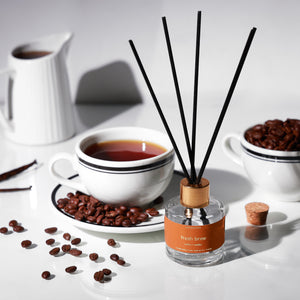
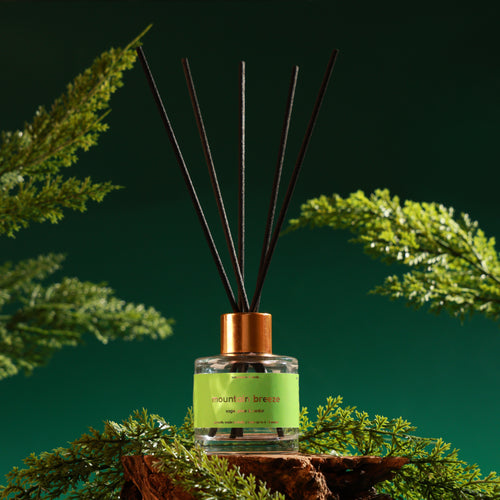
5. If depth rather than oud is the actual brief, we have two answers. Mountain Breeze at ₹849 is the deepest woody reed in the range at 9.4 — Himalayan pine, sage, Indian cedar, cool and dry and structural. Fresh Brew at ₹849 and 9.5 is the deepest thing we make full stop, and has the after-dark richness people often want from an oud room, though it is coffee and vanilla rather than resin.
Alcohol-free, phthalate-free, made in Pune. A portion of every order supports girl-child education through Nanhi Kali.
What oud actually is, and why almost nothing sold as oud is oud
Most fragrance materials are agricultural. You plant a thing, you wait a known number of seasons, you harvest a known yield, and the cost per kilogram is a function of land, labour and weather. Oud does not work like that, and every strange thing about the oud market follows from the way it does work. Agarwood is not harvested; it is produced by a tree that is fighting an infection and losing. Everything else — the price, the scarcity, the trade controls, the industrial-scale counterfeiting — is downstream of that one biological fact.
 Mountain Breeze₹849Trees of the genus Aquilaria — including Aquilaria malaccensis, which grows in the north-east of India and across South-East Asia — are ordinary pale softwood trees when healthy. Cut one down and you get timber worth very little. What perfumery wants is what happens when a mould enters a wound in the trunk: the tree responds by saturating the surrounding heartwood with a dark, dense, aromatic resin, essentially walling off the invader. That resin-soaked wood is agarwood. It is an immune response that happens to smell extraordinary, and it takes years to accumulate. In the wild the infection is uncommon, unpredictable and impossible to see from the outside, which historically meant felling many trees to find one that had it. Wild populations have been depleted enough that the genus is subject to international trade controls under CITES, and most legitimate supply today comes from plantations where trees are deliberately inoculated and then left for years. Even then, yields and quality vary enormously from tree to tree.
 Fresh Brew₹849Good wild agarwood is sold by the gram and the best grades have at times traded above gold by weight. Distilled wild oud oil is priced per millilitre in a way no other perfumery material is. Plantation oil is dramatically cheaper and still sits in a bracket that puts it out of reach of any mass-market product. Now do the division, calmly and without accusing anybody: a reed diffuser contains several millilitres of fragrance concentrate, and if a single millilitre of even plantation oud oil costs more than the finished bottle sells for, the finished bottle cannot contain it. This is not a moral claim, it is arithmetic. What is in the bottle instead is a woody-amber accord — a deliberately constructed blend, frequently built around synthetic woody-amber materials, smoky distillates such as birch tar or cade, and sometimes a genuine Indian natural like nagarmotha, which is smoky and leathery and inexpensive and does a great deal of the work people credit to oud. Some of these accords are beautifully made. None of them is oud, and the honest houses do not claim otherwise.
 Hotel Collection₹299Here is the part I am kindest about, because nobody is at fault. Genuine oud oil smells animalic. It has barnyard in it, and leather, and a dark honeyed sweetness, and smoke, and a distinctly medicinal note that people who meet it for the first time often describe as antiseptic or plaster-like. Indian oud in particular — the profile the attar tradition prizes — is the most animalic of the regional styles, while Cambodian material runs sweeter and fruitier and Malaysian material more spicy and woody. What it is not, in any of those styles, is plush, smooth, velvety or luxurious in the way an advertisement for oud invariably looks. A great many people who are certain they love oud love the accord, not the material. They love the smooth resinous woody-amber impression built in a laboratory to evoke it, which is a genuinely lovely thing to have in a room and is easier to live with. There is no shame in that. But it means the honest recommendation for such a person is a well-made amber or woody-amber, not a vial of dehn al oud that would cost thirty times more and that they would quietly stop using.
Four questions to ask before you buy an oud anything, from anybody
This section is the reason the page exists, and it applies to every vendor including us. If you take nothing else away, take these four questions, because they sort the market faster than any amount of reading reviews. The point of them is not to catch anyone out. It is that a vendor who answers them straightforwardly is worth buying from whatever the answers turn out to be, and a vendor who will not answer them has told you something more useful than any answer could.
One: is this natural agarwood, or an oud accord? There is no wrong answer to this. A well-built accord is a legitimate product with legitimate craft in it, and most of the oud-signed fragrances in the world, including some very expensive and very good ones, are accords. What matters is whether the person selling it will say the word "accord" out loud. If a listing describes a room fragrance as containing "pure oud" or "100% oud oil" at a household price, the claim is doing something the arithmetic cannot support.
Two: what is the actual price per millilitre? Not the price of the bottle — the price of the contents divided by the volume. This one number resolves most of the confusion in the category in about four seconds, and it is the reason I mention that a SOSA reed diffuser works out at roughly ₹17 a millilitre and around ₹15 a day to run. Ours is a competent fragrance concentrate at a domestic price, and it is priced like one. If a bottle sold as oud is priced in the same region as ours, it is made of the same kind of material as ours — that is to say, aroma chemicals and naturals sourced at ordinary industry cost — whatever the label says on the front.
Three: if it is natural, is it plantation-sourced? Because of the CITES listing, legitimate international movement of agarwood requires documentation, and the responsible end of the trade is now largely plantation-based, using deliberately inoculated trees rather than wild stock. A seller who deals in genuine material will know the answer and will usually be pleased to be asked, because it is a thing they have spent money getting right. A seller offering wild first-grade oud at a suspiciously reasonable price is offering something that is either not wild, not first-grade or not oud.
Four: what am I actually chasing — the material, or the effect? This is the question to ask yourself rather than the shop. If what you want is a dark, resinous, after-dark room that feels expensive and settled, an amber or a woody-amber will give you that for a very small fraction of the money and will be easier to live with. If what you want is agarwood specifically — the medicinal, animal, honeyed, unrepeatable thing — then you want a specialist oud house, you want to smell before you commit, and you should not be buying it from a home fragrance brand at all. Including this one. SOSA does not make an oud, and if oud is genuinely what you want, we are not where to buy it.
| Sold as oud | What it actually is | Roughly what it costs the industry | What it smells like | How to spot it | Does SOSA make it? |
|---|---|---|---|---|---|
| Natural wild agarwood | Resin laid down in the heartwood of a wild Aquilaria tree fighting a mould infection, then chipped or steam-distilled into oil | The highest tier in perfumery — chips sold by the gram, top-grade oil priced per millilitre and at times valued above gold by weight | Barnyard, leather, dark honey, smoke, distinctly medicinal; animalic rather than plush, and unlike anything else | Sold in grams or single millilitres by specialists, with provenance and CITES paperwork; never in a room-fragrance bottle at a household price | No |
| Plantation agarwood | The same resin, in cultivated Aquilaria trees deliberately inoculated and then left for years to build it up | Far below wild, and still far above any material a mass-market home fragrance can carry | The same family of smells, usually cleaner, sweeter and less feral than wild material, with more variation between batches | The seller says "plantation" without being pushed, and can tell you the country and often the estate | No |
| Oud accord / woody-amber | A constructed blend built to evoke agarwood — synthetic woody-ambers, smoky distillates such as birch tar or cade, often nagarmotha or patchouli for the leathery edge | Ordinary fragrance-compound pricing, orders of magnitude below any natural agarwood | Smooth, resinous, smoky-sweet, plush; the version most people picture when they say oud, and easier to live with than the real thing | The note list says "oud" but the ingredient list and the price say compound; good houses call it an accord in plain words | No — and we do not label an amber as one |
| Cheap synthetic "oud" | A thin, one-dimensional woody-amber base, often heavy on a single dominant material, poured into a carrier and sold on the word alone | Negligible — the packaging typically costs more than the fragrance in it | Flat, sharp, slightly harsh, with a dusty-sweet edge that becomes tiring within an hour and does not develop at all | Smells identical from first sniff to last, goes bitter in heat, and the copy leans hard on the words royal, luxury and pure | No |
Dry wood · Mountain Breeze₹849Shop → 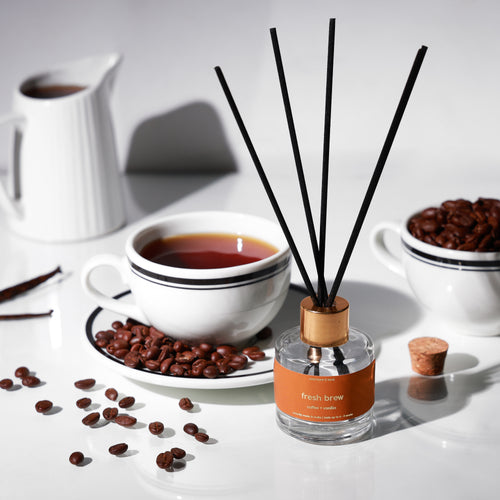 Depth · Fresh Brew₹849Shop →
  Amber, not oud · St. Regis-inspired₹299Shop →
What SOSA has instead — three answers, none of them oud
Having spent four sections explaining what we do not sell, it would be unhelpful to stop there, so here is the honest map of what is in the house and which part of an oud brief each piece actually answers. I am going to be exact about the mismatch in every case, because the useful thing is not the recommendation but the size of the gap between it and what you asked for.
In reeds, for wood: Mountain Breeze at ₹849 for 50ml or ₹1,349 for 130ml. Himalayan pine, real sage and Indian cedar, at 9.4 on our strength scale — the deepest woody reed we make and, in a room, a cool, dry, structural green wood that reads as altitude. It suits studies, bedrooms and yoga rooms, and it does the thing an oud room does in exactly one respect, which is that it settles a space rather than brightening it. Everything else is different: no resin, no smoke, no leather, no sweetness, no animal edge. It is a wood the way pine is a wood, and oud is a wood the way a wound is a wood.
In reeds, for depth and gravitas: Fresh Brew at ₹849 for 50ml. At 9.5 this is the deepest and warmest thing SOSA makes in any format, real Coorg coffee bean extract over Kerala vanilla and soft caramel, and it has the low, rich, after-dark presence a lot of people actually mean when they describe wanting an oud room. I want to be explicit that this is a substitution of one quality for another rather than a match: you would be trading resinous smoke for roasted gourmand and keeping only the depth. If depth was the whole brief, it is the strongest answer in the range. If the smoke was the point, it is not an answer at all.
On the ultrasonic side, for the plush resinous register: the St. Regis-inspired Hotel Collection scent at ₹299 for 15ml — amber, violet and woods. This is the nearest thing in the house to the after-dark, resinous, slightly opulent register that oud marketing sells, and it is genuinely good at it. It is an amber. It is not an oud, it is not an oud accord dressed up, and I am not going to let the adjacency do the work of a claim. Note also that this is not a reed product and cannot be made into one: the Hotel Collection is water-based and goes only into an ultrasonic machine, our reed oil goes only into reeds, the two are not interchangeable in either direction, and there is no hotel-inspired reed diffuser at SOSA. If you want it you also need a machine — Sukoon at ₹1,899, which covers 270–320 sq ft, runs 16–18 hours on low and arrives with three 15ml scents of your choice, or Boond at ₹899 for rooms up to 150 sq ft.
The edit, in buying order — and the gap, stated plainly
Everything above, arranged as a decision. The last row is the one that matters most on this page, and it is deliberately the row with nothing to buy in it: there is no oud at SOSA in any format, and no amount of adjacency changes that.
| Buy | What it is | When it is the right answer | Price |
|---|---|---|---|
| 1. Mountain Breeze 50ml ★ | Himalayan pine, real sage, Indian cedar — 9.4, the deepest woody reed we make | If what you wanted from oud was a wood that grounds a room, and you can do without the resin and the smoke | ₹849 |
| 2. Fresh Brew 50ml | Coorg coffee, Kerala vanilla, soft caramel — 9.5, the deepest scent SOSA makes in any format | If depth and gravitas were the brief rather than resin. A gourmand standing in for a wood, said openly | ₹849 |
| 3. St. Regis-inspired 15ml | Amber, violet and woods — the nearest resinous, plush, after-dark register in the house. Water-based, ultrasonic only | If the oud you love is the smooth resinous impression rather than the material. It is an amber and this page will not call it anything else | ₹299 |
| 4. Sukoon or Boond | The machine the Hotel Collection needs — Sukoon covers 270–320 sq ft and includes three 15ml scents; Boond suits rooms to 150 sq ft | Only if you are going down the ultrasonic route. Reed oil will never work in either of them | ₹1,899 / ₹899 |
| 5. 130ml, or a 300ml refill | The same scent in the size that suits a room above 150 sq ft, or a top-up for the bottle and reeds you already own | Once one of them is clearly the one you keep going back to | ₹1,349 / ₹2,399 |
| Oud: the honest gap | There is no oud anywhere at SOSA — not in the five reed scents, not in the seven Hotel Collection scents, not in any size and not at any price. No agarwood, and no oud accord sold under the name either | Never. If genuine oud is what you want, buy it from a specialist oud house, smell it before you commit, and ask them the four questions above | Not sold here |

Versailles
The first time I smelled a proper Indian oud oil at school in Versailles, I did not like it. I had read about it for years, I had the whole romance of it in my head, and what arrived on the blotter was a barnyard with honey poured over it and a note in the middle that I can only describe as a hospital corridor. It took me about two years to understand what I was smelling, and I still think it is the least intuitive great material in perfumery. I say this so that nobody feels foolish for preferring the accord. The accord is designed to be likeable. The material is not designed at all.
We do not make an oud because I cannot make one honestly at a price an Indian household should pay for a room fragrance. I could build a competent woody-amber, put the word on the front and sell a great many of them; the category proves that every week. But the moment I do that, everything else I have written about real Coorg coffee and real Kashmir lavender and cold-pressed Malabar lemon becomes marketing rather than fact, and that is a trade I am not willing to make for one product.
So this page sells you very little, and I am comfortable with that. If you came here wanting depth, Mountain Breeze at ₹849 and Fresh Brew at ₹849 are both genuinely good at it and neither of them is pretending. If you came here wanting agarwood, go and find a specialist, ask them the four questions, and smell it before you spend. Everything we do make is composed in Pune, and a part of every order funds a girl's classroom through Nanhi Kali.
Frequently asked questions
- Luxury oud at home and Sandalwood in India — what to buy when nobody makes the reed, and Mysore, Australian, and the synthetic majority.
- Vetiver in India and Oud in a living room — khus, and the one place SOSA has real vetiver, and the honest substitution.
- Sandalwood in a bedroom and Vetiver at home — the creamiest answer in the house, and the driest thing SOSA makes.
- Oud versus sandalwood versus vetiver — three woods, three different rooms.
- The decision tree — one bottle, no reading, if you want one bottle and no argument.
- The complete guide — every decision, and every gap, in one place.
- Brand: the SOSA founder story.
SOSA reed diffusers — facts verified August 2026: Five scents, all alcohol-free, on a heat-stable CCT (caprylic/capric triglyceride) base, phthalate-free, paraben-free, IFRA-compliant, 0 ppm formaldehyde, six fibre reeds in a refillable glass bottle, composed and made in Pune, India. Evening Calm (Kashmir lavender · chamomile · soft musk) 50ml ₹799 · 130ml ₹1,299 · 8.9, the softest in the range. Garden Bloom (British rose · night-blooming jasmine) 50ml ₹799 · 130ml ₹1,299 · 8.9. Morning Freshness (Malabar lemon · peppermint · eucalyptus globulus) 50ml ₹749 · 130ml ₹1,249 · 9.0. Mountain Breeze (Himalayan pine · sage · Indian cedar) 50ml ₹849 · 130ml ₹1,349 · 9.4, the deepest woody in the range. Fresh Brew (Coorg coffee · Kerala vanilla · soft caramel) 50ml ₹849 · 130ml ₹1,349 · 9.5, the deepest in the range. Longevity 6–8 weeks on 50ml and 14–18 weeks on 130ml. Refills 300ml ₹2,399 · 500ml ₹3,499. Climate-tested through 45°C heat and 85% RH monsoon humidity. The SOSA range contains no oud in any format — not in the reed line and not in the water-based Hotel Collection — and the reed line additionally contains no sandalwood, no vetiver, no amber and no orange blossom; where this guide is asked for one of those it says so rather than stretching the nearest scent to cover it. Hotel Collection 15ml ₹299 · 100ml ₹999 · 300ml ₹1,799 · pack of seven ₹1,799, water-based and ultrasonic-only; machines Boond ₹899 (300ml, up to 150 sq ft) and Sukoon ₹1,899 (500ml, 270–320 sq ft, 16–18h on low, three 15ml scents included). Reed diffuser oil and the Hotel Collection are separate products and are not interchangeable in either direction; there is no hotel-inspired reed diffuser. Free shipping above ₹499. SOSA is an independent Indian fragrance house; the Hotel Collection scents referenced here are SOSA's own interpretations inspired by the world's finest hotels and SOSA is not affiliated with or endorsed by any hotel brand. Prices subject to change — see the live product pages.