


Before you change anything, change the reed count. Three reeds instead of six solves this complaint in most Indian homes. Jasmine's defining quality is diffusiveness, not sweetness, and diffusiveness is a volume problem.
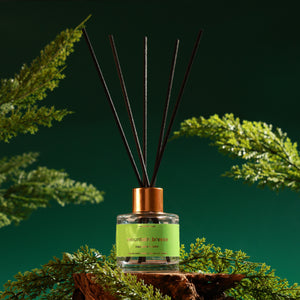
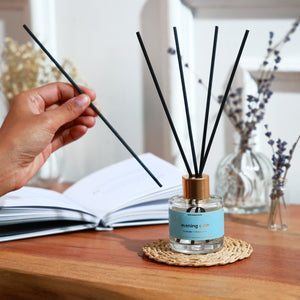
If it is genuinely sweetness you object to: Mountain Breeze at ₹849 has no sweetness in it at all, and Evening Calm at ₹799 is herbal rather than sugary. Both are substitutions, not jasmines.
The honest gap: there is no jasmine-solo reed diffuser in this range, and no tuberose, gardenia, ylang-ylang or magnolia. Garden Bloom is a two-flower composition. If you want jasmine alone in the air, we do not make it.
2. Take three reeds out before you do anything else. Jasmine's defining property is that it fills a room — perfumers call it diffusive — and diffusiveness feels exactly like sweetness from across a sofa, because both simply feel like too much. Three reeds instead of six is the single most useful adjustment on this page and it costs nothing.
3. Check the time of day. If the fragrance is fine at eight in the morning and oppressive at four in the afternoon, it did not get sweeter — it turned. Real jasmine contains indole, which reads floral below a certain concentration and frankly unpleasant above it, and indole mobilises with heat. "Too sweet" is simply the nearest word most people reach for.
4. Check what you are comparing it against. If your reference for jasmine is mogra attar out of a small bottle, you are comparing a composed room fragrance against something built on a heavy oil or sugar base and far denser than the living flower. That is a real gap, but it is not a fault.
5. If it was like that from day one at any reed count, believe yourself. Then it is genuinely sweet, and you want a different fragrance: Mountain Breeze at ₹849 has no sweetness in it whatsoever, and Evening Calm at ₹799 is herbal. Neither is a jasmine, and I would rather say that than pretend otherwise.
Alcohol-free, phthalate-free, made in Pune. A portion of every order supports girl-child education through Nanhi Kali.

The three things Indian buyers mean when they say a jasmine is too sweet
I read these messages every week and by now I can usually tell within two sentences which of the three has happened. They arrive using identical language — too sweet, too much, sickly, cloying — and they are not the same complaint at all. One is a volume problem, one is a memory problem and one is a chemistry problem. Only the third one is a reason to stop buying jasmine. The first two are reasons to change something you are already holding.
 Garden Bloom₹799Jasmine's defining quality is not that it is sweet. It is that it fills a room. The technical word is diffusive, and it describes how far a material travels from its source and how completely it occupies the air it reaches. A mogra garland in a hallway announces itself two rooms away; that is diffusiveness, and it is why jasmine is planted near windows in half the country. The trouble is that diffusiveness and sweetness feel identical from the far side of a living room, because both of them simply feel like too much. So people reach for the sweeter word.
The fix is entirely different, though, which is why the misdiagnosis costs money. Sweetness needs a different fragrance. Headiness needs fewer reeds. Three reeds instead of six solves this complaint in most Indian homes and costs nothing — if you take one line from this page, take that one. Every SOSA bottle ships with six fibre reeds precisely so that the count is a dial rather than a fixed setting; six is a living room at full volume, three is a bedroom, and two in a small bathroom will stretch a 50ml close to three months.
 Warmth & Bloom duo₹1,598This is the one nobody says out loud and almost everybody is doing. Most Indian buyers' reference point for jasmine is not a flower. It is mogra attar, or a bottled jasmine essence — sold in a small bottle, usually built on a heavy sandalwood-oil or sugar base, and very much denser than the living flower ever is. That reference is genuinely sweet and genuinely thick. It is also the thing sitting in your memory when you open a reed diffuser and decide within four seconds whether it is right.
Which produces a strange result I see constantly in our reviews. A composed jasmine that reads as lighter than an attar gets described as "not sweet" and meant as a compliment. A composed jasmine that matches the attar gets described as cheap. Same axis, opposite verdicts, and the deciding factor is a bottle somebody's grandmother kept in a cupboard. Naming this out loud is worth the page on its own: you are not comparing this to a jasmine flower, you are comparing it to an attar, and an attar is a different object built to different rules.
Garden Bloom₹799Real jasmine contains indole, and indole is the molecule that gives the flower its warmth and its animal depth — the thing that makes a real jasmine feel alive rather than drawn. Below a certain concentration it reads unmistakably floral. Above that concentration it reads unpleasant, and the shift is not gradual in the way you would expect; it is closer to a line being crossed. Critically for anybody living in this country, indole mobilises with heat. A room at 34°C does something to a jasmine formulation that a room at 22°C does not.So here is the part that gets misread. A jasmine that has crossed that line does not smell sweet. It smells wrong — heavy, slightly soiled, faintly like something left out. But most people have no vocabulary for that, and the nearest available word is "too sweet", so that is the word that ends up in the review. Garden Bloom is formulated with indole held deliberately below the threshold so that the jasmine stays floral above 30°C, and the whole thing sits on a heat-stable CCT carrier tested through a 45°C heat soak rather than the DPG that cracks and goes bitter in a Delhi May. Priya S. in Bengaluru put it better than any technical note could: "The jasmine is the real surprise. It stays warm and floral all summer — I expected it to turn awful by April. It hasn't." She expected it because it usually does.
Why the attar in your memory quietly sets the bar for every jasmine you buy
I want to stay on the second meaning a little longer, because it explains more disappointed jasmine purchases in India than the other two combined and almost nobody names it. An attar is a concentrate. It is designed to be worn on skin in tiny quantity, it is usually carried in a heavy oil — sandalwood traditionally, something cheaper now — and in many commercial versions it has been sweetened outright, because sweetness is the least expensive way to make a small quantity feel abundant. Held to the wrist it is glorious. Scaled up to fill a two-hundred-square-foot room for eight weeks, it would be unbearable within an hour, and any perfumer who has tried to do it will tell you the same thing.
A room fragrance therefore cannot be an attar, and a good one does not try. It has to survive being smelled continuously for weeks by people who are not thinking about it, which means the sweetness has to come down, the structure has to come up and something dry has to sit underneath to keep the flower from thickening as the day warms. That is a design constraint, not a compromise on quality. But it does mean that when you open a well-made jasmine diffuser holding an attar memory, the first impression is very often this is lighter than I expected — and depending on your temperament, you will file that either as a relief or as a disappointment within about four seconds.
The useful thing is to know which of the two you are before you spend anything. If your happiest jasmine memory is a garland at a wedding or a mogra plant outside a window at nine at night, a composed diffuser will suit you and you will probably find Garden Bloom reads as the real thing. If your happiest jasmine memory is a small bottle of attar, then understand that no reed diffuser on the Indian market is going to reproduce it, ours included, and that what you are looking for is a fragrance oil rather than a room fragrance. Saying that plainly costs me a sale and saves you eight weeks of low-grade irritation, which I consider a good trade.
The diagnostic table — which of the three complaints is actually yours
This is the portable version. It takes about two days to run, requires nothing you do not already own, and it will tell you whether the problem is your reed count, your reference point or the fragrance itself. Work down the table in order, because the free fixes come first for a reason.
| What you noticed | What it actually is | The test | The fix | Cost |
|---|---|---|---|---|
| It fills the whole flat and I can smell it from the next room | Diffusiveness — headiness, not sweetness | Pull three reeds out and leave it two days | Run three reeds, flip every 5–7 days | Free |
| It is fine in the morning and oppressive by evening | Indole crossing its threshold as the room heats | Smell it at 8am and again at 4pm on the same day | A formulation that holds indole low — Garden Bloom | ₹799 |
| It is nice, but it does not smell like jasmine to me | You are measuring it against mogra attar, not the flower | Ask yourself what the jasmine in your memory was in — a garland, or a small bottle | Nothing to fix. Recalibrate, or buy an attar instead of a diffuser | Free |
| It was like this on day one, at six reeds and at three | Genuine sweetness — you and the formulation disagree | Already done. Reed count changed nothing | A different fragrance: Mountain Breeze 9.4, no sweetness at all | ₹849 |
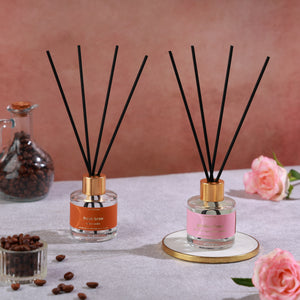
| Anything sweet at all gives me a headache | Sensitivity to gourmand and heavy-floral material | Whether vanilla in a room bothers you | Evening Calm 8.9, herbal rather than sugary. Avoid Fresh Brew 9.5 outright | ₹799 |
Jasmine, kept dry · Garden Bloom₹799Shop → 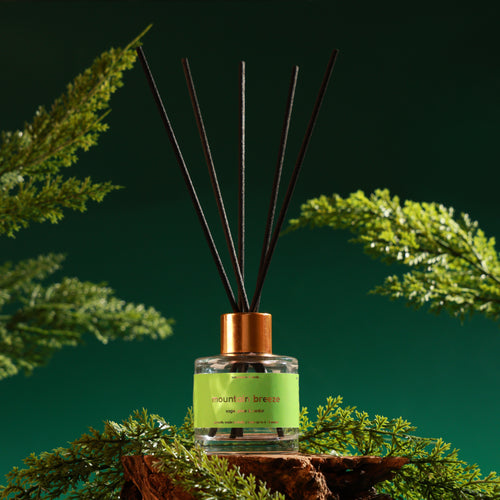 No sweetness at all · Mountain Breeze₹849Shop →
 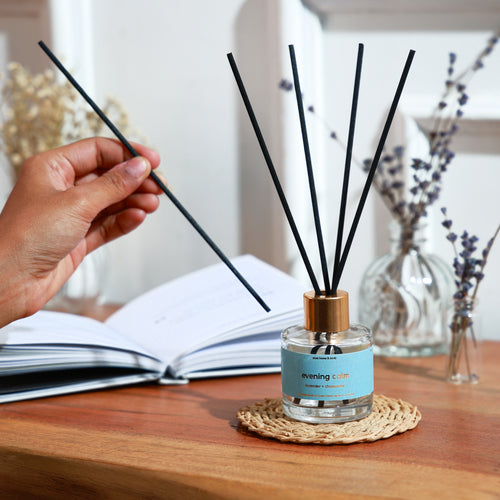 Herbal, not sugary · Evening Calm₹799Shop →
What Garden Bloom actually does to stay dry — rose for structure, musk for the day
There are two ways to stop a jasmine reading as sweet. The lazy one is to use less jasmine, which produces a thin, apologetic fragrance that nobody keeps past the first bottle. The other is to give the jasmine something to argue with, and that is what the British rose in Garden Bloom is doing. English garden rose is a cool material — structured, slightly green, daylit rather than jammy — and it belongs to a completely different temperature from the rose most Indian buyers have met in soap and in agarbatti. Set the sambac against it and the jasmine's warmth reads as depth rather than as sugar. Two buyers put the same point from opposite directions: Sneha B. in Mumbai wrote "Finally a rose that isn't Phenyl rose. The jasmine warmth is the bonus. The combination is unfairly elegant", and Aanya M., also in Mumbai, said it smelled like "a real rose garden — not like Lifebuoy rose soap." Neither of them was talking about sweetness and both of them were describing exactly this.
Underneath sits the soft musk drydown, and this is the material doing the unglamorous work. Musk is warm without being sweet — it is the only large family in perfumery that manages that — and it is what lets a jasmine run all day without thickening as the room warms. Without a base of that kind, a floral does one of two things by mid-afternoon: it either evaporates off the top and leaves you with nothing, or it concentrates and becomes heavy. The musk holds the middle steady. It is also, incidentally, why Garden Bloom sits at 8.9 on the SOSA strength scale — the same number as Evening Calm, the softest thing we make. It is a medium floral, not a loud one. People assume a jasmine must be loud because their reference is an attar or a garland; this one is calibrated well below both.
The last piece is the carrier, which never appears on a note list and decides more than any note does. Most reed diffusers in this price band sit on DPG, which is inexpensive and which cracks above roughly 40°C, going bitter and slightly acrid. Every SOSA reed sits on heat-stable CCT, a coconut-derived triglyceride, tested through a 45°C heat soak and 85% monsoon humidity and sealed AC bedrooms. For a jasmine specifically this matters more than for anything else in the range, because jasmine is the fragrance family with the most to lose from heat. A citrus that degrades goes flat. A jasmine that degrades goes unpleasant.
What to buy — and the two things I am not going to talk around
In buying order, for somebody who arrived here because a jasmine felt like too much. Then the gap, which in this family is a large one and worth stating without decoration: there is no jasmine-solo reed diffuser at SOSA, and no tuberose, gardenia, ylang-ylang or magnolia anywhere in the range. Garden Bloom is a two-flower composition — rose and jasmine — and if what you want is jasmine alone standing in a room, we do not make it and I am not going to pretend the nearest thing counts.
| Buy | What it is | When it is the right answer | Price |
|---|---|---|---|
| 1. Garden Bloom 50ml ★ | Sambac against cool British rose, soft musk drydown, 8.9 — a medium floral | First, for almost everyone here. Run it at three reeds before judging it | ₹799 |
| 2. Mountain Breeze 50ml | Himalayan pine, sage, Indian cedar — 9.4, no sweetness in it at all | If the diagnostic says genuine sweetness. A substitution, not a jasmine — say it out loud | ₹849 |
| 3. Evening Calm 50ml | Kashmir lavender, chamomile, soft musk — 8.9, herbal rather than sugary | If anything sweet at all gives you a headache. Also a substitution rather than a match | ₹799 |
| 4. Garden Bloom 130ml | The same composition for above 150 sq ft — 14–18 weeks | Once you know the reed count that suits your room | ₹1,299 |
| 5. Shangri-La-inspired 15ml | Jasmine, green tea, white tea — the driest jasmine in the house, water-based and ultrasonic-only | If you want jasmine with no warmth under it at all. Needs a Sukoon ₹1,899 or Boond ₹899 | ₹299 |
| No jasmine-solo, no tuberose, no gardenia: the honest gap | The reed range has no single-flower jasmine and no tuberose, gardenia, ylang-ylang or magnolia. It also has no oud, sandalwood or vetiver. Garden Bloom is rose and jasmine together, by design | Said plainly rather than stretched. Also: avoid Fresh Brew at 9.5 outright if sweetness is your objection | ₹799 |

Versailles
The first year we sold Garden Bloom I answered every "too sweet" message by assuming the person meant sweet. I would offer them something else, they would take it, and roughly a third of them would come back a few months later and buy the jasmine again anyway. That is a slow and expensive way to learn that people rarely have the vocabulary for what their nose is telling them, and that my job includes supplying it.
Now I ask three questions before recommending anything. How many reeds are in the bottle. Whether it is worse in the afternoon than in the morning. And what the jasmine in their memory was in — a garland at a wedding, or a small bottle of attar in a cupboard. Those three questions sort nearly every case, and two of the three answers cost the buyer nothing to act on. It is not good commerce and it is very good perfumery, and I have made my peace with the arithmetic.
The one thing I did engineer rather than explain is the indole. Holding it below the threshold where it turns is the reason Garden Bloom does not go strange in April, and it is the single most technical decision in the bottle. It does not appear on the label, nobody asks about it, and it is why Priya's review — "I expected it to turn awful by April. It hasn't" — is the one I am proudest of in the whole range. Everything is composed in Pune, and a part of every order funds a girl's classroom through Nanhi Kali.
Frequently asked questions
- Jasmine in India and A jasmine home — real sambac, and the indole problem, and where to put the one bottle.
- Bedrooms and Living rooms — night-blooming jasmine at three reeds, and jasmine, dinner and the third smell.
- White florals and Sophisticated white florals — what the category actually contains, and restraint, and the indole threshold.
- Jasmine versus the rest — a straight comparison.
- The decision tree — one bottle, no reading, if you want one bottle and no argument.
- The complete jasmine guide — every decision in one place.
- Brand: the SOSA founder story.
SOSA reed diffusers — facts verified August 2026: Five scents, all alcohol-free, on a heat-stable CCT (caprylic/capric triglyceride) base, phthalate-free, paraben-free, IFRA-compliant, 0 ppm formaldehyde, six fibre reeds in a refillable glass bottle, composed and made in Pune, India. Garden Bloom (British rose · night-blooming jasmine, sambac/mogra · soft musk drydown) 50ml ₹799 · 130ml ₹1,299 · 8.9 on the SOSA strength scale, a medium floral · 45 days to two months on the 50ml and 14–18 weeks on the 130ml · 4.9 from 138 verified buyers · indole held below the fecal threshold so the jasmine stays floral above 30°C · flip the reeds every 5–7 days. Evening Calm (Kashmir lavender · chamomile · soft musk) 50ml ₹799 · 130ml ₹1,299 · 8.9, the softest in the range. Morning Freshness (Malabar lemon · peppermint · eucalyptus globulus) 50ml ₹749 · 130ml ₹1,249 · 9.0. Mountain Breeze (Himalayan pine · sage · Indian cedar) 50ml ₹849 · 130ml ₹1,349 · 9.4. Fresh Brew (Coorg coffee · Kerala vanilla · soft caramel) 50ml ₹849 · 130ml ₹1,349 · 9.5, the deepest in the range. Duos: Warmth & Bloom ₹1,598, Day & Night ₹1,498, Fresh & Grounded ₹1,548 (50ml × 2). Refills 300ml ₹2,399 · 500ml ₹3,499. Climate-tested through 45°C heat soak, 85% RH monsoon humidity and sealed AC bedrooms. The reed line contains no jasmine-solo scent and no tuberose, gardenia, ylang-ylang, magnolia, champa or frangipani, and no oud, sandalwood, vetiver or amber; where this guide is asked for one of those it says so rather than stretching the nearest scent to cover it. Reed diffuser oil and the water-based Hotel Collection are separate products and are not interchangeable in either direction; there is no hotel-inspired reed diffuser. Hotel Collection 15ml ₹299 · 100ml ₹999 · 300ml ₹1,799. Ultrasonic machines: Sukoon ₹1,899 (500ml, 270–320 sq ft) and Boond ₹899 (300ml, up to 150 sq ft). Free shipping above ₹499. A portion of every order supports girl-child education through Nanhi Kali. SOSA is an independent Indian fragrance house; the Hotel Collection scents referenced here are SOSA's own interpretations inspired by the world's finest hotels and SOSA is not affiliated with or endorsed by any hotel brand. Prices subject to change — see the live product pages.