




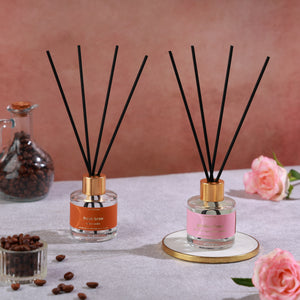
Why it stays: Indian cooking aerosolises oil. Fine droplets carry the odour compounds, travel on the heat plume and then land on and bond to surfaces — especially fabric.
What actually helps: chimney on before the pan heats and running ten minutes after; cross-ventilation while the air is still airborne; then the fabric; then, last, fragrance.
2. Because Indian cooking aerosolises oil, not just steam. This is the part most people get wrong. Boiling water releases vapour that condenses and goes. Hot oil throws off a fine aerosol of oil droplets, and those droplets carry the strongly-smelling compounds with them. They are heavy enough to land and sticky enough to stay. That is why tadka outlives the tadka — you are not smelling old air, you are smelling a thin film that is still on your things.
3. Because the plume goes up, then sideways along the ceiling. Heat makes the cooking air buoyant. It rises to the ceiling, spreads flat across it, and travels outward until it hits a wall and rolls down. In an open or semi-open 1BHK layout that path takes it directly over the seating area within a minute. Anything above about shoulder height in that room is in the flow.
4. Because the chimney is usually being used wrongly. A chimney only captures what is inside its capture zone while it is running. Switched on when the smoke starts, it has already missed the first and most aerosolising minute. Switched off the moment you serve, it leaves the residual plume to drift. On before the pan heats, off ten minutes after you finish is a free upgrade to whatever unit you already own.
5. And fragrance is the last step, not the fix. Scent is additive. Sprayed over live cooking odour it does not cancel anything; your guest gets fried onion and jasmine at the same time. Clear the air first, deal with the fabric, and then let a reed diffuser or a Sukoon set the background the room returns to.
Made in India, composed by an ISIPCA Versailles-trained perfumer — and a portion of every order supports girl-child education through Nanhi Kali.

Why a small flat has no defence against its own kitchen
Dilution is the only thing standing between a pan and the rest of a home, and dilution needs volume. Put the same quantity of aerosolised oil and volatile compounds into a 1,400 sq ft flat and into a 500 sq ft one and the small flat sees close to three times the concentration everywhere. There is also nothing in the way: no corridor, no closed intermediate door, no unused room acting as a buffer. In a 1BHK, the living room is downstream of the hob with nothing in between. This is not a failure of your cooking or your cleaning. It is the geometry of the flat, and it means the answer has to be about capture at the source and speed of removal, not about cleaning harder afterwards.
The second half of the explanation is what cooking actually puts into the air. People picture steam, which is why they expect the smell to leave when the steam does. Indian cooking, though, is largely done in hot oil, and hot oil produces a fine aerosol — droplets small enough to stay suspended and travel on convection currents, but with real mass. They carry the odour-active molecules with them. When those droplets meet a surface they land, and on a porous surface they sink in. A wiped granite counter loses them easily; a fabric sofa back does not. So the room holds a thin, evenly distributed deposit that keeps releasing its smell for hours or days. That is why the flat still smells of dinner at eleven, long after the air itself has been changed twice over.
Where the oil actually ends up in a one-room flat
 Step fourFrom ₹749Fabric is the biggest collector in the room because it has enormous internal surface area and because droplets sink into fibre rather than sitting on top of it. In a 1BHK the sofa is often within four metres of the hob, the curtain hangs in the path of the ceiling flow, and there is usually a chair with worn clothes on it that nobody thinks of as a fabric surface at all. Wash what is washable and air the rest in direct sunlight — heat and UV drive absorbed volatiles out faster than shade. Vacuum upholstery with the brush head; it lifts more of the settled deposit than wiping ever will.
Symptom to cause: reading a small flat honestly
Work down until a row matches what you actually notice, and do the confirmation step before you act. Guessing wrong here means scrubbing the same surface every week and getting the same result.
| What you notice | Most likely cause | How to confirm it | What actually fixes it |
|---|---|---|---|
| Whole flat smells of food within minutes of cooking ★ | No buffer volume — one shared air volume, plume spreading along the ceiling | Stand in the far corner two minutes after starting a tadka and note how strong it already is | Chimney on before the pan heats; cross-ventilate immediately, not after eating |
| Smell persists for hours after the air has been changed | Aerosolised oil that has landed on fabric and is re-releasing | Smell the sofa back and curtain at close range against a fresh cushion cover | Wash covers and curtains; vacuum upholstery; air in sunlight |
| Kitchen smells of old cooking before you have cooked | Loaded chimney filter, sink strainer or bin lid | Lift the filter out and smell it; open the bin and smell the underside of the lid | Degrease the filter every three to four weeks; wash the bin lid and strainer weekly |
| A stale, slightly rancid note rather than a dish | Oxidised oil film on hard surfaces near the hob | Wipe the top of a wall cabinet with a warm damp cloth and look at the cloth | Warm water and detergent on the hood underside, tiles and cabinet tops |
| Smell is worse on humid or rainy days | Humidity raising perceived odour and slowing every surface from drying | Compare the same dish on a dry day and a wet one | Longer purge ventilation between rain spells; run a fan blowing out of the window |
| A gas-like smell near the hob, at any time | A leak — this is not an odour problem | Do not test with a flame. Shut the cylinder valve, open windows, leave | Call the gas supplier immediately. Never fragrance this, never ignore it. |
| If none of these fit: check the fridge drip tray, the cabinet under the sink and any dishcloth that has been folded damp. In a small flat one of those three is very often adding a second smell that you have merged with the cooking one and stopped separating. | |||
Reeds · always-on roomsFrom ₹749Shop →  Sukoon · when you want a switch₹1,899Shop →
  Hotel Collection · the scentFrom ₹299Shop →
What to do, in sequence
Start at the pan, because everything you capture there is something you never have to clean off a cushion. Switch the chimney on two or three minutes before the pan goes on, so it is already moving air when the first oil aerosolises. Cook on the back burner where the hood coverage is best. Use a lid whenever the dish allows it — a lid is the single most effective piece of equipment in this whole article, because it stops the aerosol from ever entering the room. Keep the oil below smoking point; oil past its smoke point produces far more aerosol and a harsher smell. And leave the chimney running for ten minutes after you finish, because the residual plume is still rising off the hot pan and the hot food.
Then move the air, while the odour is still airborne. This is a timing point rather than a technique point. Odour that is still suspended can be blown out of the flat in ten minutes; odour that has landed on the sofa has to be washed out over days. So the purge happens during and immediately after cooking, not after dinner. Open two openings on opposite sides so air has a path through, and if there is only one usable window, put a fan in it blowing outwards — that drags the room's air out behind it instead of pushing street air in. Close the bedroom door before you start cooking, not after; it is the cheapest buffer volume a 1BHK has.
Then deal with what has already collected, and only then add fragrance. Cushion covers monthly, curtains seasonally, upholstery vacuumed with the brush head weekly, and the hood underside, tiles and cabinet tops wiped with warm detergent water. Once the room is genuinely neutral, fragrance has something clean to sit on rather than something to argue with. In a one-room flat I would keep the always-on layer light and put it away from the kitchen: a reed diffuser from ₹749 on three or four reeds rather than six, near the entrance or beside the sofa. If you would rather have a reset you can switch on after dinner, the Sukoon at ₹1,899 with a Hotel Collection scent from ₹299 covers roughly 270–320 sq ft, which is most of a 1BHK.
The layers, cheapest first
Three of these cost nothing and do most of the work. The fourth is the purchase, and it is a good one — but it is fourth because it cannot do the job of the first three.
| Step | What to do | When | Cost |
|---|---|---|---|
| 1. Remove the source | Chimney on before the pan heats and off ten minutes after; lid on; back burner; oil below smoking point | Before anything else | ₹0 |
| 2. Move the air | Cross-ventilate during and immediately after cooking, bedroom door closed before you start | Daily, five to ten minutes | ₹0 |
| 3. Deal with what holds it | Cushion covers monthly, curtains seasonally, upholstery vacuumed weekly, hood and tiles degreased | Weekly to monthly | ₹0 |
| 4. Then the always-on layer ★ | A SOSA reed diffuser — a light, steady background for the living area on three or four reeds rather than six | 50ml 6-8 weeks · 130ml 14-18 | from ₹749 |
| 5. Or the on-demand layer | Sukoon with a Hotel Collection scent — a reset you can run for an hour after dinner; covers roughly 270–320 sq ft, which is most of a 1BHK | Run it when you want it | ₹1,899 |
Versailles
I have cooked in a 1BHK and I have sold fragrance to people cooking in one, and the honest thing to say is that the fragrance is not what fixes this. What fixes it is the chimney habit and a lid. If you change only one thing after reading this, switch the chimney on before the pan goes on the flame and leave it running while you eat the first few mouthfuls. It costs nothing and it removes more than anything you can buy from me.
The reason I keep coming back to oil rather than steam is that it changes what you do. If cooking smell were vapour, ventilation alone would end the problem. Because it is aerosolised oil, part of every meal ends up as a thin film on your sofa, and no amount of open windows removes a film. That is why a flat can smell of cooking on a day when nobody cooked, and why washing covers does more than any spray.
When you do get to fragrance, keep it modest in a small flat. Six reeds in 450 square feet is too much; it stops being a background and becomes another strong smell competing with dinner. Three or four reeds, away from the kitchen, is the version that actually reads as a home that smells good rather than a home that has been scented. A portion of every order funds a girl's classroom through Nanhi Kali.
Frequently asked questions
- Why cooking smell stays even with the chimney on — capture rate, timing and open plans.
- Why tadka smell travels into the bedroom — the most aerosolising minute of Indian cooking.
- Why the sofa absorbs cooking smell — the largest absorber in the room.
- The routine for a flat that cooks twice a day — a standing plan, not a rescue.
- Brand: the SOSA founder story.
SOSA products & prices (verified August 2026): Hotel Collection water-based ultrasonic diffuser fragrance 15ml ₹299 · 100ml ₹999 · 300ml ₹1,799 · Pack of 7 (15ml, all fragrances) ₹1,799; refills 100ml from ₹999. Seven scents: The Ritz-Carlton-inspired (white tea · bergamot · cedar), Westin-inspired (white tea · aloe · cedar), 1 Hotels-inspired (cedarwood · vetiver · green leaves), The St. Regis-inspired (amber · violet · woods), Shangri-La-inspired (jasmine · green tea · white tea), Four Seasons-inspired (citrus · floral · sandalwood), W Hotels-inspired (citrus · pepper · amber). Diffusers: Boond 300ml ₹899 · Sukoon 500ml ₹1,899 · Megh 6L ₹3,499. Water-based, phthalate-free, composed to IFRA standards for home diffusion; 3–6 drops per tank. Made in India, Pune. The Hotel Collection scents are SOSA's own interpretations inspired by the world's finest hotels; all hotel names are trademarks of their respective owners and are used only to describe the scent style — SOSA is an independent Indian fragrance house, not affiliated with or endorsed by any hotel brand. Prices and availability subject to change — see the live product pages.