




Why it smells strong rather than faint: a closed unused room has almost no air change, so a slow leak accumulates for days.
The fix: a mug of water down every drain in the room — floor trap included, it is usually the culprit — once a week. Flush the WC too.
For a room used twice a year: add a spoon of cooking oil on top of the trap water to slow evaporation.
2. Because the floor trap is the one nobody refills. When people hear "run the taps" they run the basin and perhaps the shower. The floor drain gets nothing, because nothing is aimed at it. It is also shallower than the others and therefore the first to dry. In most guest bathrooms with this complaint, the floor trap is the source. Pour water directly into it, not near it.
3. Because a closed room has nowhere to put the gas. This is why the smell reads as sudden and strong rather than as a slow leak. The rate of entry may be small, but an unused bathroom with the door shut and the fan off has almost no air change, so whatever enters simply accumulates. Open the door on Saturday after three weeks and you meet three weeks of accumulation at once.
4. Because the WC bowl has been standing still. A second, milder contributor. Water sitting unmoved in a bowl for weeks develops its own character, and a ring forms at the waterline. The trap under the pan also loses some water to evaporation, though more slowly than a floor drain. One flush a week deals with both, and it takes five seconds.
5. And if a mug of water does not fix it, stop guessing. If you have refilled every trap and the smell returns within days, the seal is being lost to something other than evaporation — most often siphonage caused by pressure surges in the shared stack, or a cracked or missing trap. That is a plumbing job, and it is not something to put fragrance on.
Made in India, composed by an ISIPCA Versailles-trained perfumer — and a portion of every order supports girl-child education through Nanhi Kali.
Why a room gets worse from not being used
Almost everything else in a home improves when you stop using it. A bathroom does not, and the reason is that its defence against the sewer is consumable. The trap under every fixture holds a plug of water whose only job is to block gas while letting waste through, and that plug is topped up by the ordinary act of using the fixture. Take the use away and evaporation quietly removes it over a few weeks. Disuse is not neutral in a bathroom; it is a slow failure mode. This is also why the problem is so strongly associated with guest bathrooms, second bathrooms, servant bathrooms and utility floor drains — the rooms with the least traffic have the least protection, and nobody is in them often enough to notice the smell developing.
The second half is accumulation. If a trap in your main bathroom dries out, you will still barely notice it, because that room is opened, used and extracted several times a day and the gas is carried away as fast as it arrives. A closed guest bathroom has an air-change rate close to nothing: the door is shut, the fan is off, and if there is a window it has not been opened since the last visitor. A very small rate of entry over three weeks in a room with no air change produces a genuinely strong smell on opening the door. It is the same physics that makes a locked-up flat smell worse than a lived-in one, applied to a source that is actively pumping. Which is also why the smell seems to clear so fast once you open up and run water — you fixed the source and ventilated the accumulation in the same twenty minutes.
Where to pour the water, and what else to check
 Step fourFrom ₹749The drain in the floor is the one that dries first and the one nobody aims water at. Lift the grating off and look down with a torch. If you can see straight into a dry pipe with no standing water in a bend, there is no seal there at all. Pour two mugs of water directly into it and the smell will usually begin to fade within the hour. While the grating is off, scrub both of its faces and the pipe wall just below it, since a rarely used floor trap collects a surprising amount of debris. In genuinely dry or air-conditioned conditions, expect to need to do this every week or two.
Symptom to cause: the unused bathroom
An unused bathroom has a short list of possible faults, which makes this one of the easier diagnoses in the house. Confirm with water before you spend money on anything.
| What you notice | Most likely cause | How to confirm it | What actually fixes it |
|---|---|---|---|
| Strong sewer smell on opening a room shut for weeks ★ | Evaporated water seal, most likely the floor trap, plus three weeks of accumulation | Pour two mugs into the floor drain, shut the door, return in an hour | A mug of water down every drain weekly; one flush of the WC weekly |
| Fine while guests are staying, bad a fortnight later | Use was topping the seals up; disuse lets them evaporate | Note how many days after the last use it reappears | Put the weekly water round into a routine, or a reminder on your phone |
| Stale rather than sulphurous, and mild | Standing water in the WC bowl and no air change in a closed room | Flush once, open the door for ten minutes, and reassess | A weekly flush; leave the door ajar between visits |
| Returns within two or three days of refilling | Seal lost to siphonage or a cracked trap, not to evaporation | Listen for a gurgle when a neighbour flushes; look under the basin with a torch | A plumber. Vent and stack pressure, or a failed trap. Not fragrance. |
| No standing water visible in the floor outlet at all | An untrapped floor drain — there is no seal to refill | Lift the grating and look straight down with a torch | A trap has to be fitted. This is a plumbing job. |
| Musty and earthy rather than drainy, with marks on the wall | Damp or mould in an unventilated room — a health issue | Check the wall shared with the shower and the ceiling corners | Find the moisture source and remove the growth. Never scent this. |
| If none of these fit: fill every trap, then leave the room shut for a full week and go in with a fresh nose. If it is clean, you have your answer and your routine. If it is not, you have ruled out the commonest cause in the house for the price of a jug of water. | |||
Reeds · always-on roomsFrom ₹749Shop →  Sukoon · when you want a switch₹1,899Shop →
  Hotel Collection · the scentFrom ₹299Shop →
The weekly habit, and what to do before guests arrive
Make it a weekly round, because it takes ninety seconds and it prevents the whole problem. Once a week, walk into every bathroom you do not use daily with a jug: two mugs into the floor trap, thirty seconds of tap into the basin, thirty seconds into the shower outlet, one flush of the WC. That is it. Set a reminder if the room is out of sight, because out of sight is precisely why it happens. Do the same for utility-area floor drains and the washing-machine standpipe, which are the other two commonly forgotten traps in an Indian flat.
Before you travel, and before a room is shut for a long period, do the same thing plus oil. Fill every trap, then add a spoonful of ordinary cooking oil to the floor drain and to the WC bowl. The oil floats as a thin layer on top of the water and slows evaporation considerably, which can carry a trap through several weeks it would otherwise not survive. Ask whoever is checking on the flat to run the taps once. If you come home to a smell anyway, refill everything, open up, and give it an hour before drawing any conclusions.
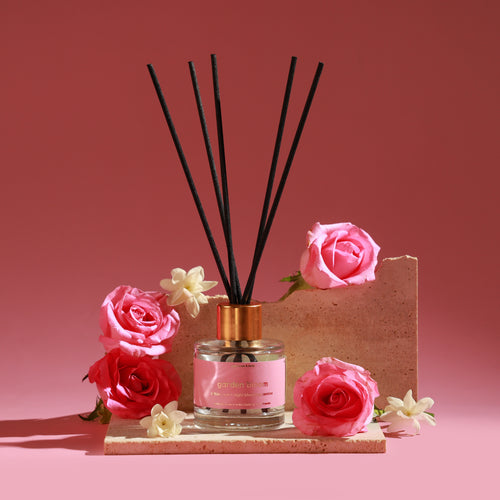
Then, once the seals hold reliably for a fortnight, add the background. A guest bathroom is actually the ideal case for a reed diffuser: nobody is standing in the room, there is often no socket, nothing needs switching on, and it works during the three weeks between visitors — which is exactly the period you care about. A 50ml from ₹749 runs 6–8 weeks and a 130ml from ₹1,249 runs 14–18. Use two or three reeds, not six. A small closed room with no air change concentrates whatever is in it, so a full six-reed dose that reads as pleasant in a living room will read as heavy the moment a guest opens the door. If the room adjoins a larger dressing area and has a socket, the Sukoon at ₹1,899 with 3–6 drops of a Hotel Collection scent from ₹299 is the alternative, run for an hour before people arrive rather than continuously.
What to do, in order
This is one of the cheapest fixes in the whole cluster — a jug of water and a weekly habit. The fourth step is worth having, but the first one is what actually removes the smell.
| Step | What to do | When | Cost |
|---|---|---|---|
| 1. Remove the source | Two mugs into the floor trap, thirty seconds of tap at basin and shower, one flush of the WC, weekly | Before anything else | ₹0 |
| 2. Move the air | Leave the door ajar between visits and run the extract fan for ten minutes when you do the water round | Daily, five to ten minutes | ₹0 |
| 3. Deal with what holds it | Scrub the floor-trap grating and the WC rim channel; add a spoon of oil to the trap water before long absences | Weekly to monthly | ₹0 |
| 4. Then the always-on layer ★ | A SOSA reed diffuser — a continuous background in a room nobody is standing in, no socket needed, at two or three reeds | 50ml 6-8 weeks · 130ml 14-18 | from ₹749 |
| 5. Or the on-demand layer | Sukoon with a Hotel Collection scent — a switchable layer if the guest bathroom adjoins a dressing area with a socket; covers roughly 270-320 sq ft | Run it when you want it | ₹1,899 |
Versailles
This is the household smell I most enjoy answering, because the fix is a jug of water and nobody has to buy anything. If a room smells only when it is unused, the fault is something that use repairs, and in a bathroom that means the water seal. Pour two mugs into the floor drain and wait an hour before you consider any other theory.
The floor trap is the piece people miss. When I say run the taps, most people run the basin, and the basin was rarely the problem. The drain in the floor is shallow, it is under a grating, it is out of mind, and it is the first one to go dry. Take the grating off once and actually look down there with a torch — it is quite educational, and it usually ends the mystery.
Afterwards, a guest bathroom is genuinely one of the best rooms for a reed diffuser, because it works while nobody is there and there is nothing to remember. But two or three reeds, please, not six. A small closed room concentrates everything, and a guest opening a door onto a wall of fragrance is not the impression you were after. A portion of every order funds a girl's classroom through Nanhi Kali.
Frequently asked questions
- Drain smell at set times of day — when the seal is being siphoned, not evaporated.
- Should I use a diffuser on a drain smell? — the honest answer, and why.
- Worse during monsoon — why nothing dries and everything grows.
- Keeping a bathroom good permanently — the routine, and the reed count.
- Brand: the SOSA founder story.
SOSA products & prices (verified August 2026): Hotel Collection water-based ultrasonic diffuser fragrance 15ml ₹299 · 100ml ₹999 · 300ml ₹1,799 · Pack of 7 (15ml, all fragrances) ₹1,799; refills 100ml from ₹999. Seven scents: The Ritz-Carlton-inspired (white tea · bergamot · cedar), Westin-inspired (white tea · aloe · cedar), 1 Hotels-inspired (cedarwood · vetiver · green leaves), The St. Regis-inspired (amber · violet · woods), Shangri-La-inspired (jasmine · green tea · white tea), Four Seasons-inspired (citrus · floral · sandalwood), W Hotels-inspired (citrus · pepper · amber). Diffusers: Boond 300ml ₹899 · Sukoon 500ml ₹1,899 · Megh 6L ₹3,499. Water-based, phthalate-free, composed to IFRA standards for home diffusion; 3–6 drops per tank. Made in India, Pune. The Hotel Collection scents are SOSA's own interpretations inspired by the world's finest hotels; all hotel names are trademarks of their respective owners and are used only to describe the scent style — SOSA is an independent Indian fragrance house, not affiliated with or endorsed by any hotel brand. Prices and availability subject to change — see the live product pages.