


The instinct to resist: turning the fragrance up. Fragrance over musty does not produce fragrance — it produces musty-and-fragrance, and that mixture is judged worse than the musty alone because it reads as a cover-up. In monsoon the correct move on the dial is usually down, or off.
The one thing to inspect first: where water enters and where it sits. Matting and umbrella management at every door, condensate runs from the cooling units, the corner of the function room that is always cold, the plant room, the gully nobody can see standing up.
The machine mistake: an ultrasonic diffuser dilutes oil in water and throws a wet mist, so it adds humidity to the air of the room you were worried about. In monsoon that is the wrong direction of travel, and I would rather say so than sell one. Waterless cold-air nebulising adds no water at all: Vaayu ₹11,999, Aangan ₹25,999.
The honest gap: SOSA sells no dehumidifier and no air purifier and makes no air-quality claim. If humidity is your binding constraint then the equipment you need is not fragrance equipment, and no diffuser will change it. Separately, no purchasable refill oil is listed for the waterless commercial machines — that fragrance is specified and quoted per property through the contact page.
2. The building is importing water all day, through the front door. On a wet afternoon every member arrives with water on a coat, an umbrella and a pair of shoes, and every door opening exchanges conditioned air for saturated air. In a club with automatic doors or a busy lobby that exchange is close to continuous. The water goes into the matting, into the carpet at the threshold, into the runner along the corridor, and then into the underlay, where it stays. This is why the entrance and the first ten metres of corridor are so often the worst-smelling part of a club in the monsoon, and why the remedy begins with matting, a proper place to put umbrellas, and somebody whose job it is to change both.
3. The cooling that used to dry the air is doing less of it. Air conditioning removes moisture as a side effect of cooling. When the outside temperature falls in the rains, the cooling load falls with it, the units run at part load or cycle off, and the moisture removal falls away at exactly the moment the incoming air is wettest. So the building can feel comfortable and still be steadily wetter than it was in April. Note the double-edged nature of air conditioning here: it distributes odour and fragrance evenly around a volume and it removes them faster than a still room would, and in the rains it also stops doing the drying you were unknowingly relying on.
4. Fragrance makes a damp room worse in two separate ways, and both are worth understanding before anybody touches a dial. The first is the mixture: a pleasant odour added to an unpleasant one produces a combination that is usually judged worse than the unpleasant one alone, because the nose reads it as concealment rather than as cleanliness. The second is perceptual and catches out every club that commissioned in the dry months — relative humidity changes how a composition is perceived, not what is in it, and the same fragrance reads heavier and sweeter in a damp room than in a dry conditioned one. So the July instinct to turn the machine up is doubly wrong: the setting is already reading stronger than it did in February, and the thing it is being turned up against is water.
5. The order does not change for the season, but the ventilation step inverts. Source, moisture, ventilation and air change, cleaning, then fragrance. What changes in monsoon is that you cannot purge with outside air, because outside air is the problem — opening the windows during the rains imports moisture into a building you are trying to dry. Drying has to be done with conditioned air, with the plant running longer rather than shorter, and with real drying equipment brought in for the carpets. SOSA sells no dehumidifier and no air purifier and makes no health or air-quality claim: fragrance adds fragrance. Once the building is dry, waterless cold-air nebulising is the right mechanism — Vaayu ₹11,999 or Aangan ₹25,999, alcohol-free, phthalate-free, IFRA-compliant, composed in Pune, with a portion of every order supporting girl-child education through Nanhi Kali.

What relative humidity actually does to a club
It is worth being precise about the mechanism, because the precision is what stops a club spending money in the wrong place. Damp air does not smell musty by itself. What happens is that the materials in the building come into equilibrium with the air around them, and in doing so they change their behaviour as stores of odour. Below are the three consequences that between them produce the entire seasonal complaint, and the last of them is the one nobody is told about until they have already spent money.
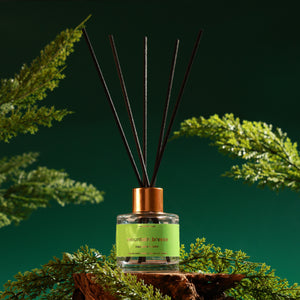
 Mountain Breeze₹849Soft mass absorbs odour and releases it later; that is true all year. What the monsoon changes is the depth and the pace. A damp underlay takes up more and hands it back more slowly, so the release becomes a continuous low background rather than a series of overnight recoveries. The practical consequence is that the club stops recovering between service periods: in February the lounge emptied itself by morning, in July it starts each evening already loaded, and by the end of a wet fortnight the level in the room is higher than anything a single day of service would produce. This is also why the rooms with the most fabric per cubic metre — the card room, the function suite, the corridor with the runner and the heavy curtains — become conspicuously worse in the rains while a marble lobby barely changes at all. Hard surfaces have almost no store, so they have almost no season.
 Vaayu₹11,999The entrance sequence of a club is a water pump in the rains, and nobody has been given the job of managing it. Members arrive wet. Umbrellas are furled and put somewhere, usually a stand on carpet. Coats go to a cloakroom that has no ventilation and no drying provision, where they sit together for three hours. Shoes deposit water into the matting for the first five paces and then into the carpet for the next twenty. Meanwhile every door cycle exchanges dried conditioned air for saturated outside air, which in a lobby with automatic doors is a continuous exchange rather than an occasional one. The remedies here are cheap, unglamorous and genuinely effective: matting long enough to take several paces rather than one, changed and dried rather than left down for a season; a hard-floored place for umbrellas with a drain or a tray, away from carpet; some ventilation and warmth in the cloakroom; and a written instruction about who changes the matting and when. None of that is a purchase from us.
Aangan₹25,999This is the point that changes how a club should be commissioned. Relative humidity alters how a composition is perceived, not what is in it. The same fragrance, at the same setting, in the same room, reads heavier, rounder and sweeter in damp air than in dry conditioned air. So a club that chose its intensity in February against a dry lobby has, by July, a lobby running at a perceptually higher level than the one it signed off, without anybody having touched a control. Members will describe it as strong, or as stuffy, or — most commonly and most damagingly — as though the club is covering something up. The correct response in the rains is to lower the setting, not to raise it. Which makes this a scheduling and governance question rather than a hardware one: a written seasonal setting, a named person who owns it, and a lock on the control so that nobody else has an opinion in the meantime. That is also why a club with a genuine musty problem should consider turning the fragrance off altogether for the season while the building is dried, and reintroducing it afterwards. A month of no fragrance is a far smaller reputational cost than a season of fragrance over damp.
Vaayu₹11,999The entrance sequence of a club is a water pump in the rains, and nobody has been given the job of managing it. Members arrive wet. Umbrellas are furled and put somewhere, usually a stand on carpet. Coats go to a cloakroom that has no ventilation and no drying provision, where they sit together for three hours. Shoes deposit water into the matting for the first five paces and then into the carpet for the next twenty. Meanwhile every door cycle exchanges dried conditioned air for saturated outside air, which in a lobby with automatic doors is a continuous exchange rather than an occasional one. The remedies here are cheap, unglamorous and genuinely effective: matting long enough to take several paces rather than one, changed and dried rather than left down for a season; a hard-floored place for umbrellas with a drain or a tray, away from carpet; some ventilation and warmth in the cloakroom; and a written instruction about who changes the matting and when. None of that is a purchase from us.
Aangan₹25,999This is the point that changes how a club should be commissioned. Relative humidity alters how a composition is perceived, not what is in it. The same fragrance, at the same setting, in the same room, reads heavier, rounder and sweeter in damp air than in dry conditioned air. So a club that chose its intensity in February against a dry lobby has, by July, a lobby running at a perceptually higher level than the one it signed off, without anybody having touched a control. Members will describe it as strong, or as stuffy, or — most commonly and most damagingly — as though the club is covering something up. The correct response in the rains is to lower the setting, not to raise it. Which makes this a scheduling and governance question rather than a hardware one: a written seasonal setting, a named person who owns it, and a lock on the control so that nobody else has an opinion in the meantime. That is also why a club with a genuine musty problem should consider turning the fragrance off altogether for the season while the building is dried, and reintroducing it afterwards. A month of no fragrance is a far smaller reputational cost than a season of fragrance over damp.
Why fragrance makes a damp room worse, in two separate ways
Most clubs arrive at this subject having already tried the obvious thing, so it is worth separating the two failures, because they have different remedies. The first failure is the mixture. Adding a pleasant odour to an unpleasant one does not replace it and does not cancel it; it produces a combination that the nose evaluates as a whole, and that evaluation is reliably worse than the unpleasant odour on its own. The reason is that the mixture carries information: it says that something is present and that something is being placed over it. A member who walks into a damp lounge and smells only damp concludes that the building needs work. The same member walking into a damp lounge that also smells of a pleasant woody composition concludes that the club knows and is hiding it, and that second conclusion is the one that gets raised at committee by name. This is why I will not sell fragrance into a musty building even when the club is asking me to.
The second failure is dose drift without a dial being touched, and it is subtler. Because damp air makes the same composition read heavier, a fragrance commissioned against dry conditions is overdosed by the time the rains arrive. Add to that the ordinary problem of adaptation — the staff who set the level have been in the building since seven in the morning and stopped registering it, while it goes on arriving exactly as before — and you have a club where the one person with the authority to adjust the intensity is the one person who cannot perceive that it has drifted. The remedy is procedural, not technical. Write the setting down with a date. Write a second, lower setting for the wet months. Key-lock the control. And test the result the only way it can honestly be tested, which is by leaving the building, staying out long enough to reset, and walking back in from the car park as a member does — ideally with an actual member, because a visitor is a better instrument than any of us.
There is a composition consequence too. A fragrance dosed low is mostly its heart and its base, since top notes are the first thing lost, and in damp air the effect is exaggerated: the bright citrus and green notes that gave a composition its lift in February are much less present in July, while the heavier base is reading rounder than ever. A composition chosen for how it smells at full strength across a committee table can therefore be almost unrecognisable in the room it was bought for, in the season it is most needed. The registers that survive this are the dry structured ones — cedar, vetiver, white tea, bergamot, a little pepper — which keep their outline when they are quiet. Sweet, powdery and gourmand registers lose their shape at low concentration and read as a vague smell of perfume, which in a room that also has a faint residual weight is the worst available combination. For the waterless commercial machines the fragrance is specified and quoted per property, and that is an advantage here rather than an inconvenience: the composition can be chosen for the level it will run at, in that building, in that climate.
The monsoon routine, week by week
This is the sheet I would give a general manager in the first week of the rains. It is organised by where the water is, because that is the only useful organising principle for this problem, and nearly every line is free or close to it. The last row is fragrance, and it is last for a reason.
| Where the water is | What it does to the smell of the club | What to do about it | Cost |
|---|---|---|---|
| The entrance sequence ★ | Coats, umbrellas and shoes load the matting, carpet and underlay for the first twenty paces | Matting long enough for several paces, changed and dried on a written cycle; a hard-floored umbrella point away from carpet; somebody named to do it | No purchase |
| The cloakroom | Wet coats sitting together for three hours in an unventilated room, then that air joining the corridor | Ventilation and a little warmth, spaced hanging, and the door not propped into the members’ side | No purchase |
| Carpet, underlay and rugs | Deeper and slower stores that no longer recover overnight between service periods | Bring in real drying equipment; lift and dry rugs and runners; deep clean and then dry properly rather than only cleaning | A drying contract |
| Condensate and drainage | Water sitting where nobody sees it — behind a bookcase, under a plant room stair, in a ceiling void | Trace every condensate run from every cooling unit and check where it discharges; check the cold corner in the function room | A maintenance instruction |
| The plant, running at part load | Cooling cycles off as outside temperature falls, so the moisture removal you relied on quietly stops | Ask the engineer to run for longer rather than shorter in the wet months, and to hold the closed rooms on the same air path | Mostly no purchase |
| Outside air, on a wet day | Opening the windows in the rains imports the problem instead of purging it | Invert the dry-season advice: purge with conditioned air, and open up on the dry days rather than the wet ones | No purchase |
| Fragrance | Reads heavier in damp air, and over a musty room reads as a cover-up | Lower the setting for the season, or switch it off while the building is dried — then reintroduce it. Vaayu ₹11,999 onwards | Often no purchase at all |
Zone · Vaayu₹11,999See it → Air system · Aangan₹25,999See it → Larger property · Meenar₹38,500See it →
Which mechanism is wrong in monsoon, and which is right
There are three mechanisms and in the rains they are not equally defensible, so it is worth being blunt about which one to avoid. An ultrasonic machine dilutes the oil in water and throws a wet mist — Sukoon ₹1,899 at 270–320 sq ft, Boond ₹899 at up to about 150 sq ft. What reaches the room is mostly water, it adds humidity, and it can leave a fine white mineral deposit on dark joinery and glass. It is a perfectly good machine for a bedroom in a dry month. Putting one into the room whose problem is water is the wrong direction of travel, and I will say so in a first meeting even though it costs us the easiest sale in the range. The same paragraph is the right place to correct a common assumption about the largest ultrasonic unit: Megh ₹3,499 holds six litres and runs for around a hundred hours, but it covers only about 215 sq ft — less than the ₹1,899 Sukoon. Tank size buys runtime, not reach, and in this family of problems it buys the wrong thing twice over.
A reed diffuser is a passive capillary device: oil climbs six fibre reeds and evaporates, with no energy consumed and no air moved, which makes it a fragrant zone of roughly a couple of metres rather than a fragranced room. On a cloakroom shelf it is exactly the right specification, and SOSA reed oils are alcohol-free, phthalate- and paraben-free, IFRA-compliant, 0 ppm formaldehyde, built on a heat-stable CCT carrier and tested at 45°C and 85% RH, which is a genuine durability statement for Indian conditions. What it is not is a solution to a lounge, in any season: two passive sources in one room do not make a plateau, they make two hills with a valley between them, and the valley is where the members sit.
Waterless cold-air nebulising is the commercial answer, and in the rains it is the only defensible one. Pressurised air shatters undiluted oil into a dry nano-mist carried by the room’s own airflow: no water, no dilution, no added humidity, no residue. Undiluted oil also delivers far more fragrance per unit of mist than the same oil diluted in water, which is why commercial scenting went waterless in the first place. Vaayu at ₹11,999 is the zone machine, up to 1000 m³ ≈ 2,000–3,000 sq ft, with a Bluetooth app and onboard buttons, 1h / 4h / 8h / 24h run windows, day selection, adjustable intensity, auto-stop, a key-lock, under 38 dB, a sealed 400ml tank lasting up to about 90+ days depending on intensity and hours, DC 12V / 1A at 5W, and CE, RoHS and SGS. Aangan at ₹25,999 is the building machine, up to 3,000 m³ ≈ 8,000–10,000 sq ft when connected into the HVAC or air handling unit, with an 800ml reservoir, under 42 dB, DC 12V at 14W, a metal body of 3.9 kg at 284 × 125 × 246 mm, one-year warranty, imported, and a programmable board with work and pause cycles and daily schedules rather than an app. That connection is a mechanical integration into air the building already moves — not a digital one, since no building-management interface or automation protocol exists on any SOSA machine. Meenar at ₹38,500 is the larger-property option, specified on enquiry. Sizing is reasoned in volume rather than floor area, because a double-height entrance hall consumes coverage a square-foot figure hides, and I publish no machine count as a formula — send connected volume, ceiling heights, door positions, the number of air systems and the occupied hours to the contact page.
The order of work, and the two gaps
Here is the sequence as a committee paper would carry it, with the price against each line. Note how many lines are instructions rather than purchases, and note that the fragrance line can be negative in the wet months — the right action may be to spend nothing and lower a setting. The last row is the pair of things this range does not contain.
| Step | What it is | Why it comes here in the order | Cost |
|---|---|---|---|
| 1. Find the water ★ | The entrance matting, the umbrella stand, the cloakroom, every condensate run, the cold corner, the plant room, the gully nobody can see standing up | Because a seasonal smell has a seasonal cause, and in the rains that cause is always water arriving somewhere specific | No purchase |
| 2. Deal with the moisture | Real drying equipment for carpet and underlay, rugs lifted and dried, coats given somewhere ventilated, matting changed on a cycle | Damp material is a deeper and slower store, so until it is dry every other measure is working against it | A drying contract |
| 3. Get the right air moving | Plant running longer rather than shorter, closed rooms held on the same air path, and the windows opened on dry days rather than wet ones | The dry-season instruction inverts here: purging with saturated outside air imports the problem instead of removing it | Mostly no purchase |
| 4. Clean, then dry | Deep clean carpet, upholstery and curtain linings, and then dry them properly rather than counting the clean as finished | A wet clean in a wet month makes the room worse for a fortnight unless the drying is part of the contract | A cleaning contract |
| 5. Turn the fragrance down, not up | A written lower setting for the wet months, or the machine off entirely while the building is dried, then reintroduced — set once, dated, key-locked | Because damp air makes the same composition read heavier, and because fragrance over musty reads as concealment to every member who walks in | Often nothing |
| Two honest gaps: what SOSA does not sell you | SOSA sells no dehumidifier and no air purifier, makes no health, air-quality or VOC claim, and nothing in the range removes an odour or removes moisture — fragrance adds fragrance. Separately, no purchasable refill oil is listed for the waterless commercial machines; that fragrance is specified and quoted per property | Said plainly, because a house committee will check both, and because in the monsoon the most useful thing a fragrance house can tell you is which of your problems is not ours | Quoted |
Versailles
A club I know well rang me in the second week of the rains to say the fragrance had gone wrong. Nobody had touched it since it was commissioned in the dry months. The general manager was certain something had failed, because members who had said nothing for five months were now describing the lounge as heavy and one had used the word cloying in writing.
Nothing had failed. Two separate things had happened at once, and both of them were water. The building was damper, so the carpet and the curtains were holding and releasing far more than they had in February; and damp air makes the same composition read heavier, rounder and sweeter than it does in dry conditioned air. So the room had both a background it did not have before and a fragrance that was reading above the level we had signed off, at a setting that had not changed by a single step.
What we did was the opposite of what the club expected. We turned the machine off for three weeks. Drying equipment went into the lounge and the corridor, the entrance matting was lengthened and put on a written change cycle, the umbrella stand was moved off the carpet onto a hard floor with a tray, and the plant was asked to run longer in the evenings rather than shorter. When we restarted the machine it was at a lower setting than the dry-season one, written on a sheet with a date, and key-locked. Nobody has complained since, and the club spends nothing extra in the wet months except on matting.
I tell clubs this story because the instinct in July is always to turn the dial up, and turning it up is the one action that guarantees a member will use the word cover-up. Whoever holds that dial has also been in the building since seven in the morning and stopped registering the fragrance hours before the first member arrived, while it carries on arriving exactly as before. Do not let that person judge it. Walk in from the car park with a member and believe them. Everything we make is composed in Pune, and a part of every order funds a girl’s classroom through Nanhi Kali.
Frequently asked questions
- What to fix first — the family pillar: the whole ordered checklist, with fragrance as the last line.
- Why it is worst at opening and why old clubs turn musty — the overnight purge, and decades of absorbent mass.
- What carpets, leather, curtains and wood actually hold — material by material, and what damp does to each.
- Why the lounge changes by evening — the day’s load, and the air conditioning settings.
- Why the reed works at the desk but not across the lobby and why ten of them still fail — the passive mechanism, at club scale.
- Why a spray vanishes in a lobby and stronger fragrance or better diffusion — an event versus a system, and a free test.
- Brand: the SOSA founder story.
SOSA commercial scenting — facts verified August 2026: Vaayu ₹11,999, waterless cold-air nebulising, coverage up to 1000 m³ ≈ 2,000–3,000 sq ft, 400ml refillable sealed tank lasting up to about 90+ days depending on intensity and hours, Bluetooth app plus onboard buttons, run windows of 1h / 4h / 8h / 24h, day selection, adjustable intensity, auto-stop and key-lock, under 38 dB, freestanding, wall-mounted or HVAC-return mounting, DC 12V / 1A at 5W, CE, RoHS and SGS, black and white. Aangan ₹25,999, HVAC or AHU connection or standalone wall-mount or lay-flat, coverage up to 3,000 m³ ≈ 8,000–10,000 sq ft, 800ml reservoir, under 42 dB, DC 12V at 14W, intelligent PCB with programmable work and pause cycles and daily schedules, metal body 3.9 kg at 284 × 125 × 246 mm, black or white, one-year warranty, imported; it has no app and no Bluetooth, and no certifications are published for it. Meenar ₹38,500 is the larger-property option and is specified on enquiry; no coverage figure is published for it here. Ultrasonic machines: Sukoon ₹1,899 at 270–320 sq ft, Boond ₹899 at up to about 150 sq ft, Megh ₹3,499 with a six-litre tank and around 100 hours of runtime but only about 215 sq ft of coverage. Reed diffusers ₹749–₹849 for 50ml lasting 6–8 weeks and ₹1,249–₹1,349 for 130ml lasting 14–18 weeks, six fibre reeds, alcohol-free, phthalate-free, paraben-free, IFRA-compliant, 0 ppm formaldehyde, heat-stable CCT carrier, refillable glass bottle, tested at 45°C and 85% RH, composed in Pune. The Hotel Collection fragrance oils are water-based and ultrasonic-only at 15ml ₹299, 100ml ₹999 and 300ml ₹1,799; they are not for reed diffusers and not for the waterless commercial machines. No purchasable refill oil is listed for the waterless commercial machines — that fragrance is specified and quoted per property. SOSA publishes no leather fragrance in any format and no tobacco or smoky fragrance for any diffuser. SOSA sells no air purifier, no dehumidifier and no room spray for interiors, and makes no health, air-quality, VOC or mould claim. No dealer programme, reseller margin, trade price, territory or service contract is published. Free shipping above ₹499. A portion of every order supports girl-child education through Nanhi Kali. SOSA is an independent Indian fragrance house; the Hotel Collection scents are SOSA’s own interpretations inspired by the world’s finest hotels, and SOSA is not affiliated with or endorsed by any hotel brand. Prices subject to change — see the live product pages.