


The one that is nearly always underestimated: the air handling. A system throttled back because the space temperature is satisfied is moving less air, and fresh air per person is an occupancy question rather than a temperature question. The busiest hour in the club is often the hour with the least ventilation behind it.
The fix is the schedule, not the dial and not the composition. A machine at a fixed output produces a rising level in a room whose removal rate is falling. Run windows, work and pause cycles, day selection and a lower evening intensity fix that. Changing the fragrance fixes nothing, because the fragrance was never the variable.
Who cannot judge this: anybody who has been in the building since seven in the morning, which is everybody holding the dial. The nose reports change rather than constancy, so the fragrance stops being reported while it continues to arrive. The only valid test is to leave, stay out long enough to reset, and walk back in at the hour members complain about.
The honest gaps: nothing SOSA makes removes an odour, and there is no air purifier and no dehumidifier in the range, so the kitchen door, the extract and the AHU schedule are building work we do not sell. SOSA also publishes no consumption rate, no air-change figure and no adaptation time in minutes — and I will not invent any of them.
2. Food service carries through, and cooking aerosols are the slowest guest in the building. The aerosols that come off a kitchen are oily. They do not pass through a room and leave with the air; they settle onto carpet, curtains and upholstery and then release again slowly for hours afterwards. That is the whole reason the smell of dinner outlasts dinner. A lounge two doors from a kitchen, or across a lobby from a dining room whose doors are open at service, is receiving deliveries at lunch and again at dinner, and what it received at lunch is still coming back out of the carpet at nine. The service corridor propped open for the sake of the staff carrying trays is, in my experience, the single most common physical cause of an evening lounge that nobody can explain.
3. The smoking area comes back indoors on clothing, whatever the policy says. A terrace, a courtyard, a cigar corner or simply the porch by the car park all behave the same way: members go out, they come back, and what they were standing in comes back with them on jackets and hair and settles onto the chair they sit in. If the smoking area sits upwind of a fresh-air intake, or beside the door members use to re-enter, the room receives it twice. This is not a matter for a stronger fragrance. It is a matter for where the area is, which door it feeds, and whether the lounge’s intake is anywhere near it.
4. The air handling is doing less, at exactly the hour it should be doing more. Most club systems are controlled on temperature. Once the sun leaves the elevation and the space temperature is satisfied, the plant throttles back, the fan drops, and the volume of air moved falls away. But the fresh air a room needs is a function of how many people are in it, not of how warm it is — and the busiest hour of a club evening is frequently the hour with the least ventilation standing behind it. Air that leaves takes the fragrance and everything else with it; air that is not moving accumulates all of it. The same room, the same machine, the same setting, behaves in the opposite direction once removal falls below loading.
5. Your fragrance has been running all day into a room that has been changing under it. A machine at a fixed output is a constant input. At ten in the morning it is meeting a nearly empty room with the plant running hard after the morning purge, and it reads as clean and light. At eight in the evening it is meeting a full, warm, less-ventilated room that is already carrying a day’s accumulation, and the same input reads as heavy. The correction is to change the input across the day rather than to change what is in the bottle: Vaayu ₹11,999 offers run windows of 1h / 4h / 8h / 24h with day selection and adjustable intensity, and Aangan ₹25,999 carries programmable work and pause cycles and daily schedules on its board. Alcohol-free, phthalate-free, IFRA-compliant, composed in Pune, with a portion of every order supporting girl-child education through Nanhi Kali.

The three loads that arrive with the day
A club lounge at opening and the same lounge at eight in the evening are, for this purpose, two different rooms that happen to share a floor. What separates them is three streams of loading, each with its own timing and its own remedy, and it is worth separating them because two of the three cost nothing to address and the third is the one clubs always try to solve with fragrance.
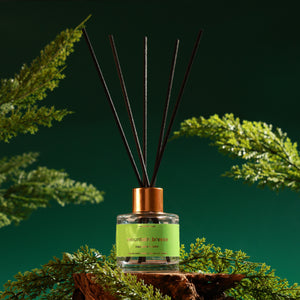
 Mountain Breeze₹849Occupancy is the load that is most obvious and least often designed for. People are warm, they raise the moisture content of the air, and a membership of the kind most clubs have wears fragrance — frequently good fragrance, frequently a lot of it, and all of it leaving the wearer continuously into a shared volume. By the evening a busy lounge contains a composite of everything worn into it that day, and the soft furnishings have taken some of it up and are returning it quietly on their own schedule. This is the reason a business club at its most crowded should be dosed lower than the same room at four in the afternoon: the room is already carrying a great deal of fragrance that the club did not choose and cannot control, and adding to it is what produces the complaint that the lounge smells like a perfume counter. It also explains why two members in the same room will describe the strength completely differently and both be correct: dwell time, seat position relative to airflow, height and recent exposure all differ, so they are genuinely not smelling the same thing.
 Vaayu₹11,999Cooking aerosols are oily, and that single property explains most of the timing. They do not behave like a gas that disperses and leaves; they settle onto carpet, curtains and upholstery and then re-release over hours. So a lounge adjacent to service receives a delivery at lunch, keeps releasing it through the afternoon, receives a second delivery at dinner, and by nine in the evening is running both at once underneath whatever the club intended the room to smell of. The things that change this are a door closer on the service corridor, a kitchen extract that is genuinely pulling rather than nominally installed, a pantry door that is not propped, and a route for trays that does not cross the lounge. The smoking area is the second delivery and it arrives on clothing. Whatever the policy, members go out and come back, and the chair they sit in receives it. Where this becomes structural rather than incidental is when the area sits upwind of a fresh-air intake or immediately beside the door people re-enter through, in which case the room takes it twice: once on jackets and once through the plant. Moving a door or a seating cluster costs nothing next to a machine, and it is the intervention I would make first.
Aangan₹25,999This is the part of the answer a supplier is least likely to volunteer, so I will. A diffuser left on one setting from opening to closing is not delivering one experience; it is delivering the same input into a room whose ability to clear it changes by the hour. In the morning, after a purge, with the plant running hard and the room empty, the level in the air stays low and the fragrance reads as clean. By evening, with the plant throttled and the room full, the same input has nowhere to go. The soft furnishings have been charging all day as well and are now contributing rather than absorbing. The result is a room that is genuinely stronger in the evening even though nobody has touched anything, and the person most likely to be asked about it — the general manager, who has been in the building since seven — is the one person who cannot assess it, because the nose reports change rather than constancy and has long since stopped reporting a fragrance that never varies.
Vaayu₹11,999Cooking aerosols are oily, and that single property explains most of the timing. They do not behave like a gas that disperses and leaves; they settle onto carpet, curtains and upholstery and then re-release over hours. So a lounge adjacent to service receives a delivery at lunch, keeps releasing it through the afternoon, receives a second delivery at dinner, and by nine in the evening is running both at once underneath whatever the club intended the room to smell of. The things that change this are a door closer on the service corridor, a kitchen extract that is genuinely pulling rather than nominally installed, a pantry door that is not propped, and a route for trays that does not cross the lounge. The smoking area is the second delivery and it arrives on clothing. Whatever the policy, members go out and come back, and the chair they sit in receives it. Where this becomes structural rather than incidental is when the area sits upwind of a fresh-air intake or immediately beside the door people re-enter through, in which case the room takes it twice: once on jackets and once through the plant. Moving a door or a seating cluster costs nothing next to a machine, and it is the intervention I would make first.
Aangan₹25,999This is the part of the answer a supplier is least likely to volunteer, so I will. A diffuser left on one setting from opening to closing is not delivering one experience; it is delivering the same input into a room whose ability to clear it changes by the hour. In the morning, after a purge, with the plant running hard and the room empty, the level in the air stays low and the fragrance reads as clean. By evening, with the plant throttled and the room full, the same input has nowhere to go. The soft furnishings have been charging all day as well and are now contributing rather than absorbing. The result is a room that is genuinely stronger in the evening even though nobody has touched anything, and the person most likely to be asked about it — the general manager, who has been in the building since seven — is the one person who cannot assess it, because the nose reports change rather than constancy and has long since stopped reporting a fragrance that never varies.
What the air system is actually doing at eight in the evening
If a club takes one question away from this page, it should be this one, and it should be put to the engineer rather than to the perfumer: is the fresh-air provision to the lounge tied to temperature or to occupancy? In most buildings the honest answer is temperature, because that is what the control system was set up to manage. The consequence is straightforward and almost always unnoticed. Through the middle of the day the plant works hard, because the sun is on the glass and the space needs cooling, and the room therefore gets a great deal of air moved through it as a by-product. In the evening the load falls away, the space temperature is satisfied, the fan modulates down and the volume of air moved collapses — while the number of people in the room is at its highest of the day. Ventilation per person is falling off a cliff at the exact hour the club is fullest, and nobody sees it because nobody is looking at the fan and the occupancy on the same chart.
Air conditioning helps and hurts at the same time, which is why this is worth thinking about properly rather than reaching for a rule. When it runs, it moves fragrance around a volume evenly and takes the day’s accumulation away with it; a well-ventilated room is a room in which the fragrance is being continuously replaced rather than allowed to build. When it stops, or throttles, the same volume begins to accumulate everything in it, including your composition. The same machine, at the same setting, behaves in opposite directions in a high-air-change room and a sealed one — and a club lounge is frequently both, at different hours of the same day. That is the mechanism underneath the whole question in this page’s title, and once a general manager has seen it the rest of the answer becomes obvious.
Three practical checks follow, none of which costs anything. First, ask whether there is a minimum fresh-air position the fan holds regardless of temperature, and what it is; if there is not one, that is a conversation to have with the mechanical consultant before any fragrance decision is made. Second, ask whether the lounge is on the same air path as the rooms around it — a closed door is a real boundary, so a lounge with its doors open to a corridor and a dining room at service is a single large volume in the evening and three separate ones in the morning, and it will behave completely differently in the two states. Third, look at where the return is. A room whose fragrance is introduced near the supply and removed near the return behaves evenly; a room whose only source sits in a dead corner behind a screen builds a pocket there and leaves the seating short, and that is a distribution failure rather than a dose failure. Most complaints that a fragrance is wrong in the evening turn out, on inspection, to be complaints about air movement at a particular hour.
Morning against evening, hour by hour
This is the table I would put in front of a house committee, because it turns an argument about taste into an argument about the building, which is where it belongs. The last row is the one to read twice: it is the thing we sell, and it is the smallest lever on the page.
| Variable | At ten in the morning | At eight in the evening | What it means in practice |
|---|---|---|---|
| Air moved by the plant ★ | High — the building needs cooling, so the fan is working and the room is being flushed as a by-product | Low — the space temperature is satisfied, so the fan modulates down while the room is at its fullest | Ask for a minimum fresh-air position held regardless of temperature. This is the largest single lever and it is free |
| Occupancy and personal fragrance | A handful of people; almost no composite load in the air | The day’s peak, and a composite of every fragrance worn into the room since opening | Dose the evening lower, not higher. The room is already carrying scent the club did not choose |
| Food service carry-over | Nothing yet, unless breakfast is served nearby | Lunch still releasing from the carpet, dinner arriving through the doorway on top of it | Door closer on the service corridor, working extract, tray route that does not cross the lounge |
| Smoking area returning indoors | Negligible | Continuous, on jackets, and twice over if the area sits near an intake or the re-entry door | Move the door, the seating cluster or the area — all cheaper and more effective than any machine |
| Soft furnishings | Releasing last night, having had all night to do it quietly | Charged with the day and contributing rather than absorbing | A cleaning and drying question, on a written cycle. Vacuum reaches the pile, not the store |
| Who is judging the room | Staff who arrived at seven and can still smell it | Staff who arrived at seven and stopped smelling it hours ago | Judge only by walking in from the car park at the hour members complain about |
| Relative humidity in the room | Lower, after a night of plant and a morning purge | Higher, with occupancy and moisture and a throttled system | The same composition reads heavier in a damp room. Perception changes; the recipe should not |
| Your fragrance machine | A constant input into a well-flushed, empty room — reads clean and light | The same constant input into a full, warm, throttled room — reads heavy | Schedule it down for the evening: Vaayu ₹11,999 run windows, or Aangan ₹25,999 work and pause cycles |
Zone · Vaayu₹11,999See it → Air system · Aangan₹25,999See it → Larger property · Meenar₹38,500See it →
Why the answer is a schedule and not a stronger fragrance
Almost every club I have visited with an evening problem has already tried two things, and both of them make it worse. The first is raising the intensity, usually in the afternoon, usually by somebody who has been in the building all day and genuinely cannot smell the room any more. The second is changing the fragrance, on the theory that the composition has gone wrong somewhere between lunch and dinner. It has not. What changed was the room, and a composition cannot be reformulated to compensate for a fan that has throttled back. Every failure mode in premium scenting is a dose failure rather than a fragrance failure, and the evening lounge is the clearest example of it I know.
What actually works is dull and procedural, which is why it is rarely done. Set the machine once, at a level chosen for the fullest and least ventilated hour rather than for the emptiest one, and write the setting down with a date. Turn the key-lock, so that a duty manager on a difficult evening cannot correct it in the direction that makes it worse. Then use the schedule to shape the day: a higher input in the morning when the room is empty and the plant is flushing it, a lower one through the evening when the room is full and the plant is not. On Vaayu that is run windows of 1h / 4h / 8h / 24h together with day selection and an adjustable intensity; on Aangan it is an intelligent PCB carrying programmable work and pause cycles and daily schedules. A board rather than a phone, in a club, is an advantage: a setting on a board does not travel home in somebody’s pocket.
One caution about how you use a cycle, because it is the mistake that follows immediately from learning the machine has one. A machine running low and continuously produces a plateau; a machine running hard on a short cycle produces peaks, and people describe peaks as “too strong” even when the total delivered across the day is identical. In an evening lounge, where somebody may sit for three hours, a peak is particularly badly received, because a member who has settled into a room notices a change far more readily than a level. So the evening setting should be quieter and more continuous rather than shorter and stronger. And a composition dosed low is mostly its heart and its base, because the top notes are the first thing lost, which is why dry structured registers — tea, cedar, vetiver, bergamot, a thread of pepper — hold their outline when they are quiet, while sweet and powdery ones lose their shape and read as a vague smell of perfume. For the waterless commercial machines the fragrance is specified and quoted per property rather than bought from a shelf, which is an advantage here: the composition can be chosen for the level it will actually run at during the hours that matter.
The order of work, and the two gaps
Here is the sequence as a committee paper would carry it, with the cost against each line. The first four lines are operational and mechanical and we sell none of them; the fifth is the only one that involves a purchase, and it is deliberately last. The final row is what this range does not contain, stated plainly, because a committee will check it.
| Step | What it is | Why it comes here in the order | Cost |
|---|---|---|---|
| 1. Find the sources the evening adds ★ | The service corridor and whether it is propped at dinner, the tray route, the kitchen extract, where the smoking area sits relative to the re-entry door and the fresh-air intake, and every dried water seal in the building | Because these are the loads that arrive with the day, they cost nothing to change, and no fragrance decision made before them will survive | No purchase |
| 2. Deal with the moisture the evening brings | Occupancy raises humidity, and the same composition reads heavier in a damp warm room than in a dry conditioned one. Keep the room’s moisture stable rather than letting it climb through service | Because perception changes with humidity even when nothing about the fragrance has changed, and a club will otherwise reformulate to chase a weather condition | Plant settings |
| 3. Get the air changing when the room is full | Ask whether fresh air is tied to temperature or to occupancy, establish a minimum fan position held through the evening, and look at where supply and return sit relative to the seating | Because removal has to keep pace with loading, and in most clubs this is the step that is quietly not happening at exactly the busiest hour | Mostly no purchase |
| 4. Empty what has been storing all day | Carpet and underlay dried properly, curtain linings named in the cleaning contract, upholstery on a written cycle, and the vacuum scheduled after a morning purge rather than before it | Because oily cooking deposits settle into soft furnishings and release for hours, which is what makes lunch still audible in the room at nine | A cleaning contract |
| 5. Only then, fragrance — scheduled, and lower in the evening | Vaayu set for the fullest hour rather than the emptiest, run windows and day selection used to shape the day, the setting written down with a date and the key-lock turned | Because a constant input into a falling removal rate produces a rising level, and because the person holding the dial in the evening is the person least able to judge it | ₹11,999 |
| Two honest gaps: what SOSA does not sell you | Nothing in the range removes an odour or changes the air: there is no air purifier and no dehumidifier, and no health, air-quality or VOC claim is made, because fragrance adds fragrance. And no consumption rate, air-change figure, humidity percentage or adaptation time in minutes is published for any SOSA machine, so none is quoted here. No purchasable refill oil is listed for the waterless commercial machines either — that fragrance is specified and quoted per property | Said plainly, because the evening problem is mostly a mechanical one and a supplier who pretends otherwise will sell you a machine that makes it worse | Quoted |
Versailles
A city club once asked me to change their fragrance because, as the secretary put it, it was lovely in the morning and oppressive by dinner. They had already been through two compositions with a previous supplier and were preparing to go through a third. I asked to come at a quarter to nine in the evening instead of at eleven in the morning, which is when suppliers are usually invited, and to sit in the lounge for half an hour before saying anything.
The room was not oppressive because of the fragrance. It was warm, it was full, and it was almost completely still. The chandeliers were not moving a thing. Behind the seating, the service corridor to the dining room had been wedged open with a fire extinguisher so that the staff could get trays through, and it had evidently been wedged open every evening for years. Two members came back in from the terrace and sat down beside me. And when I asked the engineer what the air handling was doing, he said, reasonably, that the building did not need cooling at that hour — which was true, and which was exactly the problem, because the room needed air for a quite different reason.
What we changed was a door closer on the service corridor, a minimum fan position held through the evening regardless of temperature, and the seating cluster nearest the terrace door. Then we left the existing machine alone for a fortnight and asked the duty managers to write down, each evening at nine, whether the room was better or worse than the night before. When we finally touched the setting, we lowered it for the evening and left the morning where it was, and we key-locked it. The secretary told me afterwards that members had started saying the club smelled fresher, which is the word I like best, because it is not a word about fragrance at all.
The part I would want any general manager to keep is this. I could have sold that club a third composition and it would have failed as the first two had, because the variable was never the fragrance. Nothing we make removes an odour or changes the air, and we do not pretend otherwise. What we do is add a quiet, well-chosen fragrance to a room that has already been sorted out, and hold it steady through a long evening. Everything we make is composed in Pune, and a part of every order funds a girl’s classroom through Nanhi Kali.
Frequently asked questions
- What to fix first — the family pillar: the whole ordered checklist, with fragrance as the last line.
- Why it is worst at opening — the same building twelve hours later, with the plant stopped and the drain traps drying.
- Why old clubs turn musty and why the monsoon makes it worse — decades of absorbent mass, and what damp does to perception.
- What carpets, leather, curtains and timber hold — where the day’s load actually goes, and how long it keeps coming back out.
- Why the reed works at the desk but not across the lobby and why ten of them still fail — the passive mechanism, at club scale.
- Why a spray vanishes in a lobby — an event rather than a system, and why SOSA sells no such product for interiors.
- Stronger fragrance or better diffusion — a decision test you can run in one afternoon, free.
- Brand: the SOSA founder story.
SOSA commercial scenting — facts verified August 2026: Vaayu ₹11,999, waterless cold-air nebulising, coverage up to 1000 m³ ≈ 2,000–3,000 sq ft, 400ml refillable sealed tank lasting up to about 90+ days depending on intensity and hours, Bluetooth app plus onboard buttons, run windows of 1h / 4h / 8h / 24h, day selection, adjustable intensity, auto-stop and key-lock, under 38 dB, freestanding, wall-mounted or HVAC-return mounting, DC 12V / 1A at 5W, CE, RoHS and SGS, black and white. Aangan ₹25,999, HVAC or AHU connection or standalone wall-mount or lay-flat, coverage up to 3,000 m³ ≈ 8,000–10,000 sq ft, 800ml reservoir, under 42 dB, DC 12V at 14W, intelligent PCB with programmable work and pause cycles and daily schedules, metal body 3.9 kg at 284 × 125 × 246 mm, black or white, one-year warranty, imported; it has no app and no Bluetooth, and no certifications are published for it. Meenar ₹38,500 is the larger-property option and is specified on enquiry; no coverage figure is published for it here. Ultrasonic machines: Sukoon ₹1,899 at 270–320 sq ft, Boond ₹899 at up to about 150 sq ft, Megh ₹3,499 with a six-litre tank and around 100 hours of runtime but only about 215 sq ft of coverage. Reed diffusers ₹749–₹849 for 50ml lasting 6–8 weeks and ₹1,249–₹1,349 for 130ml lasting 14–18 weeks, six fibre reeds, alcohol-free, phthalate-free, paraben-free, IFRA-compliant, 0 ppm formaldehyde, heat-stable CCT carrier, refillable glass bottle, tested at 45°C and 85% RH, composed in Pune. The Hotel Collection fragrance oils are water-based and ultrasonic-only at 15ml ₹299, 100ml ₹999 and 300ml ₹1,799; they are not for reed diffusers and not for the waterless commercial machines. No purchasable refill oil is listed for the waterless commercial machines — that fragrance is specified and quoted per property. SOSA publishes no leather fragrance in any format and no tobacco or smoky fragrance for any diffuser. SOSA sells no air purifier, no dehumidifier and no room spray for interiors, and makes no health, air-quality, VOC or mould claim. No digital integration of any kind exists on any SOSA machine; the Aangan HVAC connection is mechanical. No dealer programme, reseller margin, trade price, territory or service contract is published. Free shipping above ₹499. A portion of every order supports girl-child education through Nanhi Kali. SOSA is an independent Indian fragrance house; the Hotel Collection scents are SOSA’s own interpretations inspired by the world’s finest hotels, and SOSA is not affiliated with or endorsed by any hotel brand. Prices subject to change — see the live product pages.