



What is emitting: mostly you, through the bedding. Skin lipids transfer to sheets and pillow, sit warm against fabric and oxidise in air — that oxidation is the smell.
The honest test: get up, spend ten minutes in another room, and walk back in. You cannot judge a smell you have been asleep inside.
2. Because emission is continuous and removal is nearly zero. For the next eight hours one or two bodies emit steadily into a closed volume with the door shut and often the window shut too. A sealed bedroom runs at roughly 0.2 to 0.5 air changes an hour. Across a whole night that is somewhere between one and a half and four dilutions of the room's air, and because dilution is gradual rather than a clean sweep, nothing is ever fully carried out.
3. Because the bed is doing chemistry while you sleep. Skin lipids transfer onto the sheet, the pillowcase and the duvet cover through the night. Held at body temperature, pressed against fibre, in contact with air, they oxidise. The compounds that oxidation produces are what people are actually describing when they say a bedroom smells "used" or "warm" or "slightly sour" in the morning. It is not a hygiene failure. It is ordinary chemistry running for eight hours in a warm box.
4. Because you wake up already adapted to it. Olfactory adaptation is essentially complete in about twenty minutes, and you have been in there for eight hours. Anything you can still detect on waking is the fraction strong enough to get past a nose that has stopped reporting. Whatever you notice is understated. The honest reading is taken by leaving the room for ten minutes and walking back in.
5. And fragrance comes after the reset, not instead of it. Scent is additive: it puts molecules in and takes none out. Laid over a room that has not been aired, it gives you both at once. Air the room, deal with the bedding, then add a reed diffuser or a Sukoon as the finishing layer.
Made in India, composed by an ISIPCA Versailles-trained perfumer — and a portion of every order supports girl-child education through Nanhi Kali.
Why the eleven o'clock reading misleads you every single night
Think of the bedroom as a container with a tap running into it and a very small hole in the bottom. The tap is you: skin, breath, moisture, the slow release of everything the bedding absorbed on previous nights. The hole is the air-change rate, and in a closed Indian bedroom with the door shut it is small — somewhere around 0.2 to 0.5 of the room's air volume per hour. The level in the container is not set by how clean the room is. It is set by the ratio of those two numbers. At eleven o'clock you had just tipped a bucket of corridor air into it by walking through the door, so the level was low. By six the tap has run for eight hours and the hole has barely kept up.
The second half of the explanation is that you are the wrong instrument. Olfactory adaptation removes a steady, unchanging smell from conscious perception in roughly twenty minutes, and you have been lying in this one for eight hours. That has an uncomfortable implication people rarely follow through: the smell you can detect on waking is only the part that is strong enough to break through an adapted nose. It is not the smell — it is the tip of it. This is why partners disagree about it, why a guest who slept in the room says something you found surprising, and why the only measurement worth taking is the one you get by leaving. Get up, go and make tea, spend ten minutes doing something else, and come back through the door. That first breath is the reading. Everything else is guesswork taken from inside the sample.
What is actually emitting into a closed bedroom all night
 Step fourFrom ₹749The bed is the largest single piece of fabric in your home and the only one held in direct contact with skin for eight hours at a stretch. Sebum and skin lipids transfer continuously into the sheet, the pillowcase and the inside of the duvet cover. Warmed to body temperature and exposed to air, those lipids oxidise, and the products of that reaction are the characteristic "slept-in" note. This is chemistry, not dirt — it happens to fastidious people who shower before bed, because the lipids arrive on clean skin too. The lever is not more washing of you. It is more frequent removal of the fabric they are sitting in, and more air moving over it during the day.
Symptom to cause: reading your own bedroom
Work down until a row matches the specific thing you notice. The timing of a bedroom smell is unusually informative, because a room on an eight-hour cycle gives you a clean before-and-after every day.
| What you notice | Most likely cause | How to confirm it | What actually fixes it |
|---|---|---|---|
| Fine at bedtime, noticeable on waking, gone by mid-morning ★ | Straightforward overnight accumulation in a closed room | Cross-ventilate ten minutes on waking; if it clears completely, this is it | Ten-minute morning purge; sleep with a window ajar where you can |
| A warm, slightly sour note strongest near the pillow | Skin lipids oxidising in the pillowcase and pillow itself | Smell the pillow directly, then a freshly laundered one, and compare | Weekly pillowcase and sheet wash; a washable pillow protector; air the pillow in sun |
| Room smells worse after two people sleep in it | Twice the emission into exactly the same volume — arithmetic, not hygiene | Compare a night alone with a night together, same linen, same window | Same routine, run harder: more airing, tighter linen cycle, two pillow protectors |
| Heavy and close rather than smelly, with slight condensation | Humidity and warmth building up — the "stuffy" composite rather than an odour | Open the window and see whether it lifts in minutes rather than hours | Ventilate; do not dry laundry in the bedroom; keep the en-suite door shut |
| A sharp sewer note near the en-suite, worse in the morning | A dry P-trap in a rarely-used drain — a plumbing matter, not an odour | Pour a mug of water down the shower and basin drains and wait an hour | Refill the trap weekly; if it returns, get the seal checked. Do not fragrance this. |
| Musty earth smell, or dark marks on a wall behind the headboard | Damp or mould — a health issue, not a fragrance one | Pull the bed away from external walls and look behind it in daylight | Find the moisture source and remove the growth before anything else. |
| If none of these fit: sleep one night with the bedroom door open and the window ajar, changing nothing else. If the morning is noticeably better, the problem was the air-change rate. If it is identical, the problem is in the bed. | |||
Reeds · always-on roomsFrom ₹749Shop →  Sukoon · when you want a switch₹1,899Shop →
  Hotel Collection · the scentFrom ₹299Shop →
The morning reset, and the weekly one
First, change what happens in the first five minutes after you wake. Throw the duvet fully back rather than making the bed immediately — a made bed traps the night's moisture and warmth against the sheet for the whole day, and the bed is the thing you most want to dry out. Open the window and the bedroom door at the same time so air has an entry and an exit. Ten minutes is enough; five to ten minutes of genuine cross-flow moves more air than an hour of one cracked window. If your window opens onto a shaft or a busy road, put a small fan in the window blowing outwards, which pulls the room's air out behind it instead of pushing street air in. In an air-conditioned bedroom this matters more, not less: the unit recirculates, so it has cooled the same air all night without exchanging any of it.
Second, put the bedding on a schedule you actually keep. Sheets and pillowcases weekly. The pillow itself is the piece people forget and the one in longest contact with skin and scalp — use a washable pillow protector under the case and wash it monthly, and air the pillow in direct sun when you get a dry day, because UV and heat drive absorbed volatiles out faster than shade. Strip the bed rather than making it on the morning of the wash so the mattress gets a few hours of open air. Once a season, pull the mattress off and let both sides breathe. And keep the small things out of the room: damp towels on the balcony rail, worn clothes in a basket, the en-suite door shut overnight.
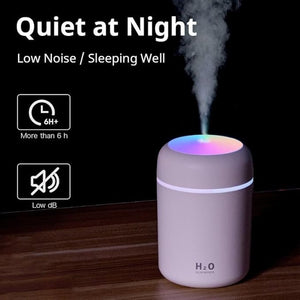
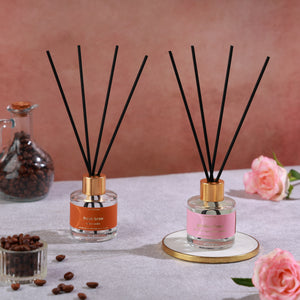
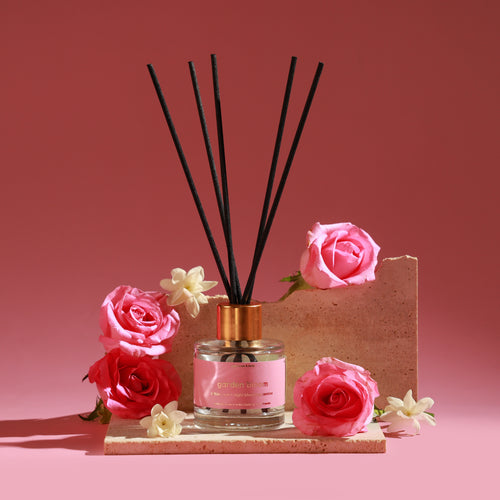
Third, and only now, add the fragrance layer. A bedroom that has been aired and has clean linen is a neutral room, and a scent finally has something to sit on rather than argue with. For a bedroom I would use a reed diffuser from ₹749 on three or four reeds rather than six, placed on a dresser or shelf on the far side of the room from the bed and away from an AC vent. Reed count is the volume control, and a room you sleep in for eight hours needs far less than a hall you walk through. If you would rather have scent you can switch on for an hour before bed and off afterwards, the Sukoon at ₹1,899 takes 3–6 drops of the water-based Hotel Collection from ₹299 and covers roughly 270–320 sq ft. The two liquids are not interchangeable.
What to do, in order
The first three steps are free and they do most of the work. The fourth is the one you buy, and in a bedroom it should be dosed lower than you would think.
| Step | What to do | When | Cost |
|---|---|---|---|
| 1. Remove the source | Damp towels and worn clothes out of the room, en-suite door shut at night, water down a rarely-used drain weekly | Before anything else | ₹0 |
| 2. Move the air | Throw the duvet fully back on waking and cross-ventilate window and door together for ten minutes | Daily, five to ten minutes | ₹0 |
| 3. Deal with what holds it | Sheets and pillowcases weekly, a washable pillow protector, mattress and pillow aired in sun when you can | Weekly to monthly | ₹0 |
| 4. Then the always-on layer ★ | A SOSA reed diffuser — a quiet, continuous background on three or four reeds — no switch, no electricity, nothing to remember | 50ml 6-8 weeks · 130ml 14-18 | from ₹749 |
| 5. Or the on-demand layer | Sukoon with a Hotel Collection scent — scent for an hour before bed and silence at 2am; covers roughly 270–320 sq ft | Run it when you want it | ₹1,899 |
Versailles
I would rather you spent nothing on this one. A bedroom that smells wrong at six in the morning is almost never a fragrance problem — it is a room that has been sealed for eight hours around the largest piece of fabric you own, with a person lying in it. Ten minutes of open window and a duvet thrown back does more than any bottle I sell, and it does it before you have finished your first cup of tea.
The part I find people are relieved to hear is that the oxidation of skin lipids is not about being unclean. It happens to everyone, it happens on freshly washed skin, and it is simply what those molecules do when they sit warm against fabric in air for hours. Knowing that changes what you do about it. You stop scrubbing yourself and start moving the linen and the air, which is where the actual lever is.
When you do get to fragrance, please under-dose it. A bedroom is the one room you cannot walk out of when you have gone too far — you are lying still inside your decision for eight hours. Three reeds. Across the room from the bed. If a guest mentions it, it is too strong. A portion of every order funds a girl's classroom through Nanhi Kali.
Frequently asked questions
- Why does a closed bedroom start smelling stuffy overnight? — what stuffy actually is.
- Why do my pillow and bedding affect how the bedroom smells? — the deepest reservoir in the room.
- Window open versus window closed — the same room at two air-change rates.
- Why does my bedroom smell stale every morning? — the eight-hour occupancy case.
- Brand: the SOSA founder story.
SOSA products & prices (verified August 2026): Hotel Collection water-based ultrasonic diffuser fragrance 15ml ₹299 · 100ml ₹999 · 300ml ₹1,799 · Pack of 7 (15ml, all fragrances) ₹1,799; refills 100ml from ₹999. Seven scents: The Ritz-Carlton-inspired (white tea · bergamot · cedar), Westin-inspired (white tea · aloe · cedar), 1 Hotels-inspired (cedarwood · vetiver · green leaves), The St. Regis-inspired (amber · violet · woods), Shangri-La-inspired (jasmine · green tea · white tea), Four Seasons-inspired (citrus · floral · sandalwood), W Hotels-inspired (citrus · pepper · amber). Diffusers: Boond 300ml ₹899 · Sukoon 500ml ₹1,899 · Megh 6L ₹3,499. Water-based, phthalate-free, composed to IFRA standards for home diffusion; 3–6 drops per tank. Made in India, Pune. The Hotel Collection scents are SOSA's own interpretations inspired by the world's finest hotels; all hotel names are trademarks of their respective owners and are used only to describe the scent style — SOSA is an independent Indian fragrance house, not affiliated with or endorsed by any hotel brand. Prices and availability subject to change — see the live product pages.