



The second doubling: two pillows, twice the skin-contact area, a duvet loaded from both sides. Skin lipids oxidise on all of it.
The third multiplier: twice the water vapour. Humidity raises perceived odour and keeps the bed from drying out during the day.
2. Because the fabric load doubled at the same time. A shared bed has two pillows rather than one, twice the sheet area in contact with skin, and a duvet whose inner surface is loaded from both sides. The bed is the largest fabric object in your home and the only one held against skin for eight hours, and a shared one is carrying twice the load into the same weekly wash cycle.
3. Because humidity climbs faster, and humidity multiplies everything. Two bodies put twice the water vapour into a small closed room overnight. Higher relative humidity raises how strongly you perceive an odour that is present, and it slows the rate at which the mattress and pillows dry out during the day. In a coastal city during monsoon this is the difference between a room that resets and one that never quite does.
4. Because neither of you is in a position to judge it. Two adapted noses in the same room do not add up to one reliable one. Olfactory adaptation is essentially complete in about twenty minutes and you have both been lying in it for eight hours. Whoever gets up first should leave the room, spend ten minutes elsewhere and walk back in — that first breath is the only honest measurement either of you will get all day.
5. And fragrance is the finish, not the fix. Scent is additive. It cannot dilute an accumulation; it simply joins it. Air the room, run the linen cycle, and then a reed diffuser or a Sukoon gives the room a settled character it will keep.
Made in India, composed by an ISIPCA Versailles-trained perfumer — and a portion of every order supports girl-child education through Nanhi Kali.

Why one extra person changes a room this much
The concentration of anything in a room settles at a level set by two numbers: how fast it is going in, and how fast it is being carried out. In a closed bedroom the second number is fixed and small — roughly 0.2 to 0.5 air changes an hour, which is the same whether the bed contains one person or two. So when you double the first number, you raise the level the room settles at. You have not made the room dirtier. You have moved it to a different equilibrium. That is why the change is so consistent: it is not an event that sometimes happens, it is a property of the arrangement, and it will happen every night that two people sleep with the door shut.
What makes it feel like more than a doubling is that three separate things scale at once. The people scale, so emission scales. The bedding scales — two pillows, twice the sheet in contact with skin, a duvet loaded on both faces — so the reservoir that re-releases through the following day is larger. And the moisture scales, which raises perceived intensity of whatever is present and slows the drying of the mattress and pillows between nights. Not one of those three is dramatic on its own. Stacked in the smallest, most sealed volume in the flat, over eight hours, they are the whole answer. And because both occupants have been asleep inside the result, neither has a usable opinion about how strong it is.
The three things that double when a second person moves in
 Step fourFrom ₹749A typical Indian bedroom is the smallest room anybody spends real time in, and with the door shut it is close to sealed. Put two people in it for eight hours and everything that a body releases arrives at twice the rate into the same cubic metres. There is no version of this that better cleaning solves, because the input is not soil — it is ordinary human output meeting a room with a very small exit. The only two levers that exist are the exit and the fabric, which is exactly why the answer is a longer morning purge and a tighter laundry cycle rather than a stronger floor cleaner.
Symptom to cause: reading a shared bedroom
The useful thing about a shared room is that you have a natural experiment available: a night when only one of you is there. Use it. Change nothing else and compare the morning.
| What you notice | Most likely cause | How to confirm it | What actually fixes it |
|---|---|---|---|
| Clearly stronger on nights you both sleep there ★ | Two emitters into one fixed volume at an unchanged air-change rate | Compare a night alone with a night together, same linen, same window position | Longer morning purge, weekly linen, both pillows protected and washed |
| Noticeably stronger on one side of the bed | That pillow and that half of the bedding carrying more load | Smell both pillows at close range against a freshly laundered one | Rotate and wash pillows; protectors on both; air the heavier one in sun |
| Fine in winter, difficult from June onwards | Humidity raising perceived odour and stopping the bed drying between nights | Compare a dry week with a wet one in the same room and same routine | Fan over an open bed in the morning; never dry laundry in the bedroom |
| Worse on nights the AC runs, better with a window open | The unit recirculates — it cools the same air and exchanges none of it | Sleep one night with the window ajar and the AC off, and compare | Purge on waking regardless; wash the AC filter monthly |
| A sour, sharp note that comes and goes near the en-suite | A dry P-trap or a failed seal — this is a plumbing job, not an odour | Pour a mug of water down every drain in the en-suite and wait an hour | Refill traps weekly; call a plumber if it returns. Fragrance has no role here. |
| Musty, earthy smell and marks on the wall behind the bed | Damp or mould — a health matter first | Move the bed off the external wall and inspect in daylight | Find the moisture source and remove the growth. Do not scent over it. |
| If none of these fit: swap sides of the bed for three nights. If the impression follows the side of the room rather than the person, you are looking at a ventilation dead spot or a wall, not at either of you. | |||
Reeds · always-on roomsFrom ₹749Shop →  Sukoon · when you want a switch₹1,899Shop →
  Hotel Collection · the scentFrom ₹299Shop →
Running the same routine, harder
First, lengthen the purge. A single-occupancy bedroom resets on ten minutes of cross-ventilation in the morning. A shared one wants ten to fifteen, with the window and the bedroom door open together so air has somewhere to go, and with the duvet thrown fully back rather than the bed made. Making a shared bed immediately after two people have left it traps twice the moisture and twice the warmth against the sheet for the rest of the day, which is exactly the wrong thing to do to your largest reservoir. If your window gives onto a shaft, put a fan in it blowing outwards. If the room is air-conditioned, remember the unit has recirculated the same air all night and exchanged none of it, so the purge matters more, not less.
Second, tighten the linen cycle and add protectors. Sheets and pillowcases weekly, without negotiation — two people on a fortnightly cycle are effectively running a monthly one. Put a washable protector on both pillows and wash them monthly; the pillow is in longer, closer contact with skin and scalp than anything else in the house and it is the piece almost nobody launders. Air both pillows in direct sunlight when you get a dry day. Once a season, stand the mattress up and let both faces breathe for a few hours. Keep worn clothes in a basket rather than on a chair, damp towels out on the balcony, and the en-suite door shut overnight so the bedroom is not sharing air with a permanently wet room.
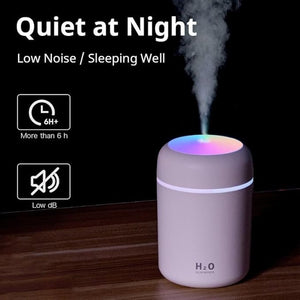
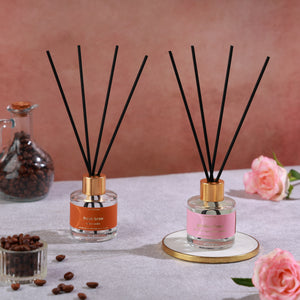
Third, and only then, add the scent layer — and dose it low. Two people in a small room means two noses that will be lying inside your decision for eight hours. A reed diffuser from ₹749 on three or four reeds rather than six, on the far side of the room from the bed, is the right shape of answer: continuous, quiet, no electricity, nothing to switch. Reed count is the volume control, so a shared bedroom does not need a bigger bottle, it needs a smaller dial setting. If one of you is more sensitive than the other, the Sukoon at ₹1,899 is the fairer option — 3–6 drops of the water-based Hotel Collection from ₹299, run for an hour in the evening and off at bedtime. It covers roughly 270–320 sq ft, which is generous for a bedroom. The two liquids are not interchangeable.
What to do, in order
Three free steps that do the actual work, then one purchase that finishes it. In a shared room the first three simply need to be done more often than a single sleeper would need.
| Step | What to do | When | Cost |
|---|---|---|---|
| 1. Remove the source | Worn clothes into a basket, damp towels out, en-suite door shut at night, water down rarely-used drains weekly | Before anything else | ₹0 |
| 2. Move the air | Duvet thrown fully back and ten to fifteen minutes of window-and-door cross-ventilation every morning | Daily, five to ten minutes | ₹0 |
| 3. Deal with what holds it | Sheets and pillowcases weekly, protectors on both pillows washed monthly, mattress aired each season | Weekly to monthly | ₹0 |
| 4. Then the always-on layer ★ | A SOSA reed diffuser — a quiet continuous background on three or four reeds, placed away from the bed | 50ml 6-8 weeks · 130ml 14-18 | from ₹749 |
| 5. Or the on-demand layer | Sukoon with a Hotel Collection scent — scent for an hour in the evening and silence overnight — fairer when one of you is more sensitive | Run it when you want it | ₹1,899 |
Versailles
The first thing I want to say about this question is that people ask it apologetically, and they should not. Two people sleeping in a bedroom produce more than one person sleeping in a bedroom. That is all that is happening. It is arithmetic, not a verdict on anybody. I have had customers describe elaborate washing routines to me before getting to the actual problem, which was a shut door, a made bed and a fortnightly sheet change.
The lever most couples miss is the pillow. Sheets get changed because they are visible and because changing them feels like the job. The pillow underneath sits in contact with a face and hair for eight hours a night for years, and in a shared bed there are two of them. A washable protector costs very little and turns an unwashable object into a washable one. If you do one thing after reading this, do that.
And when you get to fragrance, remember there are two people in the decision. A bedroom is the only room where you cannot walk away from a scent you have overdone, and in a shared room you have doubled the number of people who cannot walk away. Three reeds, across the room, and check with the other person rather than with your own adapted nose. A portion of every order funds a girl's classroom through Nanhi Kali.
Frequently asked questions
- Fine at night, weird by morning — the eight-hour accumulation curve.
- Why pillow and bedding decide how a bedroom smells — the deepest reservoir in the room.
- Eight hours with the AC on — why cooling is not ventilating.
- Fresh without being perfumed — restraint as the technique.
- Brand: the SOSA founder story.
SOSA products & prices (verified August 2026): Hotel Collection water-based ultrasonic diffuser fragrance 15ml ₹299 · 100ml ₹999 · 300ml ₹1,799 · Pack of 7 (15ml, all fragrances) ₹1,799; refills 100ml from ₹999. Seven scents: The Ritz-Carlton-inspired (white tea · bergamot · cedar), Westin-inspired (white tea · aloe · cedar), 1 Hotels-inspired (cedarwood · vetiver · green leaves), The St. Regis-inspired (amber · violet · woods), Shangri-La-inspired (jasmine · green tea · white tea), Four Seasons-inspired (citrus · floral · sandalwood), W Hotels-inspired (citrus · pepper · amber). Diffusers: Boond 300ml ₹899 · Sukoon 500ml ₹1,899 · Megh 6L ₹3,499. Water-based, phthalate-free, composed to IFRA standards for home diffusion; 3–6 drops per tank. Made in India, Pune. The Hotel Collection scents are SOSA's own interpretations inspired by the world's finest hotels; all hotel names are trademarks of their respective owners and are used only to describe the scent style — SOSA is an independent Indian fragrance house, not affiliated with or endorsed by any hotel brand. Prices and availability subject to change — see the live product pages.