



How the timing works: a slug of water falling down a shared stack pushes air ahead of it and pulls a partial vacuum behind it. If the vent cannot relieve that, it relieves through your water seal — bubbling gas up through it, or siphoning it away.
The likely root cause: a blocked, capped or undersized vent terminal, usually at roof level, and usually the society's to fix.
This is plumbing. Do not scent it.
2. Because that pressure has to go somewhere. A correctly designed drainage system gives it somewhere: a vent pipe that runs up past the highest fixture and terminates in open air, letting the stack breathe. When the vent is blocked, capped over during a waterproofing job, or was never adequate, the pressure equalises through the path of least resistance instead. The path of least resistance is the small plug of water in your P-trap.
3. Because a water seal is only a few centimetres of water. Positive pressure pushes air up through the trap; you get a gurgle and a puff of sewer gas into the room. Negative pressure does the more damaging thing — it pulls the plug of water out of the trap and down the pipe, which is called induced siphonage, and leaves the trap dry and permanently open until something refills it. That is why some episodes are a brief whiff and others become a smell that stays for hours.
4. Because it is very often the floor trap, not the basin. Floor traps in Indian bathrooms are shallow, hold less water than a basin or WC trap, and are the first to be emptied by a pressure event or by simple evaporation. They are also the ones nobody thinks about. When the smell is worst at ankle level and improves if you pour a mug of water into the floor drain, you have found both the fixture and the mechanism.
5. And no, this is not something to fragrance. A drain smell means the barrier between your home and the waste system has failed. It is a signal, and it is a plumbing job — often a building-level one involving the society and the vent terminal on the roof. Scent laid over it gives you a perfumed sewer smell and takes away the only warning you had. Fix it, confirm it stays fixed for a fortnight, then scent the room.
Made in India, composed by an ISIPCA Versailles-trained perfumer — and a portion of every order supports girl-child education through Nanhi Kali.

Why a household smell can keep a timetable
Most household smells are continuous, because most sources are continuous. A loaded drain, a damp curtain, an old bin — these produce at a steady rate and the room concentration rises and falls only with ventilation. An intermittent smell is therefore diagnostically valuable: something is switching on and off, and in a bathroom there are very few candidates. If it correlates with your own showering, it is probably biofilm being disturbed. If it correlates with the clock rather than with anything you did, the switch is outside your flat. That points at exactly one system: the shared drainage stack and its ventilation.
The physics is unglamorous and worth understanding once. Water falling down a vertical pipe does not fill it; it clings to the wall and falls as an annulus with an air core down the middle, and it drags that air core along with it. Ahead of a large discharge the air is compressed, behind it the air is rarefied. A vent pipe open to the atmosphere lets the stack draw in and expel air freely, so those swings stay small. Without one — or with one that has been blocked by debris, a bird's nest, or a slab poured over it — the stack has to find its air somewhere else, and every trap connected to it becomes a candidate valve. Your bathroom is not producing the smell. Your bathroom is being used as a pressure relief valve by the rest of the building.
Three ways a water seal fails, and how to tell which one you have
 Only after the fixFrom ₹749A large discharge passing your branch connection creates suction behind it and drags the water out of your trap down into the stack. The tell is a distinct gurgle at your floor drain or basin at the moment a neighbour flushes, followed by a smell that then persists rather than passing. The trap is now dry and is not a barrier at all. Short-term, pour a mug of water into every drain in the room to re-establish the seals. Long-term this recurs until the venting is corrected, because the same suction will empty them again tomorrow.
Symptom to cause: reading the timing
The timing and the sound are your two best pieces of evidence here. Match what you actually observe against these rows before you call anyone, because it changes who you need to call — a plumber for your flat, or the society for the stack.
| What you notice | Most likely cause | How to confirm it | What actually fixes it |
|---|---|---|---|
| Early morning and mid-evening, most days ★ | Peak building water use surging the shared stack | Log three days of times; ask a neighbour on another floor if they get it too | Vent inspection at roof level. A plumbing and society job, not a cleaning one. |
| A gurgle at your drain, then the smell stays | Induced siphonage — the water seal has been pulled out | Pour water in, wait an hour, pour again and listen for a hollow splash | Refill traps now; correct the venting so they stop emptying |
| A bubble and a sharp whiff, then it passes | Back-pressure pushing stack air up through an intact seal | Note whether the trap still holds water immediately afterwards | The vent, again. Refilling the trap will not help. This is plumbing. |
| Only after you run the washing machine | Your own discharge siphoning a nearby trap, or an unsealed machine outlet | Run a cycle deliberately and stand in the bathroom as it drains | A properly trapped and sealed washing-machine standpipe |
| Worse after the flat has been shut for a few days | Evaporation emptying a rarely-used floor trap or second bathroom | Pour a mug of water in and see whether it clears within the hour | A mug of water down every unused drain weekly; ask someone to do it when you travel |
| Constant, not timed, and more sour than sulphurous | Biofilm inside the waste pipe rather than a seal failure | Smell at the floor trap with the grating lifted out | Brush inside the pipe, hot water and soda, clear the hair catcher weekly |
| If none of these fit: take the grating off your floor trap and look straight down with a torch. If you can see a clear open pipe with no standing water in a bend, there is no seal there at all — either it has been emptied, or that outlet was never trapped. Both are plumbing conversations and neither is your fault. | |||
Reeds · always-on roomsFrom ₹749Shop →  Sukoon · when you want a switch₹1,899Shop →
  Hotel Collection · the scentFrom ₹299Shop →
What to actually do about it, in order
First, gather three days of evidence, because it costs nothing and it changes the conversation. Note the exact times it occurs, which part of the room it is strongest in, whether you heard water moving in the wall in the seconds before, and whether anyone in the flat used water at that moment. Then run two deliberate tests. Empty a full bucket fast down your own floor trap and see whether the smell follows. Run the washing machine and stand in the bathroom while it discharges. Finally, ask one neighbour above and one below whether they get the same thing at the same hours. A pattern shared across floors is close to proof that the problem is the stack.
Second, do the two things you can do yourself. Pour a mug or two of water into every drain in the flat that you do not use daily — floor traps, the second bathroom, the utility outlet — and repeat weekly. That rules evaporation in or out within a day. Then get under the basin with a torch and check the trap is present, sound and tight, and check that any washing-machine hose enters a properly trapped standpipe rather than being pushed into an open floor drain. If the smell disappears after refilling and stays away for a week, your problem was evaporation and you are finished.
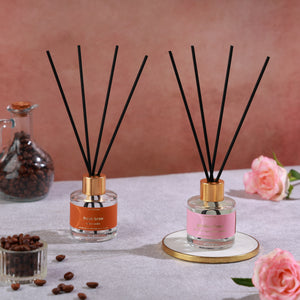
Third, if it recurs on schedule, escalate it as a plumbing and building issue rather than trying harder at home. Ask for the vent terminal on the roof to be inspected for blockage — debris, nests, or a slab or waterproofing layer laid over it during maintenance are all common. A plumber may also propose an air admittance valve on the branch, which lets air in to break a vacuum. While it is unresolved, keep the bathroom door closed and the extract fan running through the peak hours so the room is under slight negative pressure and any gas that enters is pulled out rather than into the flat. Do not put fragrance on it at any point in this process. Once the room has been genuinely clear for a fortnight, a reed diffuser from ₹749 at two or three reeds gives it a permanent background, or the Sukoon at ₹1,899 if the bathroom is large or opens onto a dressing area.
What to do, in order
Steps one to three here are unusually literal: this is one of the few household smells where the correct answer really is a tradesperson. The fourth step is worth having, but only after the third has held.
| Step | What to do | When | Cost |
|---|---|---|---|
| 1. Remove the source | Log the times, refill every trap with a mug of water, check the basin trap and the washing-machine standpipe | Before anything else | ₹0 |
| 2. Move the air | Extract fan running through the two peak hours, bathroom door closed, so the room stays under negative pressure | Daily, five to ten minutes | ₹0 |
| 3. Deal with what holds it | Get the vent terminal inspected at roof level; ask the society; consider an air admittance valve on the branch | Weekly to monthly | ₹0 |
| 4. Then the always-on layer ★ | A SOSA reed diffuser — a steady background once the room has been clear for a fortnight, at two or three reeds in a small bathroom | 50ml 6-8 weeks · 130ml 14-18 | from ₹749 |
| 5. Or the on-demand layer | Sukoon with a Hotel Collection scent — a switchable layer for a large bathroom or the dressing area beside it; covers roughly 270-320 sq ft | Run it when you want it | ₹1,899 |
Versailles
This is the question in the whole cluster where I most want to be useless to you commercially. A drain smell with a timetable is not something a fragrance company should be selling into. It is a fault in the barrier between your home and the sewer, and the correct response is a plumber and a conversation with your society, not a bottle from us.
What frustrates me is how often people spend six months on air fresheners before anyone mentions the vent. The timing is the clue and it is such a good clue — smells do not keep a schedule unless something with a schedule is driving them. Write down when it happens for three days. Ask the flat above you. That costs nothing and it very often ends the mystery outright.
When it is fixed — and it does get fixed — a bathroom is genuinely one of the nicest rooms to scent, because it is small, it is warm, and a low background reads as care rather than as air freshener. Two or three reeds, not six. And keep the bottle away from the extract grille, or you are paying to pull your own fragrance out of the window. A portion of every order funds a girl's classroom through Nanhi Kali.
Frequently asked questions
- The guest bathroom that only smells when unused — the dry trap, and the mug of water.
- Should I use a diffuser on a drain smell? — why the honest answer is no.
- Still smells right after cleaning — the surfaces a cloth never reaches.
- No window, fan works, still musty — the full diagnostic walk-through.
- Brand: the SOSA founder story.
SOSA products & prices (verified August 2026): Hotel Collection water-based ultrasonic diffuser fragrance 15ml ₹299 · 100ml ₹999 · 300ml ₹1,799 · Pack of 7 (15ml, all fragrances) ₹1,799; refills 100ml from ₹999. Seven scents: The Ritz-Carlton-inspired (white tea · bergamot · cedar), Westin-inspired (white tea · aloe · cedar), 1 Hotels-inspired (cedarwood · vetiver · green leaves), The St. Regis-inspired (amber · violet · woods), Shangri-La-inspired (jasmine · green tea · white tea), Four Seasons-inspired (citrus · floral · sandalwood), W Hotels-inspired (citrus · pepper · amber). Diffusers: Boond 300ml ₹899 · Sukoon 500ml ₹1,899 · Megh 6L ₹3,499. Water-based, phthalate-free, composed to IFRA standards for home diffusion; 3–6 drops per tank. Made in India, Pune. The Hotel Collection scents are SOSA's own interpretations inspired by the world's finest hotels; all hotel names are trademarks of their respective owners and are used only to describe the scent style — SOSA is an independent Indian fragrance house, not affiliated with or endorsed by any hotel brand. Prices and availability subject to change — see the live product pages.