



Why it seems to return: your cleaner is a scent with a twenty-minute life. It did not remove the source, it out-shouted it briefly.
If it smells of sewer rather than of dirt: that is a water-seal failure, which is a plumbing job. Do not clean it and do not scent it.
The order: reach the real surfaces, dry the room, then scent it — two or three reeds, not six.
2. Because the WC has a channel you have never seen. Under the lip of the bowl is a horizontal rim channel that distributes flush water. It is permanently wet, never dry, never scrubbed and, in most homes, never looked at. Run a finger along the underside of the rim. If what comes back is slimy rather than clean porcelain, you have found a meaningful part of your smell. A brush that only goes down into the bowl has never once cleaned this.
3. Because grout and silicone are porous and permanently damp. Cement grout is a sponge with a hard face. It takes up water, holds it, and holds whatever organic matter came with it. Silicone beading around the shower tray and behind the basin does the same at its edges. Both dry very slowly in a bathroom, which means both host growth more or less continuously. A mop passes over the top of grout without going into it.
4. Because your cleaner is a scent with a short life. Floor cleaners and bathroom sprays are perfumed to be noticeable on application. That scent decays over roughly twenty minutes. The underlying smell did not go away and come back — it was simply the quieter of two smells for a short while. If a room smells clean only during and just after cleaning, you have not removed anything.
5. And if it smells of sewer, stop cleaning. A sulphurous, eggy, unmistakably drain-like smell is not dirt. It means the water seal in a P-trap somewhere in the room has failed — evaporated, siphoned out, or bypassed — and gas from the waste system is entering the room. That is a plumbing job. It is not a cleaning failure and it is absolutely not something to put fragrance on.
Made in India, composed by an ISIPCA Versailles-trained perfumer — and a portion of every order supports girl-child education through Nanhi Kali.
Why the surfaces you clean are not the surfaces that smell
Think about what you actually touched during that clean. The floor, the outside of the pan, the seat, the basin bowl, the mirror, maybe the tiles to shoulder height. Now think about the wetted surface area of the room as a whole: every one of those, plus the inside of the basin waste, the inside of the floor trap, the inside of the shower waste, the rim channel of the WC, the underside of the seat hinges, the full depth of every grout line, and the edges of every run of silicone. The parts you can reach with a cloth are a minority of the parts that stay wet, and staying wet is the only qualification a surface needs in order to smell.
That is the second half of the answer. A bathroom is the one room in the house where water is permanently available, which means it is the one room where biofilm is permanently in play. Biofilm is a thin bacterial layer that establishes on any surface that does not dry out; it feeds on soap residue, skin, hair and toothpaste, and it produces sulphur and amine compounds as it works. That is the sour, faintly cheesy note under a bathroom smell. It regrows within days, which is why bathroom odour behaves like a rate rather than an event — knock it back on Sunday and it is measurable again by Thursday. Cleaning the exposed surfaces resets a small part of the population and leaves the sheltered part entirely alone. Getting into the drain, the rim and the grout once is worth more than wiping the floor five times.
The three places a cloth never reaches
 Step fourFrom ₹749Lift the grating out of the floor trap and look at the underside of it, then look at the pipe wall just below. In most Indian bathrooms both are coated. The same is true inside the basin waste and inside the shower outlet. This coating sits above the water seal, so it is in contact with room air at all times and vents straight up into the room. Pouring cleaner down the drain mostly misses it, because liquid runs down the centre. What reaches it is a bottle brush or a drain brush, physically, followed by a kettle of very hot water and a cup of soda. Clear the hair catcher every week rather than every month.
Symptom to cause: reading a bathroom smell
The character of the smell tells you which of the four bathroom systems has failed. Work down until a row matches what you actually notice, and use the confirmation column before you act — the wrong guess here means cleaning the same thing every weekend.
| What you notice | Most likely cause | How to confirm it | What actually fixes it |
|---|---|---|---|
| Sour or cheesy, worst near the floor ★ | Biofilm inside the floor trap and on the underside of the grating | Lift the grating out and smell at the opening with a torch | Brush the pipe wall physically, then hot water and soda; clear hair weekly |
| Smell strongest when you lean over the WC | Loaded rim channel under the lip, or the seat hinges and bolt caps | Run a gloved finger under the rim and look at what comes back | An angled-neck brush into the rim; unscrew and clean the seat fixings |
| General mustiness, grout looks grey or spotted | Growth established in porous grout and at the edge of silicone | Scrub one small grout line hard and compare it with its neighbour | Stiff narrow brush worked into the grout; cut out and replace blackened silicone |
| Clean for twenty minutes, then the same as before | Nothing was removed — the cleaner's own perfume simply decayed | Clean without any perfumed product and see what the room smells like bare | Reach the drain, rim and grout properly; stop judging the room during a clean |
| Sulphurous, eggy, unmistakably like a sewer | A failed water seal in a P-trap — not a cleaning problem | Check whether the trap is dry, and whether it worsens after a big flush upstairs | Refill the trap; if it recurs, this is a plumbing job. Never scent it. |
| Dark patches spreading on the ceiling or wall | Mould from persistent condensation — a health issue | Look above the shower and in the corner furthest from the extract fan | Fix the ventilation and remove the growth. Fragrance is not relevant here. |
| If none of these fit: clean the room with unperfumed product only, dry it completely, shut the door for two hours and then walk in from outside. Whatever you smell at that first breath is the real, unmasked baseline, and it is usually much easier to place than the version you have been sniffing at all week. | |||
Reeds · always-on roomsFrom ₹749Shop →  Sukoon · when you want a switch₹1,899Shop →
  Hotel Collection · the scentFrom ₹299Shop →
The cleaning that actually reaches the source
Start with the drain, because it is the most likely single source and the least likely to have been done. Lift the grating out of the floor trap and scrub both faces of it. Push a drain brush or a long bottle brush down into the pipe and work it around the wall for a good thirty seconds — you are trying to physically remove a film, not dissolve it. Do the same at the basin waste and, if you can, the shower outlet. Follow with half a cup of bicarbonate of soda and a kettle of very hot water down each one. Then take out the hair catcher, clear it, and put it back. Repeat the brushing monthly and the hair clearing weekly; it is the single highest-value ten minutes in bathroom maintenance.
Then the rim and the grout, which are both about tools rather than effort. Buy an angled-neck toilet brush, get it up into the rim channel and work all the way round; do this every week from now on. Unscrew the seat once and clean the hinges and the bolt caps properly, then refit. For grout, use a narrow stiff brush and a bathroom cleaner, work along the lines rather than across them, and rinse. Where a silicone bead has gone black at the edges, accept that it is finished — the growth is inside the material — and replace it. While you are at it, wash the bath mat, empty the water out of the toilet-brush holder, and hang the mop somewhere it will actually dry.
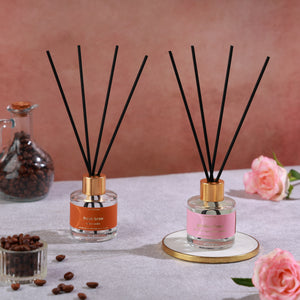
Then dry the room, and only then scent it. Run the extract fan for fifteen to twenty minutes after a shower rather than switching it off with the light, squeegee the shower walls and the floor, and leave the door ajar afterwards so the room can dry rather than sitting saturated. A bathroom that dries between uses grows very much less of everything. Once that is habitual and the room smells of nothing at all when you walk in from outside, a reed diffuser from ₹749 gives it a constant, low background with no electricity and nothing to switch on. Use two or three reeds, not six — a bathroom is small, warm and humid, all three of which raise both evaporation and perceived intensity, and six reeds in a 40 sq ft room reads as an air freshener rather than as a scent. Keep the bottle away from the direct line to the extract grille, or you are simply extracting your fragrance.
What to do, in order
The first three steps are where the smell actually goes away, and they cost nothing but a drain brush and an angled toilet brush. The fourth is the one you buy, and it works properly only after the others.
| Step | What to do | When | Cost |
|---|---|---|---|
| 1. Remove the source | Brush inside the floor trap, basin waste and shower outlet; clear the hair catcher; hot water and soda down each | Before anything else | ₹0 |
| 2. Move the air | Run the extract fan fifteen to twenty minutes after every shower, not just while the light is on | Daily, five to ten minutes | ₹0 |
| 3. Deal with what holds it | Angled brush into the WC rim weekly, stiff brush into the grout, replace blackened silicone, wash and dry the mat | Weekly to monthly | ₹0 |
| 4. Then the always-on layer ★ | A SOSA reed diffuser — a constant quiet background in a small wet room, no electricity and nothing to switch, at two or three reeds | 50ml 6-8 weeks · 130ml 14-18 | from ₹749 |
| 5. Or the on-demand layer | Sukoon with a Hotel Collection scent — scent on demand for a large bathroom or the dressing area next to it; covers roughly 270-320 sq ft | Run it when you want it | ₹1,899 |
Versailles
The first thing I ask anyone with this complaint is whether they have ever put a brush physically inside the floor trap. Almost nobody has. We clean bathrooms visually — we clean until the room looks right — and a bathroom's smell has very little to do with how it looks. A gleaming bathroom with a loaded drain will smell worse than a slightly tired one with a clean drain, every time.
The second thing I ask is whether the smell is sour or sulphurous, and people find that a strange question until they think about it. Sour is organic and it is yours to clean. Sulphurous is a drain, which means a water seal has failed somewhere, which means a plumber. I would rather send you to a plumber than sell you a diffuser, because a diffuser over a sewer smell gives you a scented sewer smell and takes away the signal that was telling you something in the plumbing needed attention.
When the room is genuinely clean and it dries between uses, then yes, a reed diffuser in a bathroom is one of the best-value things we sell — it runs continuously, needs no socket, and a bathroom is small enough that a 50ml bottle lasts. But use two or three reeds. People buy for a bathroom and put all six in out of habit, then wonder why the room announces itself from the corridor. A portion of every order funds a girl's classroom through Nanhi Kali.
Frequently asked questions
- Drain smell only at certain times of day — pressure changes in the stack.
- Musty even with an exhaust fan — why a fan alone is not ventilation.
- Should I use a diffuser on a drain smell? — the honest answer is no, not yet.
- Keeping a bathroom good permanently — the routine that holds it.
- Brand: the SOSA founder story.
SOSA products & prices (verified August 2026): Hotel Collection water-based ultrasonic diffuser fragrance 15ml ₹299 · 100ml ₹999 · 300ml ₹1,799 · Pack of 7 (15ml, all fragrances) ₹1,799; refills 100ml from ₹999. Seven scents: The Ritz-Carlton-inspired (white tea · bergamot · cedar), Westin-inspired (white tea · aloe · cedar), 1 Hotels-inspired (cedarwood · vetiver · green leaves), The St. Regis-inspired (amber · violet · woods), Shangri-La-inspired (jasmine · green tea · white tea), Four Seasons-inspired (citrus · floral · sandalwood), W Hotels-inspired (citrus · pepper · amber). Diffusers: Boond 300ml ₹899 · Sukoon 500ml ₹1,899 · Megh 6L ₹3,499. Water-based, phthalate-free, composed to IFRA standards for home diffusion; 3–6 drops per tank. Made in India, Pune. The Hotel Collection scents are SOSA's own interpretations inspired by the world's finest hotels; all hotel names are trademarks of their respective owners and are used only to describe the scent style — SOSA is an independent Indian fragrance house, not affiliated with or endorsed by any hotel brand. Prices and availability subject to change — see the live product pages.