
 Reed oil refill 300ml ₹2,399
 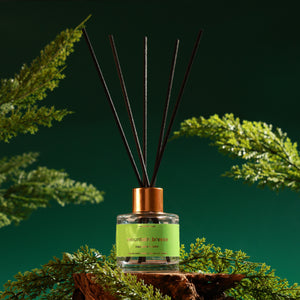 Mountain Breeze ₹849
  Sukoon ₹1,899
 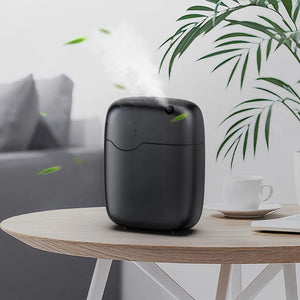 Vaayu ₹11,999
  Hotel Collection 300ml ₹1,799
Bottles bought at different times run on different curves. Each has a days 1–3 spike, a one-to-two-week settle and then a long plateau. Three staggered purchases means three phases running at once, which is felt as a room that never settles.
The running cost has probably already passed the machine. 3 × ₹1,349 = ₹4,047 per cycle, 52 ÷ 16 = 3.25 cycles a year, 3.25 × ₹4,047 = ₹13,153 a year. A Sukoon is ₹1,899 once.
Before buying anything, rule out the building. In an under-ventilated reception a fourth source reads as weight rather than fragrance, and no product at any price fixes air exchange.
2. Where the zones do meet, they add — and that is the only place anything changes. The overlap regions receive from two bottles at once, which is felt as a heavy strip, usually across the walking route. So the effect of buying more is a less even room, not a more even one.
3. Three bottles bought at different times are on three different curves. Every bottle spikes for one to three days as dry reeds saturate and top notes leave, settles over the next week or two, then holds a long plateau. Stagger three purchases and the building always has one of each phase running.
4. A fourth bottle is a fourth of everything. A fourth zone, a fourth overlap, a fourth reorder date, a fourth thing to flip weekly. It is the definition of buying activity instead of a result.
5. Do the annual arithmetic once, because it is decisive. Three 130ml at ₹1,349 is 3 × ₹1,349 = ₹4,047 a cycle. A 130ml runs 14–18 weeks; at sixteen weeks that is 52 ÷ 16 = 3.25 cycles a year, so 3.25 × ₹4,047 = ₹13,153 a year. Switching to oil-only refills brings it to 3 × 130ml = 390ml a cycle, 3.25 × 390 = 1,268ml a year, at ₹7.00 a millilitre from the 500ml = ₹8,873. Both figures are larger than one machine bought once.
6. The honest ceiling for reeds is around 250–300 sq ft of connected open volume. A large clinic reception is past it. Above that the answer is one Sukoon ₹1,899 covering 270–320 sq ft; above roughly 320 sq ft on one unbroken air path, one Vaayu ₹11,999 — for under 38 dB, a key-lock and scheduled run windows rather than for reach.
7. Rule out the building before you buy the machine. If your reception has not exchanged air with outside since it opened this morning, more sources will read as weight rather than as fragrance, and that is true at ₹849 and at ₹11,999 alike. A fortnight of a deliberate mid-morning and mid-afternoon airing routine costs nothing and settles the question.
8. The standing rules do not change with the format. The clinical pathway stays fragrance-free; the correct intensity in a clinic is lower than in any retail or hospitality space; a fragrance-free seat must genuinely exist; reception staff set the level. If you go to a Vaayu, freestanding only — never ducted into shared HVAC — and confirm current refill availability with SOSA first, because there is no separate cold-air refill oil on sale at the time of writing. Composed and made in small batches in Pune; a portion of every order supports girl-child education through Nanhi Kali.

Part one — the three reasons three bottles do not add up
There is a geometric reason, a temporal reason and a financial one, and they are independent — fixing any one of them leaves the other two intact. Together they are why the fourth bottle is the single least productive purchase available to a large clinic.
 Reed oil refill₹2,399 / 300ml · oil onlyEvery reed diffuser follows the same curve. Days one to three are a spike, because the reeds are dry and drink hard and the lightest top notes are leaving all at once. The next week or two is a settle. After that comes a long plateau which holds until the bottle is finished — and the plateau, not the spike, is the product. One bottle, and you learn that curve once. Three bottles bought on three different dates, which is what happens when a practice adds them as a response to dissatisfaction, and your reception permanently contains one bottle spiking, one settling and one plateauing. The room is never in a steady state, so nobody can tell you what it smells like — the honest answer is that it depends which week you ask. That is also why the "it stopped working" complaint arrives so reliably about ten days after each new bottle: the spike set an expectation, the plateau is the reality, and the difference between them gets read as decline. The clinic-relevant fix is duller and better. Run fewer sources, start them together, judge the room in week three rather than week one, and use somebody who has been outside for fifteen minutes as your instrument rather than your own nose, which adapts to a constant within minutes and adapts hardest where you spend your day.
Part two — the bottle ladder, costed
Every rung, with the arithmetic shown. Read down the annual column and the decision usually makes itself somewhere around row three.
| The step | Up-front | Yearly, with the arithmetic | What it delivers | Can it be switched off? |
|---|---|---|---|---|
| Three 130ml bottles, replaced ★ | 3 × ₹1,349 = ₹4,047 | 52 ÷ 16 = 3.25 cycles × ₹4,047 = ₹13,153 | Three zones, three overlaps, gaps unchanged | No — only carried out by hand |
| One 50ml bottle | ₹749–₹849 | 6–8 weeks a bottle; 52 ÷ 7 = 7.4 bottles ≈ ₹5,543 at ₹749 | One deliberate zone at the desk | No |
| One 130ml bottle | ₹1,249–₹1,349 | 52 ÷ 16 = 3.25 × ₹1,349 = ₹4,384 | The same zone, three times as long | No |
| Three bottles kept on oil refills | Vessels already owned | 3.25 × 390ml = 1,268ml × ₹7.00 = ₹8,873 | Identical performance, about a third less spent | No |
| A fourth bottle | +₹1,349 | +₹4,384 a year on the same basis | A fourth zone and a fourth overlap | No — and now four flip dates |
| One Sukoon ₹1,899 | ₹1,899, or ₹1,899 + ₹1,799 = ₹3,698 with a 300ml | Oil use depends on setting; no per-day figure is published | 270–320 sq ft from one point, one level | Yes — steady, 2H, 4H, and a remote |
| One Vaayu ₹11,999 | ₹11,999, 400ml oil included | 400ml ÷ 90 days = 4.4ml a day at a mid setting | Under 38 dB, key-lock, 1h/4h/8h/24h windows | Yes, and it can be locked at a level |
| The honest caveat: every yearly figure above is arithmetic on published bottle-life ranges at six reeds, not a measurement, and real intervals vary with temperature, humidity, air movement, reed count and how often reeds are flipped; no bottle-life figure is published below six reeds, and running two of six — which is what I would do in a clinic — will extend every interval and lower every annual figure well below what is shown. No per-day or per-year oil consumption figure is published for the Sukoon, and none is invented here. No claim is made that scenting affects ratings, reviews, footfall, patient numbers, revenue or any business or clinical outcome; this is a comparison of what things cost, not of what they return. Nothing on this page is medical, clinical, ventilation, air-handling, infection-control, accreditation or regulatory advice. No SOSA product or setting is described as safe or unsafe for any patient or staff group; some people are sensitive to airborne fragrance, which is why the clinical pathway stays fragrance-free and why a fragrance-free seat must genuinely exist. SOSA publishes no bulk or commercial pricing, corporate account, maintenance contract, installation service, warranty term, delivery window or multi-site programme — ask through the contact page before committing. | ||||
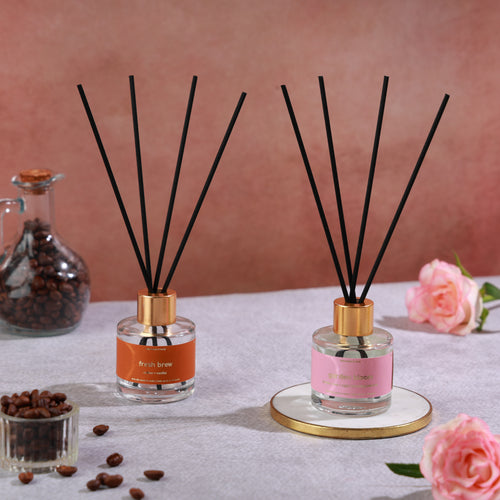 Oil refill · ₹7–8 a millilitre₹2,399Shop → Sukoon · one source, one level₹1,899Shop →
 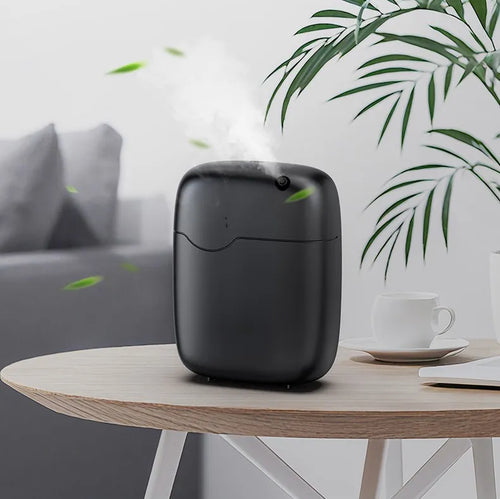 Vaayu · scheduled, locked, under 38 dB₹11,999Shop →
Part three — when it is the building rather than the bottles
Before you replace three bottles with a machine, there is one alternative explanation that has to be ruled out, because if it is true then the machine will disappoint you exactly as the bottles did. A large clinic reception that reads of nothing may not be under-supplied. It may be a room whose air is doing something that no source can overcome — or, in the opposite and commoner case, a room that is retaining everything so evenly that your own noses have simply stopped reporting it. Take the second one first, because it costs nothing to test and it is the single most frequent explanation for "we have three and still notice nothing". Olfactory adaptation removes a constant from awareness within minutes, and it is strongest in the place you spend the most time, which for your reception staff is precisely the room in question. So the instrument has to be somebody who has been out of the building for fifteen minutes and who walks back in through the patient door without being told what to look for, writing one sentence before speaking to anybody. Do it at four in the afternoon, three times across a fortnight. If those sentences report a pleasant, clean entrance, then your three bottles are working and the problem was the measurement.
The first case is the one that ends in spending nothing. A reception with no openable window on the patient side, a front door onto an internal corridor, one recirculating system and no deliberate air exchange between opening and closing is a room in which everything added accumulates and nothing leaves — and in that room extra sources produce weight rather than freshness. Practices in this situation describe the result oddly: not "stronger", but "closed", "heavy", "stuffy with a smell in it". Then they lower everything, adapt within a fortnight, decide the room has gone flat, and raise it past where it started. If any of that sounds like your building, the honest project is free and comes before any purchase: two openings on opposite sides of the arrival zone held open together for ten to fifteen minutes, mid-morning and mid-afternoon, every day for a fortnight, with the cold-nose check running through it. Whether your air handling should be doing something different is a real and important question that belongs entirely to your own clinicians and facilities contractor — I will not offer a view on ventilation in a healthcare building, and I would be wary of anyone in my trade who did. What I can tell you is where my range stops, and it stops here: fragrance adds a scent to the air you have. It does not clean, purify, filter or freshen it, SOSA sells no air purifier and no dehumidifier, and no price tier changes any of that.
There is a third possibility worth naming because it is specific to clinics. Sometimes three bottles read as nothing because they are all sited badly for the same reason — near AC supply grilles, on the counter under a vent, in the draught of a door — and are being stripped and carried away as fast as they evaporate. The tell is the oil level: bottles emptying in four or five weeks instead of six to eight, in a room that still reads thin. That is a placement problem with a free fix, and it is worth an afternoon before any order. Move each bottle two metres out of the airflow, off the counter, onto a tray at waist to chest height with clear space around it, out of direct sunlight, away from every return grille and well back from the corridor to consultation. Flip all six reeds with gloves at the same time. Then leave everything alone for a fortnight — no adjustments, no additions — and run the cold-nose check three times. In roughly half the practices I have taken through this sequence, the answer arrived without a purchase. In the other half, the reception was genuinely large, the bottles genuinely could not hold it, and the machine was the right call — but at least it was a call made on evidence rather than on the fourth bottle in a row.
Part four — the stopping rule, symptom by symptom
Match your symptom, do the free thing first, and note the last column. Four of these eight rows resolve without buying anything at all.
| The report from the desk | What it is really telling you | The free move, in order | The purchase it justifies, if any |
|---|---|---|---|
| Three bottles, still patchy across a large reception ★ | Past the reed ceiling of ~250–300 sq ft | Cold-nose check at 4 p.m., three times in a fortnight | One Sukoon ₹1,899 — and remove two bottles |
| A heavy strip on the way in, thin at the seats | Overlap between two sources on the walking route | Remove the bottle nearest the door for a fortnight | Keep one bottle; site it away from the route |
| Staff notice nothing; visitors say it is fine | Olfactory adaptation, not under-supply | Use an outside nose as the instrument, not your own | Nothing. Do not raise a level on an adapted nose |
| Bottles emptying in four or five weeks | Draught — AC supply, door or direct sun | Move each bottle two metres off the airflow | If the rate normalises but the room stays thin, size up |
| The room never seems the same two weeks running | Three bottles on three staggered curves | Start replacements together; judge in week three | One source removes the problem entirely |
| "Closed" or "heavy", rather than weak | An under-ventilated reception | Two airings a day for a fortnight, opposite openings | Buy nothing. The building is the project |
| Spending more each year than a machine costs once | Replacement bottles instead of refills | Switch to oil-only refills: ₹7.00–₹8.00 a millilitre | Move to one machine at the next cycle |
| One connected public volume above ~320 sq ft | A machine problem, and always was | Pace the connected public floor and write it down | Vaayu ₹11,999, freestanding — never HVAC |
Versailles
A practice manager in Gujarat sent me an order for a fourth bottle with a one-line note: "still not enough, please suggest the strongest one." I asked, before processing it, how long the other three had been running and what they had cost over the previous year. He came back a day later having added it up for the first time, slightly winded.
They had spent more in twelve months on replacement bottles than the largest machine I sell costs once, and their reception was still, in his words, "good near the desk and nowhere else". Nobody had done anything wrong. Each individual order had been small enough not to feel like a decision, and each had been made in response to genuine dissatisfaction, which is exactly the sequence that makes this trap so easy to fall into.
We cancelled the fourth bottle. He moved two of the three to other parts of the practice where a small deliberate zone was all anyone wanted, kept one at the desk on two reeds, and took a single machine for the reception at the following cycle. What I would like other practices to take from it is not the product but the habit: once a year, multiply what you are buying by how often you buy it. If a fragrance company will not tell you when its own format has run out of road, the annual total will eventually tell you instead — just more expensively. Composed and made in small batches in Pune, and a part of every order funds a girl's classroom through Nanhi Kali.
Frequently asked questions
- Why a reed is noticeable only at reception — the mechanism behind this page.
- One machine or several zones and 2,000 sq ft and above.
- The 1,000 sq ft threshold and the 1,500 sq ft centre.
- When a clinic genuinely needs a Vaayu — the pillar for this whole family.
- Brand: the SOSA founder story.
SOSA range, specifications and prices used in this guide (verified August 2026): Vaayu ₹11,999 — waterless cold-air nebulisation of undiluted fragrance oil; no water, no heat, no added humidity, no white mineral dust. Coverage up to 1000 m³, about 2,000–3,000 sq ft. 400ml refillable tank lasting roughly 90+ days at a mid setting. Bluetooth app plus onboard controls, 1h / 4h / 8h / 24h run windows, day selection, adjustable intensity, auto-stop and key-lock. Under 38 dB. DC 12V / 1A, 5W. Freestanding or wall / HVAC mount. CE, RoHS and SGS certified. SOSA does not currently sell a separate Vaayu cold-air refill oil; the 400ml supplied in the box is the fragrance available at the time of writing, so a practice planning continuous or multi-site use should confirm current refill availability with SOSA before committing. The water-based Hotel Collection is made for ultrasonic machines and must not be used in a Vaayu. Other machines: Boond 300ml ₹899 (~150 sq ft, ultrasonic) · Sukoon 500ml ₹1,899 (270–320 sq ft, 16–18 hours on low, remote and steady/2H/4H timers, three 15ml fragrances included, ultrasonic) · Megh 6L ₹3,499 (~215 sq ft — a runtime and humidity machine that covers less than a Sukoon, never a coverage upgrade) · Safar ₹3,999 (waterless cold diffusion, cordless, 20ml, about 6.9cm, three speeds, 1/2/3-hour auto-off — sold as a car and travel diffuser, personal-scale only; SOSA publishes no coverage figure for it) · Aangan ₹25,999 (HVAC nebulising, ~8,000–10,000 sq ft) · Meenar ₹38,500 (commercial HVAC, 12,000–18,000 sq ft). Water-based Hotel Collection for ultrasonic machines: 15ml ₹299 · 100ml ₹999 · 300ml ₹1,799 · pack of seven ₹1,799; scents are inspired by the atmosphere of well-known hotels — SOSA is an independent Indian brand and is not affiliated with, endorsed by or supplying any hotel group. Reed diffusers ₹749–₹1,349 (50ml 6–8 weeks, 130ml 14–18 weeks, six fibre reeds, no 100ml size; replacement reeds are not sold separately). Reed oil cannot be used in an ultrasonic machine and Hotel Collection oil cannot be used in reeds. SOSA sells no room spray or home spray — every SOSA spray is a car perfume. Nothing in this guide is medical, clinical or safety advice. A fragrance diffuser adds a scent to the air. It does not clean, purify, filter, sanitise or disinfect air, does not remove or neutralise disinfectant, damp or occupancy smells, and has no effect on comfort, anxiety, waiting time, recovery or any clinical outcome. Some people are sensitive to airborne fragrance, which is why this guide recommends that examination rooms, diagnostic areas, consultation cabins, procedure suites and post-operative areas remain fragrance-free, that a fragrance-free seating option always exist, and that a diffuser is never mounted into shared HVAC in a clinical building. Decisions about clinical policy, ventilation standards, infection control and patient suitability rest entirely with the practice and its clinicians. A persistent stale, damp or disinfectant smell is a ventilation, moisture or cleaning problem — SOSA sells no dehumidifier and no air purifier, and fragrance should never be used to cover one. Coverage, runtime and longevity figures are manufacturer specifications and typical ranges, not guarantees, and vary with room volume, ceiling height, air exchange, occupancy and season. SOSA publishes no commercial or bulk pricing, no corporate account, no annual maintenance contract, no installation service, no stated warranty term and no multi-location programme; warranty length, spare parts, servicing and app platform availability are unconfirmed, and larger or multi-site enquiries should go through the contact page before any commitment. Composed and made in small batches in Pune, India. Free shipping above ₹499. A portion of every order supports girl-child education through Nanhi Kali. Prices subject to change — see the live product pages.