


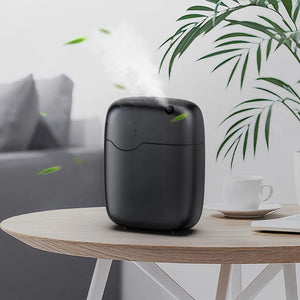
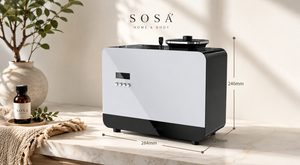
Each unit: 90–120cm up, on glass, stone, laminate or sealed wood, on the airflow line; bedroom units 1.5m from the pillow, on low with the 2H timer.
The constraint people forget: four to six tanks need one walkable refill route, done as a single circuit rather than reactively.
2. Each unit at 90–120cm, on something hard, on the airflow line. Cool mist is denser than room air and descends as it spreads, so a unit on the floor scents the lowest third of a room. A console, sideboard or chest of drawers in glass, stone, laminate or sealed wood, because a fine haze settles within about a foot.
3. Never two units in one open plan. Two Sukoons in a single 450–700 sq ft living-dining overlap in the middle rather than adding their ratings together — the centre gets heavier, the ends stay much as they were, and a bedroom has been left silent to achieve it.
4. The corridor gets no machine. It has no door of its own, nobody stands in it for more than a minute, and it borrows from whichever rooms are open — which is exactly the blending a hotel corridor performs for free. A reed diffuser from ₹749 there is decoration rather than coverage.
5. Place for the refill route, not only for the room. Four to six 500ml tanks want emptying, rinsing and refilling as one deliberate circuit. Put each machine where you can lift it one-handed, near enough to a path you already walk, and not on the one surface in the house that would mind a spill.
A portion of every order supports girl-child education through Nanhi Kali.

The shape: spread to the corners, one per air mass
At one machine the useful question is where this unit goes. At four to six it becomes whether the flat changes as you walk through it, which is a question about the arrangement rather than about any individual position. In a 2,000–3,000 sq ft home with five or six enclosed volumes, the machines should sit at the extremities — the front of the flat, the master bedroom, the far end of the corridor — so that every threshold you cross does something and there is no dead stretch in the middle. Underneath that shape, each unit still obeys the same three rules on its own.
Where each machine goes, room by room
The positions, the settings and the two spaces that still get nothing. Read the last column rather than copying the middle one, because the reasoning travels between flats and the furniture does not.
| Where | The position | Setting | Why there |
|---|---|---|---|
| Living-dining ★ | Central to the volume at 90–120cm on a console — not against an end wall, not beside the kitchen zone | Steady or the 4H timer while people are home | The largest air mass and the one the front door opens into. At 450–700 sq ft this is the one room where placement may not be enough on its own |
| Master bedroom | On a chest of drawers across the room from the pillow, at least 1.5m away | Low, 2H timer | A 160–220 sq ft room is well inside the rating, so the job is restraint. The 2H timer means it has stopped long before the middle of the night |
| Second and third bedrooms | Same rule, on the far side of each room from the bed | Low, 2H timer | Each is a separate air mass with its own door and its own occupant — and its own fragrance, which is the reason there is a machine in each |
| Study or family lounge | At desk height or above, out of the direct line of a laptop and papers | Low or the 4H timer across a working afternoon | It earns a machine on conscious hours rather than floor area. Keep the fragrance dry, since eight hours behind a door punish anything rich |
| The corridor | No machine at all | — | No door of its own and nobody in it for more than a minute. It borrows and blends from the rooms either side, which is the job a hotel corridor does too |
| Bathrooms and the utility | A Boond at ₹899 on a shelf, if anything at all | Low | A 500ml unit rated for 270–320 sq ft in a bathroom is absurd. Extraction, a dry floor and an emptied bin come first, as they always have |
Sukoon · 90–120cm, hard surface₹1,899Shop → 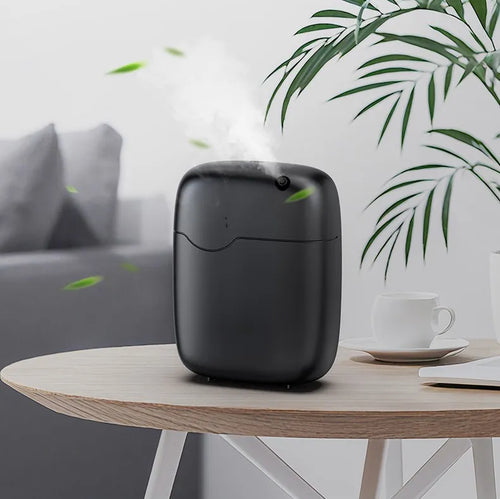 Vaayu · the corridor-fed volume₹11,999Shop →
  Boond · the bathrooms₹899Shop →
Refill logistics as a placement rule
Here is the constraint nobody plans for and everybody eventually meets. Four to six 500ml tanks is somewhere between forty and sixty minutes of accumulated small effort a month, and at that scale where you put the machines determines whether that effort is a ten-minute circuit or an errand you keep postponing. A tank wants emptying, rinsing and a wipe at the misting plate, refilled with filtered or RO water if your city is hard-water — none of which is difficult, all of which is easier when the machine can be lifted one-handed from a surface at 90–120cm rather than crouched over on a floor behind a bed. So place with the route in mind. Put each unit on a clear surface at that height with nothing to move first: not behind a lamp, not wedged between photo frames, not on the shelf that also holds the books. Keep them broadly on a path you already walk — bedroom, bedroom, corridor, living-dining — so one lap of the flat collects all of them. And avoid the one surface in the house that would genuinely mind a spill, because a full 500ml tank travels badly and a fine haze settles within about a foot of the machine anyway, which is why glass, stone, laminate or sealed wood is the recommendation rather than a preference. Do all the tanks on one morning rather than reacting to whichever has run dry — the reactive version is what turns five machines into a rota nobody owns.
The second logistical rule is about how the fragrance moves rather than the water. With four to six tanks there is a real temptation to top up a machine with whatever bottle is nearest, and that is how a considered arrangement becomes several versions of the same muddle. Never layer a new fragrance onto a half-rinsed tank; empty it, rinse it properly, then refill. Keep each room's bottle in that room rather than in one cupboard, so nobody has to remember which character belongs where — this matters far more at five machines than at two, and it is also what makes the autonomy of a machine per bedroom actually work in practice. Buy the running cost sensibly too: a 300ml 300ml refill at ₹1,799 works out at roughly ₹6 per ml against about ₹20 per ml in 15ml bottles and about ₹10 per ml in 100ml, and one bottle of the household's everyday scent serves every tank in the flat for months, which is what keeps a five-machine home from being quietly rationed. And remember what the tanks do not take: the Sukoon is a 2.4MHz water-based unit and thicker essential and carrier oils clog the misting plate, so it runs SOSA's own water-based Hotel Collection fragrance and nothing else.
Which leads to the placement decision that is really a purchasing decision, and I would rather set it out here than pretend the two are separate. The machines that create most of the refill work in a 4BHK are the ones in the common areas, because they run longest, empty fastest and belong to nobody in particular. The bedroom units, by contrast, are easy — a 110–220 sq ft room on low with the 2H timer goes most of a week between fills, and the person who benefits is the person standing next to it. So if you have placed a machine in the living-dining, raised it to 90–120cm, moved it central and onto the front-door-to-balcony line, and it still reads thin at the ends of a 450–700 sq ft open plan, you have arrived at the point where the honest answer changes technology rather than adding another tank. A waterless Vaayu at ₹11,999 is a cold-air nebuliser running undiluted oil with no tank at all, rated for up to 1000m³ of connected space, adding no humidity, under 38dB, and — the part that matters for a room nobody is in at five in the afternoon — carrying a Bluetooth app with genuine scheduling, where the Sukoon's steady, 2H and 4H timers are duration timers that cannot start the machine at a clock time. Place it in that connected volume, keep the Sukoons behind the bedroom doors, and the flat is ₹19,595 with four of them. What it will not do is open a bedroom door, so it is an addition to the placement plan rather than a replacement for it.
The SOSA 4BHK edit
Placement as a shopping list, because half of it is free and the other half is deciding which machine belongs in which kind of volume. The last two rows are the positions to avoid.
| Buy or do | What it does | When it earns its place | Price |
|---|---|---|---|
| 1. Height, hard surface, airflow line ★ | Every unit at 90–120cm on glass, stone, laminate or sealed wood, central to its own volume and on the line the air already takes — the change that does most for coverage | Before buying anything else. It is free and it is the biggest single improvement | Free |
| 2. Four Sukoons, one per bedroom | 270–320 sq ft each, spread to the extremities of the flat, on low with the 2H timer and 1.5m from the pillow — twelve 15ml Hotel Collection bottles between them | One per enclosed air mass somebody is awake in | ₹7,596 |
| 3. Vaayu for the connected volume | Up to 1000m³ with no tank at all, no added humidity, under 38dB and app scheduling — placed in the living, dining and entrance as one space | Only after height and central placement have failed in that room | ₹11,999 |
| 4. Boond 300ml | A bathroom or utility at the right scale, on bottles you already own | Once every room you are awake in has something | ₹899 |
| Not this: two machines in one open plan | Two units overlapping in the middle of a single air mass, with the ends unchanged and a bedroom left silent | Never. Move the first one higher and more central instead | ₹1,899 |
| Not this: a machine in the corridor | Fragrance in a passage nobody stands in, and nothing for the rooms either side | Never. A corridor borrows by design — reeds there are decoration | ₹1,899 |
Versailles
Placement is the part of this I would most like people to take seriously, because it is free and because at four or five machines it is the difference between a home that reads as designed and an expensive set of appliances. The two errors I see most often are opposite in spirit and identical in outcome: everything clustered where the sockets happen to be, or two machines crowded into the one room that felt thin. Both leave a bedroom silent, and in a 4BHK there is always a bedroom far enough away to be forgotten.
Spread them to the corners, one per air mass, at 90–120cm on something hard, on the line the air already takes. Then do the thing almost nobody does before ordering, which is to walk the refill route. Stand at each proposed position and ask whether you would happily lift that tank on a Sunday morning in a bad mood — and if the answer is no, move it, because a machine that is awkward to refill is a machine that will be standing dry by March. That single question has changed more 4BHK setups than any advice I give about fragrance. And if the walk itself is what puts you off, that is worth listening to as well: the common areas are where the tanks empty fastest, and a machine with no tank in it is a perfectly honest answer to that half of the house.
Everything is made and supported from Pune, and a part of every order funds girl-child education through Nanhi Kali. You get a home that smells like somewhere you chose; a girl gets a classroom. That equation has always felt right to me.
Frequently asked questions
- Should you use Sukoon in bedrooms and Vaayu in the living room? — the split, argued properly.
- Best home fragrance diffuser setup for a 4BHK — six configurations, fully costed.
- Should every bedroom in a 4BHK have its own Sukoon? — the autonomy argument.
- The complete SOSA home fragrance buying guide for a 4BHK — the pillar guide.
- Brand: the SOSA founder story.
Facts verified August 2026: SOSA Sukoon — 500ml tank, 2.4MHz ultrasonic cool mist, 270–320 sq ft coverage, 16–18 hours runtime on low and 9–12 on high, 30–50 ml/h mist output, 7-colour LED, remote and steady/2H/4H timers, BPA-free ABS with auto shut-off and overheat protection, ~17cm high — ₹1,899, including three 15ml Hotel Collection fragrances of your choice. Boond 300ml ₹899; Megh 6-litre ₹3,499. Hotel Collection water-based fragrance 15ml ₹299, 100ml ₹999, 300ml ₹1,799, Pack of 7 × 15ml ₹1,799; 100ml and 300ml refills from ₹999. Seven scents: The Ritz-Carlton-inspired (white tea, bergamot, cedar), Westin-inspired (white tea, aloe, cedar), 1 Hotels-inspired (cedarwood, vetiver, green leaves), The St. Regis-inspired (amber, violet, woods), Shangri-La-inspired (jasmine, green tea, white tea), Four Seasons-inspired (citrus, floral, sandalwood), W Hotels-inspired (citrus, pepper, amber). Waterless systems for larger and connected spaces: Vaayu ₹11,999 (up to 1000m³), Aangan ₹25,999 (8,000–10,000 sq ft), Meenar ₹38,500 (12,000–18,000 sq ft). The Hotel Collection scents are SOSA's own interpretations; SOSA is not affiliated with or endorsed by any hotel brand. Prices subject to change — see the live product pages.