


What two reeds still win outright: silence, no socket, nothing to fill or charge, working through a power cut, two different scents in two zones, no device lifespan, nothing that can break, and a lower entry price.
The disclosures I will make every time: Safar is named and sold as a car and travel diffuser; SOSA publishes no room coverage figure for it; its auto-off timer runs one, two or three hours and the battery needs recharging, so it is not set-and-forget. Buy one — never several.
Cheaper first, and it should not be skipped: Sukoon ₹1,899, 500ml, 270–320 sq ft, 16–18 hours on low, three 15ml Hotel Collection scents included. It is very often the right bedroom answer at less than half the price.
Free before either: a ceiling fan on low in a closed room, and halve the distance to where you sit.
2. Two reeds is two zones, and two zones is not one field. Put a bottle at each end of a room and you get a peak here, a peak there, and between them the point that is farthest from both sources at once. That midpoint is usually where the bed or the sofa is. Doubling the emission does not fill the middle; it just makes the two ends busier.
3. The disclosures, which I make every time Safar appears. It is named and sold as a car and travel diffuser, and SOSA's own page describes it for a car, a handbag, a desk, a bedside and a hotel room. SOSA publishes no room coverage figure for it and I will not invent one. Its auto-off timer runs one, two or three hours, and it needs recharging, so it is something you switch on deliberately rather than forget about. Buy one; never buy several.
4. Try the cheaper machine first, because it is very often the right answer. Sukoon at ₹1,899 is an ultrasonic: 500ml tank, 270–320 sq ft, 16–18 hours on low, three 15ml Hotel Collection scents included. It moves air, which is the whole point, at less than half Safar's price. Its costs are the oil being diluted in water, added humidity, a tank to fill, possible white mineral dust in a hard-water city, and a socket. For one bedroom I would not let anyone walk past it.
5. Concede the reeds' rows before deciding. Two bottles are silent, need no power, work in a power cut, need nothing filled or charged, never break, and can run two different scents in two places — none of which any single machine offers. And before either purchase, run the free fixes: ceiling fan on low with the door closed, bottle moved to half the distance, at nose height, out of a draught but not in a dead corner.
Alcohol-free, phthalate-free, paraben-free, IFRA-compliant, 0 ppm formaldehyde, six fibre reeds in a refillable glass bottle, composed in Pune. Free shipping above ₹499, and a portion of every order supports girl-child education through Nanhi Kali.

Two mechanisms, described properly, so the scorecard means something
A reed diffuser is passive capillary diffusion. Oil climbs six fibre reeds by capillary action and evaporates from their surface at whatever rate the room's temperature, humidity and airflow allow. No energy goes in, so no air is moved out. Concentration is therefore highest at the reeds and falls away with distance, in a smooth gradient that perception compresses into what feels like a corner with an edge. That is the design rather than a defect, and it is precisely why the object can sit silently on a table for six to eight weeks with nothing to switch on. It also means the reach of a reed depends on the room and not on the bottle, which is why there is no published figure for how far a reed projects — ours or anybody else's. A brand quoting you a distance in feet is quoting a number for a room it has never seen.
Safar is waterless cold-air diffusion. Pressurised air shatters undiluted fragrance oil into a dry micro-mist, which is then carried by the room's own air currents. The difference in payload matters and is worth understanding: an ultrasonic throws a mixture of oil and water as a visible wet mist, so each droplet is mostly water, while a cold-air nebuliser delivers oil alone as a dry mist — same oil, different payload per droplet, and no added humidity and no white mineral dust. The verified specification is a 20ml bottle, a 2000 mAh battery over Type-C, fully cordless at 6.9 cm, up to ten hours continuous or about thirty hours intermittent per charge, three speeds and a one, two or three-hour auto-off timer. Thick, sticky or water-based blends can clog it.
The clearest way to feel the difference is a question people ask after a good hotel stay: why can I never find the diffuser in the room? Usually because there is not one in the room to find. The scent has been introduced into moving air rather than released from an object on a table, so there is no gradient to walk up and no source to locate — it is simply present in the air you are in. That absence of a findable source is exactly what "projection" means when people use the word, and it is why the answer to your question is a mechanism rather than a quantity.
The three things this scorecard is actually measuring
Before the table, the three axes — because most head-to-head comparisons quietly score one product on one axis and the other on a different one, and that is how readers end up disappointed.
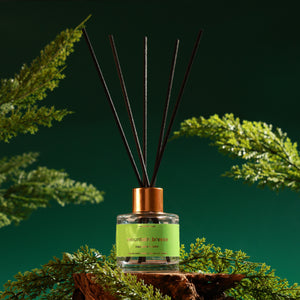
 Mountain Breeze₹849Reed count, bottle size, room temperature and the oil itself all sit on this axis, and two bottles genuinely double it. This is the axis on which extra purchases feel like they ought to work — and on paper they do work, which is exactly why the disappointment is so consistent. A second bottle really is emitting twice as much fragrance into the room. What it is not doing is moving any of it. Emission is the axis you have been buying along; transport is the axis you are short of. Worth knowing on this axis: six reeds is full projection, three is a soft bedside level that roughly doubles the life of the bottle, and if a room has ever felt cloying rather than fragrant, that is over-dosing rather than a wrong scent.
 Sukoon₹1,899Transport requires moving air, and a reed supplies none. On this axis two reeds score exactly what one reed scores, which is nothing — you cannot add transport by multiplying a device that has none. Safar scores here because it does not wait for the room to come and collect the fragrance; it puts a dry micro-mist into the air and lets the room's currents carry it. So does Sukoon, by a different route, at ₹1,899. And so, remarkably, does a ceiling fan on low, which is why I keep insisting people try it before spending anything: a fan is transport, it is already installed, and it costs nothing — though it will shorten the life of the bottle, which is a real trade and yours to make.
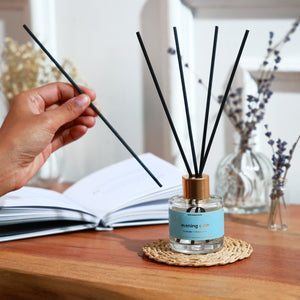
 Evening Calm₹799This is the axis where the reeds take their revenge, and I am not going to soften it. Two bottles are silent, need no socket, need nothing filled or charged, need nothing switched on and nothing remembered, carry on right through a power cut, add no humidity, leave no dust, and never break because there is nothing in them to break. They are objects rather than appliances, which matters more than people expect in a bedroom. Safar, by contrast, has a timer that runs one, two or three hours, a battery to recharge, and the lifespan of a device. If you are the sort of person who resents having to switch something on, weight this axis heavily before you spend ₹3,999.
The head-to-head, scored row by row
Each row scored on its own terms, with the winner named. The reeds win five rows and I am not going to bury them at the bottom. The last row is the gap in our own range, which is real and which I would rather name than sell around.
| Row | Two reed diffusers · ₹1,498–₹1,698 | Safar · ₹3,999 | Winner |
|---|---|---|---|
| Projection across a room | Two peaks, a weak middle. No transport at all | Undiluted oil as a dry mist, carried by the room's airflow | Safar ★ |
| Evenness | Structurally impossible from passive sources | Moved air is the only route to evenness | Safar |
| Control over intensity | Reed count only, and it changes over days rather than seconds | Three speeds and a 1/2/3-hour auto-off timer | Safar |
| Oil delivered undiluted | Yes, but by evaporation rather than into moving air | Yes — no water, no dilution, no added humidity, no mineral dust | Safar |
| Silence | Completely silent | A working device makes some sound | Two reeds ★ |
| Works in a power cut | Yes, and needs no socket at all | Battery-powered, but the battery needs recharging | Two reeds ★ |
| Nothing to fill, charge, switch on or remember | Nothing. Flip the reeds every 3–5 days and that is all | Charging, refilling the 20ml, and switching it on deliberately | Two reeds ★ |
| Two different scents in two places | Effortless — one scent per zone | One oil at a time | Two reeds ★ |
| Nothing that can break | Glass and fibre. It never breaks and has no lifespan | Electronics and a battery, so a device's lifespan | Two reeds ★ |
| Cost of entry | ₹1,498–₹1,698, but recurring at roughly ₹26–₹30 a day | ₹3,999 once, plus oil at a rate SOSA does not publish | Depends on how long you keep it running |
| Published room coverage | 50ml suits up to ~150 sq ft; 130ml above that. No projection distance is published for any reed | None published. SOSA has no room coverage figure for Safar and none is quoted here | Neither — stated rather than invented |
| The cheaper machine you should consider first | Sukoon ₹1,899 — 500ml, 270–320 sq ft, 16–18h on low, three 15ml Hotel Collection scents included. Moves air, at less than half Safar's price. Dilutes in water, adds humidity, needs filling and a socket | Sukoon, for most bedrooms | |
| The honest gap | Between Safar ₹3,999 and Vaayu ₹11,999 SOSA has no mid-sized waterless bedroom nebuliser. Nothing is “a Vaayu for one room”, and Vaayu at 1000 m³ — roughly 2,000–3,000 sq ft — is the wrong purchase for one bedroom | Named, not sold around | |
Try first · Sukoon₹1,899See it → 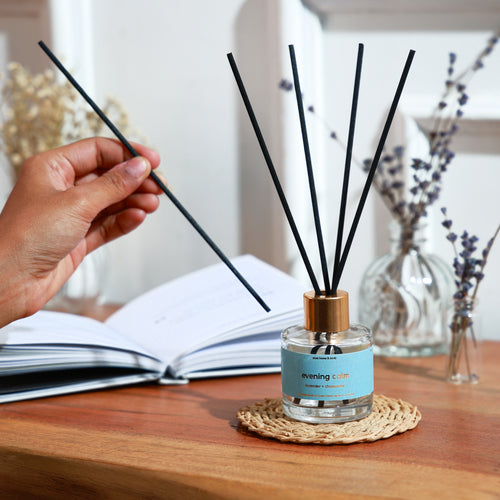 Silent zone · Evening Calm₹799Shop →
 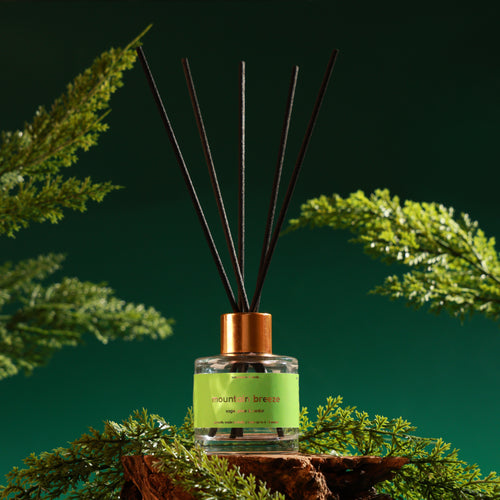 Second zone · Mountain Breeze₹849Shop →
What two reeds genuinely win, and when I would choose them over Safar
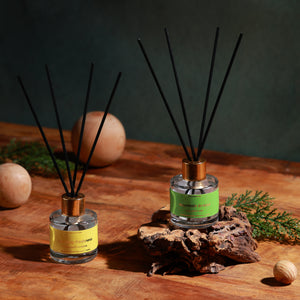
There are real situations in which I would take the two bottles, and they are not consolation prizes. A long or L-shaped room used at both ends is the clearest: if you sit at a desk at one end and sleep at the other, two zones centred on those two places is a design rather than an escalation, and the weak midpoint is somewhere nobody stands. Two rooms that are really one volume, divided by an archway rather than a door, is the same case. Wanting different scents in different zones is a genuine advantage no single machine can match — Mountain Breeze where you work and Evening Calm where you sleep is a thing two bottles do effortlessly and one Safar cannot do at all. And a budget short of ₹3,999 is a perfectly respectable reason; a second ₹849 bottle placed where you actually sit is a sound purchase and I would rather you made it than stretched.
There is also the question of what kind of object you want in the room. A reed diffuser is furniture. It does not need a socket, it does not blink, it does not stop when the power goes, it does not need to be remembered, and it will not one day fail. If your bedroom is a room you are trying to keep uncluttered and quiet, that is worth something real, and the ₹3,999 device is one more thing to manage. The honest framing is that a machine buys you transport, control and evenness, and it costs you simplicity.
One warning that applies whichever way you go, because it is the likeliest disappointment in this whole subject. Switching mechanism may mean switching scent. Reed oil is formulated for capillary wicking on a heat-stable CCT carrier and cannot go into an ultrasonic machine. The water-based Hotel Collection is made for ultrasonic diffusion and cannot go into reeds, and there is no hotel-inspired reed diffuser. Safar takes pure fragrance oil and can be clogged by anything thick, sticky or water-based. So if what you love is a particular SOSA reed and you were assuming it would follow you into a device, please check before you order rather than after.
What to buy, in order
Free first, then the cheaper machine, then Safar with its disclosures attached, and the gap in our own range named at the bottom.
| Buy | What it is | When it is the right answer | Price |
|---|---|---|---|
| 1. Ceiling fan on low, door closed, bottle moved closer ★ | The transport a reed structurally lacks, already installed above you | Always first. It is the only free change that improves projection rather than dose | Free |
| 2. Sukoon ultrasonic | 500ml, 270–320 sq ft, 16–18h on low, three 15ml Hotel Collection scents included. Moves air | For one bedroom, very often the correct answer, at less than half Safar's price. Never skip it on the way to something dearer | ₹1,899 |
| 3. Safar waterless | Undiluted oil as a dry micro-mist. 20ml, 2000 mAh Type-C, cordless, 6.9 cm, up to 10h continuous or ~30h intermittent, three speeds, 1/2/3-hour timer. Named and sold as a car and travel diffuser; no published room coverage figure; not set-and-forget | When water, dilution, humidity or mineral dust are the objection and you will switch it on deliberately. Buy one, never several | ₹3,999 |
| 4. Two reeds, deliberately zoned | One scent per zone, silent, no socket, works in a power cut, never breaks | A long or L-shaped room used at both ends, two rooms that are one volume, different scents per zone, or a budget short of a machine | ₹1,498–₹1,698 |
| 5. The right oil for the mechanism | Reed oil cannot go into an ultrasonic; the water-based Hotel Collection cannot go into reeds; Safar takes pure fragrance oil. The ₹299 15ml is a machine refill, never a first purchase | Before you order, not after. Switching mechanism may mean switching scent | 15ml ₹299 · 100ml ₹999 |
| What I would talk you out of, and the gap: Vaayu for one bedroom | Vaayu ₹11,999 is rated to 1000 m³, roughly 2,000–3,000 sq ft — nine-tenths wasted in 120 sq ft. And between Safar and Vaayu SOSA has no mid-sized waterless bedroom nebuliser | It earns its price on a whole floor or an open-plan home, never on one room. The gap is named rather than sold around | ₹11,999 |

Versailles
I like this question because it is properly framed. You have not asked which product is better — you have said what you want and asked which one delivers it, and that is the only version of this comparison that can be answered honestly. On projection, the answer is the machine, and it is not a close call, because projection is a transport property and a reed has no transport to multiply.
What I will not do is oversell the one we charge ₹3,999 for. Safar is a beautiful piece of engineering and it is named, on its own box, as a car perfume diffuser. Our own page describes it for a car, a handbag, a desk, a bedside and a hotel room, so recommending it for a small personal space is supported by our own copy — but we have never published a room coverage figure for it, and until we do I will not quote one. Its timer runs one, two or three hours. It needs charging. Buy one, use it deliberately, and do not expect it to fill a living room.
And please look at Sukoon at ₹1,899 before you look at anything dearer. It covers 270 to 320 square feet, it comes with three oils, and for one bedroom it is very often exactly right. Between it and the ₹11,999 Vaayu, which is the wrong shape for a bedroom entirely, we have no mid-sized waterless machine, and I would rather tell you that than pretend one of ours is it. Meanwhile keep a reed somewhere, because it is silent, it needs no socket, it works when the power does not, and it never breaks. Everything is composed in Pune, and a part of every order funds a girl's classroom through Nanhi Kali.
Frequently asked questions
- Should I buy two if one isn't filling my bedroom? — two hills, not a plateau.
- One on the opposite side of the room? — what actually happens in the middle.
- Two smaller bottles or one active diffuser? — and the sizes SOSA really sells.
- One by the bed, one by the door — a reasonable setup, and its limit.
- Better coverage, or two strong corners? — the clearest statement of the geometry.
- I keep buying more to make it stronger — a rational response to a misdiagnosis.
- Cheaper long-term: several reeds or a waterless machine? — the arithmetic, with the counterweights.
- How many before a machine is more practical? — a real decision rule.
- About to buy a third for one room? — the moment the requirement changed.
- Brand: the SOSA founder story.
SOSA facts verified August 2026: Reed diffusers in 50ml and 130ml only — Morning Freshness ₹749 / ₹1,249, Evening Calm ₹799 / ₹1,299, Garden Bloom ₹799 / ₹1,299, Mountain Breeze ₹849 / ₹1,349, Fresh Brew ₹849 / ₹1,349. 50ml suits rooms up to about 150 sq ft and runs 6–8 weeks; 130ml suits above 150 sq ft and runs 14–18 weeks; roughly ₹13–₹15 a day. Six fibre reeds, not rattan, in a refillable glass bottle, on a heat-stable CCT carrier rather than DPG, alcohol-free, phthalate-free, paraben-free, IFRA-compliant, 0 ppm formaldehyde, tested at 45°C and 85% RH, composed in Pune. Duos: Day & Night ₹1,498, Fresh & Grounded ₹1,548, Warmth & Bloom ₹1,598 (50ml × 2). Refills 300ml ₹2,399 · 500ml ₹3,499 — oil only, never a first purchase. Machines: Boond ₹899 (300ml, up to about 150 sq ft, about 6 hours, USB), Sukoon ₹1,899 (500ml, 270–320 sq ft, 16–18h on low, three 15ml Hotel Collection scents included), Megh ₹3,499 (6 litres, about 100 hours runtime, only about 215 sq ft), Safar ₹3,999 (waterless cold diffusion of undiluted oil, 20ml, 2000 mAh Type-C battery, up to 10 hours continuous or about 30 hours intermittent per charge, three speeds, 1/2/3-hour auto-off timer, 6.9 cm), Vaayu ₹11,999 (up to 1000 m³, roughly 2,000–3,000 sq ft, 400ml tank, under 38 dB). Between Safar and Vaayu SOSA has no mid-sized waterless bedroom machine, and this guide names that gap rather than stretching a product to cover it. Hotel Collection oils are water-based and ultrasonic-only: 15ml ₹299, 100ml ₹999, 300ml ₹1,799; the 15ml is a machine refill and never a first purchase. Reed oil and the Hotel Collection are not interchangeable in either direction, and there is no hotel-inspired reed diffuser. No health, air-quality, allergy or sleep claims are made for any SOSA product, and fragrance does not remove an unwanted smell — deal with the source, then ventilate, then fragrance. Free shipping above ₹499. A portion of every order supports girl-child education through Nanhi Kali. SOSA is an independent Indian fragrance house; the Hotel Collection is SOSA's own interpretation inspired by the world's finest hotels, and SOSA is not affiliated with or endorsed by any hotel brand. Prices subject to change — see the live product pages.