


Track age instead. Our guidance is to refresh reeds every few months, which lands at roughly two fresh sets across one 300ml refill — one per two or three pours, not one per pour.
The three ageing signals: colour darkening from the exposed end down, stiffness where the reed used to flex, and a wet line that sits barely above the oil after a full day standing in it.
The sourcing catch: reeds are not sold separately. Six fresh fibre reeds arrive only inside a new bottle, from ₹749 — so plan reed changes around the occasional bottle purchase.
2. Change reeds by age and condition, not by pour. Refresh every few months is the guidance, so across one 300ml refill running 8–11 months you should expect to want about two fresh sets. A household running ten reeds through a Delhi summer will want them sooner; four reeds in a cool sealed bedroom will go longer.
3. Use the wet-line test rather than the calendar alone. Lift one reed after it has stood in fresh oil for a day. Wet well up the shaft, pale, still flexible — keep it. Wet barely above the oil, dark, stiff — the set is done, and no amount of new oil will fix it.
4. Know where reeds come from before you plan. We do not sell replacement reeds as a separate item. Six fresh fibre reeds arrive with every bottle, from ₹749 for 50ml. That is an honest gap in the range, and the practical workaround is to buy a bottle when the reeds are due rather than another refill.
5. Never mix an old set with a new one. Three ageing reeds beside three new ones gives you a bottle wicking at two different rates and a room that reads oddly for weeks. Change the six together.
6. Write the date somewhere. On the base of the bottle in pencil, or in your phone the day the refill arrives. Reed age is invisible; it is the one variable in this whole product that nothing on the shelf reminds you of.
Composed and handmade in small batches in Pune, and a portion of every order supports girl-child education through Nanhi Kali.

Part one — two clocks running in the same bottle
Almost every mistake in this area comes from assuming one schedule governs the whole object. It does not. The oil clock is fast, visible and predictable; the reed clock is slow, invisible and conditional. The oil clock announces itself — you can see the level fall, and 6–8 weeks on a 50ml or 14–18 weeks on a 130ml is what it should read. The reed clock gives you no gauge at all: a four-month-old reed and a four-week-old reed look nearly identical standing in a bottle, and the difference only shows in the room. Below, both clocks, and the third one people forget.
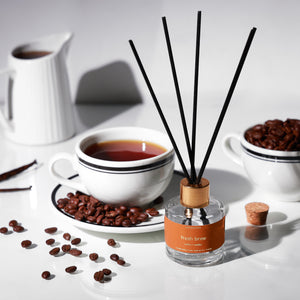
 Fresh Brew₹849 · 9.5/10Refresh every few months is the guidance, and three things move it. Reed count: ten reeds in a 50ml expose far more surface than four, so residue accumulates faster across the set and they age sooner. Heat: a 45°C summer drives evaporation hard, which means more oil passing through the same channels and a set that reaches its limit in months rather than seasons. Composition: the richer, heavier compositions carry more of the slow-moving material that eventually settles in the fibre — Fresh Brew, with Coorg coffee and Kerala vanilla, is naturally more demanding of a reed than the cold, light Morning Freshness. None of this is a defect; it is what a wick does for a living.
Part two — reading reed age, month by month
What a set of fibre reeds looks and behaves like as it ages, and what each stage calls for. These are working observations from our own testing and from customer correspondence rather than laboratory figures, and heat, reed count and composition all shift the timeline — treat the months as a guide and the condition column as the authority.
| Reed age | What you can see | Wet-line reading after a day in fresh oil | What the room does | Action |
|---|---|---|---|---|
| 0–6 weeks ★ | Pale, uniform, flexible | Wet high up the shaft, dark boundary well above the oil | Days 1–3 spike, then the settle, then the plateau | Nothing but the weekly flip |
| 6 weeks – 3 months | Slight tint at the exposed end | Still climbing well; boundary a little lower | Steady plateau — the product working as designed | Pour fresh oil, keep the reeds, flip weekly |
| 3–5 months | Visible darkening on the top third; ends feel firmer | Boundary noticeably lower than it used to sit | Wants flipping more often to hold the same level | Plan the next purchase as a bottle, not a refill |
| 5–8 months | Dark, stiff, sometimes slightly tacky to handle | Barely above the oil after a full day | Full bottle, quiet room — the classic mismatch | Replace all six together |
| Any age, after a scent change | May look perfect | Normal | Two fragrances at once for weeks | Replace regardless — old reeds hold the old composition |
| The honest caveat: the action column asks you to replace something we do not sell on its own. Reeds are not a separate SKU at SOSA, so "replace all six" in practice means buying a bottle — from ₹749 for a 50ml, which arrives with six fresh fibre reeds and 50ml of oil you will use anyway. We would rather publish the gap than write a maintenance schedule you cannot follow. | ||||
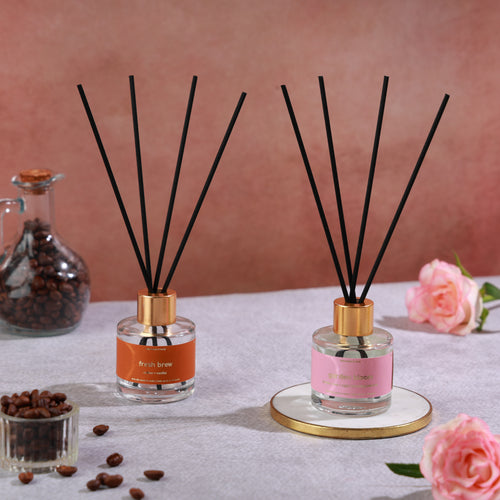 300ml refill · six pours₹2,399Shop → Garden Bloom · six fresh reedsfrom ₹799Shop →
 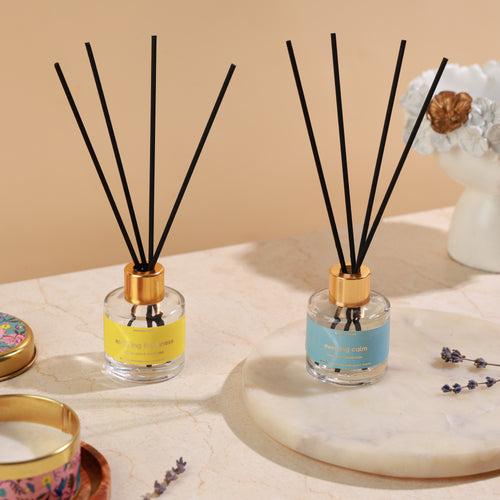 Day & Night duo · two vessels₹1,498Shop →
Part three — keeping the calendar without thinking about it
The whole problem is that reed age is invisible. There is no gauge, no indicator, nothing on the object that tells you the set has been standing there since February. So the only reliable method is an external note, and it needs to be somewhere you will actually see it. Write the month on the base of the bottle in pencil the day you fit a fresh set of six. It survives washing better than you would expect, it is invisible on a shelf, and it turns an unanswerable question into a two-second check. If pencil on glass offends you, put a repeating note in your phone at four months from the day the parcel arrives. Either works; nothing at all does not.
The second habit is to let the flip cadence report on the reeds for you. Six fibre reeds flipped once a week is the calibration every SOSA composition is dosed around. If you find yourself flipping twice a week to hold the room at the level you are used to, that is not a fault and it is not the oil — it is a set of reeds asking for retirement, and it is the earliest honest signal you will get. Flipping restores the designed rate; it never exceeds it, so when a flip buys you three days instead of seven, the ceiling has moved down and only new fibre will move it back up.
The third is seasonal, and specific to this country. A set fitted in November will age far more slowly than a set fitted in April, because a 45°C summer drives evaporation hard and every millilitre that leaves passes through the fibre first. In a Delhi or Ahmedabad summer, with eight or ten reeds standing in the bottle, I would expect a set to be tired by the end of the season rather than the end of the year. In a coastal monsoon the enemy is different — damp air changes how the fibre behaves rather than how fast the oil moves — and it is exactly why the range ships fibre rather than rattan, whose natural pores swell and clog when the humidity sits at 85%. Plan the reed set you fit in March as a summer set, and expect to retire it when the rains break.
Part four — planning a refill and the reeds that go with it
One table that turns all of the above into a purchase plan. The pours and months columns are arithmetic on the listed sizes and durations; the reed-set column is our guidance of a few months per set applied to that timeline.
| Refill and vessel | Pours it gives | Months it covers | Reed sets to plan | How to source them |
|---|---|---|---|---|
| 300ml ₹2,399 into a 50ml vessel ★ | Six (300 ÷ 50 = 6) | About 8–11 months | Two | One 50ml bottle now, one later — from ₹749 each |
| 300ml ₹2,399 into a 130ml vessel | Just over two (300 ÷ 130 ≈ 2.3) | About 8–11 months | Two | A 50ml bottle gives six reeds and spare oil |
| 500ml ₹3,499 into a 50ml vessel | Ten (500 ÷ 50 = 10) | About 14–18 months | Three to four | Spread bottle purchases across the period |
| 500ml ₹3,499 into a 130ml vessel | Just under four (500 ÷ 130 ≈ 3.8) | About 14–18 months | Three to four | Same — plan them, do not improvise them |
| Two vessels from a duo set | Halve the pours per vessel | Roughly half as long | Two sets of six per change round | Twelve reeds arrive with the duo · ₹1,598 for 2 × 50ml |
| Ten reeds in a 50ml, Delhi summer | Fewer weeks per pour | Shortens the whole plan | Sooner than the table says | Let the wet line decide, not the calendar |
Versailles
When we designed the refill I assumed the hard part would be the oil. It was not. The hard part has been explaining that the reeds and the oil do not finish together, because everything about the object suggests they should — they arrive in the same box, they stand in the same bottle, and one of them empties dramatically while the other quietly stops working.
The commonest fault report I get is a full bottle and a silent room, and nine times in ten the reeds have simply been in there since last winter. It is not a failure of the oil and it is not a failure of the customer. It is a failure of the product to have any way of telling you. Hence the pencil mark, which is the least sophisticated advice on this entire site and the piece I get thanked for most.
I will say the awkward part once more. We do not sell reeds on their own yet, so the maintenance schedule I have just given you runs through the bottles rather than through a spares packet. I dislike it, we are working on it, and until it changes I would rather you plan around the gap than find it at four months on a Sunday evening. Everything is composed and handmade in Pune, and a part of every order funds a girl's classroom through Nanhi Kali.
Frequently asked questions
- Refill or a new diffuser? — the per-millilitre arithmetic, laid out.
- Do you need new reeds when refilling a SOSA diffuser? — the same question from the reed side.
- The complete stick-replacement guide and changing fragrance in the same bottle.
- Why can't I smell my reed diffuser? — for a full bottle in a quiet room.
- Brand: the SOSA founder story.
SOSA reed diffuser range & prices (verified August 2026): alcohol-free, phthalate-free, paraben-free and IFRA-compliant compositions on a heat-stable coconut-derived (CCT) carrier, low-VOC, supplied in a refillable glass bottle with six fibre reeds; 50ml lasts 6–8 weeks and 130ml lasts 14–18 weeks. Morning Freshness (Malabar lemon · peppermint · Nilgiri eucalyptus) 50ml ₹749 · 130ml ₹1,249 · 9.0/10; Garden Bloom (British rose · night-blooming jasmine) 50ml ₹799 · 130ml ₹1,299 · 8.9/10; Evening Calm (Kashmir lavender · chamomile) 50ml ₹799 · 130ml ₹1,299 · 8.9/10; Fresh Brew (Coorg coffee · Kerala vanilla) 50ml ₹849 · 130ml ₹1,349 · 9.5/10; Mountain Breeze (Himalayan pine · sage · Indian cedar) 50ml ₹849 · 130ml ₹1,349 · 9.4/10. Reed diffuser refills are oil only — you reuse your own vessel and reeds: 300ml ₹2,399 (roughly 8–11 months) · 500ml ₹3,499 (roughly 14–18 months), about ₹7–8 per ml against ₹15–17 per ml for a 50ml bottle. Duo sets ₹1,498–₹1,598 for 2 × 50ml and ₹2,498–₹2,598 for 2 × 130ml. Strength figures are positions on SOSA’s own internal strength scale, not an industry standard. Replacement reeds are not sold as a separate SKU; SOSA guidance is to refresh reeds every few months. The reed line is separate from the water-based Hotel Collection for ultrasonic machines (15ml ₹299 · 100ml ₹999 · 300ml ₹1,799) and the two are not interchangeable. Diffusers: Boond 300ml ₹899 · Sukoon 500ml ₹1,899 · Megh 6L ₹3,499 · waterless Vaayu ₹11,999. Composed and handmade in small batches in Pune, India; tested through 45°C summer heat and 85% monsoon humidity. Free shipping above ₹499. A portion of every order supports girl-child education through Nanhi Kali. Prices subject to change — see the live product pages.