



Concentrated on three rooms: three 130ml = ₹3,847. Sixteen weeks each — 48 room-weeks, about ₹80 each.
At a tighter budget: two 130ml ₹2,548 give 32 room-weeks; three 50ml ₹2,347 give 21.
The exception: a room-week in a room nobody sits in is worth nothing, so concentrate on occupied hours rather than on floor area.
2. The same thing happens at every budget. At ₹2,500: two 130ml at ₹2,548 give 32 room-weeks at about ₹80, while three 50ml at ₹2,347 give 21 at about ₹112. At ₹1,500: one 130ml at ₹1,249 gives 16 room-weeks at ₹78, while the duo at ₹1,498 gives 14 at ₹107. Every time you widen the same money over more spaces, the cost per room-week rises and the total number of room-weeks falls.
3. Because there is no cheap version of a room. An air space needs a whole bottle. It does not need a proportionally smaller one because you happen to be buying five. Every bottle, at every price, holds a closed still room of up to about 150 sq ft on six reeds — the 50ml is not a smaller circle, it is the same circle for fewer weeks at a higher rate. Spreading therefore buys extra starting points at a penalty, and the penalty is roughly ₹36 a room-week.
4. It also multiplies the admin. Five 50ml bottles finishing every seven weeks is about 35 purchases a year. Three 130ml finishing every sixteen weeks is about nine. That is twenty-six extra orders, twenty-six extra deliveries and twenty-six extra decisions, for a flat that smells of less. The invisible cost of spreading is not money, it is attention, and attention is what makes people give up on home fragrance altogether.
5. But concentrate on the right rooms. This is the one place the arithmetic can mislead you. A room-week is only worth something if somebody is standing in it. Two 130ml bottles in a bedroom and a guest room is a worse purchase than three 50ml bottles in a bedroom, a study and a kitchen if those three are where the household actually lives. Rank rooms by occupied hours first, then apply the arithmetic to the rooms that survive.
Made in India, composed by an ISIPCA Versailles-trained perfumer — and a portion of every order supports girl-child education through Nanhi Kali.

Why there is no cheap version of a room
The instinct behind spreading is that fragrance should scale like paint — that if a whole flat is the goal, you buy a little for each part of it. It does not work that way, because an air space is a fixed unit and a bottle is the unit that fills it. Fragrance does not pass a closed door, so a five-space flat is five separate problems, each of which needs a source of its own. What the small bottle offers is not a smaller circle — it is the same circle for fewer weeks. A 50ml on six reeds holds a closed, still room of up to about 150 sq ft, exactly as a 130ml does. So spreading does not divide the coverage requirement into cheaper pieces; it multiplies the number of full-price sources you have to buy, and it forces each one into the size with the worst cost per week — about ₹107 against ₹78, or ₹14.98 a millilitre against ₹9.61.
The second reason is perceptual rather than financial, and it is the one people are surprised by. A flat in which every space is faintly scented reads as less considered than one in which two rooms are clearly scented and the corridor between them is not. Contrast is part of the effect. Your nose registers change, not constancy — olfactory adaptation is essentially complete within about twenty minutes — so what a visitor actually experiences is the transition from a neutral hallway into a scented room. Remove the neutral stretches and you remove the moment the fragrance is noticed at all. A corridor is a transit space and a foyer is a threshold; both work better as the plain ground against which a scented room registers. This is why hotels scent lobbies and rooms rather than every metre of corridor between them.
Three ways to allocate roughly the same money
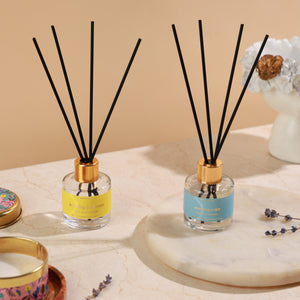
 Three 130ml₹3,847Morning Freshness ₹1,249, Evening Calm ₹1,299, Garden Bloom ₹1,299, one in each of the three rooms your household actually occupies — typically a living room, a main bedroom and a study or second bedroom. Sixteen weeks each, six reeds in the living room and four in the bedrooms. Forty-eight room-weeks and about nine orders a year. Every unscented space in the flat is doing useful work as contrast.
Sizing by space — which spaces survive the ranking
Rank your spaces by occupied hours, then read down. The cost is the real total, and two rows here spend nothing, because those spaces work better unscented.
| Space | What it needs | How many | Cost |
|---|---|---|---|
| The two rooms with the most occupied hours ★ | One 130ml each — 32 room-weeks at about ₹80, the best rate available without owning glass | Two 130ml | ₹2,548 |
| A third room genuinely used for hours a day | A third 130ml — 48 room-weeks at about ₹80. The rate does not worsen while the rooms are real | Three 130ml | ₹3,847 |
| A bathroom under about 40 sq ft | One 50ml on two or three reeds — the one place the small bottle is genuinely the right size | One 50ml | from ₹749 |
| Five spaces, each given a 50ml to cover the flat | More money and less fragrance — ₹4,045 for 35 room-weeks against ₹3,847 for 48, and 35 orders a year | Not recommended | ₹4,045 |
| A living room of about 220 sq ft | Not an allocation question at all. Past what one passive bottle holds — two positions, or the Sukoon at about 270–320 sq ft | Two bottles or one machine | ₹2,498 or ₹1,899 |
| The corridor, the foyer, the box room and the guest bedroom | Nothing. These are the spaces spreading exists to fill, and they are the spaces that make a scented flat read as intentional by staying plain | None | ₹0 |
| A note on all of the above: room-week figures assume six reeds, closed rooms and standard ceiling height — 16 weeks for a 130ml and 7 for a 50ml. Four reeds in a bedroom improves every concentrated build above and does nothing to rescue a spread one, because the spread build's problem is the number of bottles, not the setting. | |||
One room · the unitFrom ₹749Shop → 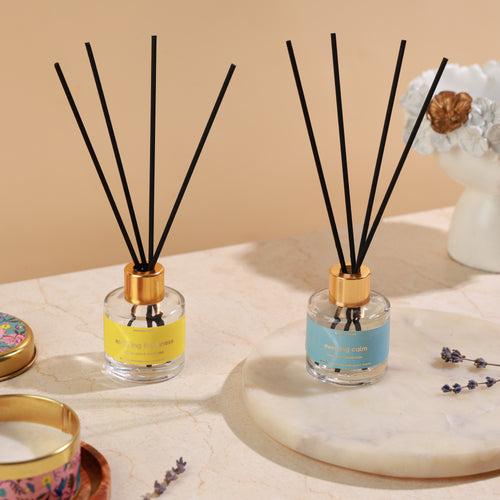 Two rooms · better value₹1,498Shop →
  Large room · a switch₹1,899Shop →
Choosing the rooms, and then the reeds inside them
Rank by occupied hours before you rank by anything else. Write down every space and the hours a day someone is actually in it with the door in its usual position. A bedroom is eight or nine hours even if most of them are spent asleep, because the first breath on waking and the last on going to bed are both real. A living room might be four. A study, for anyone working from home, might be seven. A corridor is zero — people pass through it, and passing through is not occupancy. Then apply the arithmetic only to the spaces at the top of that list. This ordering matters more than any sum on this page, because concentrating your budget on the wrong two rooms is worse than spreading it across the right five.
Then let reed count do the spreading that money cannot. If you have three rooms and want a different intensity in each, that is a reed decision rather than a bottle decision. Six reeds in a living room or entrance, four in a bedroom, two or three in a small bathroom. Reed count is the only volume dial a reed diffuser has and it moves consumption and strength together — four reeds instead of six pushes a 130ml from about sixteen weeks towards eighteen, taking the concentrated build from about ₹80 a room-week down towards ₹71. It is free, it is reversible, and it is the adjustment most people never make because six reeds came in the box.
And stagger the bottles rather than starting them together. Three 130ml bottles begun on the same day will empty within a fortnight of each other and present you with a ₹3,847 reorder in one go. Start the second a fortnight after the first and the third a fortnight after that, and the household settles into one bottle roughly every five weeks instead. Once the rooms and the scents have settled, a 300ml refill at ₹2,399 takes the running cost to about ₹8.00 a millilitre against ₹9.61 — but that is a decision for month five, not month one, since a refill contains liquid only, with no glass and no reeds.
What to buy
Ordered by how well each option serves a concentrated build. The 50ml appears here for the rooms it is genuinely right for, not as a way of covering more of the flat.
| Buy | What it covers | Lasts | Price |
|---|---|---|---|
| One 50ml | A single reed diffuser — a bathroom under about 40 sq ft, or a scent you have not smelled — not a way to reach a fifth space | 6–8 weeks | from ₹749 |
| One 130ml ★ | The value size — every room with real occupied hours — 14–18 weeks at about ₹78 a week and about ₹80 a room-week | 14–18 weeks | from ₹1,249 |
| The duo | Day & Night duo — two rooms started on the same day when you would rather have two scents than one long bottle | 6–8 weeks each | ₹1,498 |
| Sukoon | 500ml ultrasonic — a room past about 200 sq ft, where allocation is not the problem and coverage is | Runs when you switch it on | ₹1,899 |
| 300ml refill | The running cost — the running cost once three rooms are settled — about ₹8.00 a millilitre and about ₹65 a week | Roughly 2 × 130ml fills | ₹2,399 |
Versailles
I am asked this most often by people furnishing a new flat, and the honest answer disappoints them, because they want the whole home to smell of something. Three 130ml bottles in three rooms is ₹3,847 for 48 room-weeks. Five 50ml bottles in five spaces is ₹4,045 for 35. Spreading costs more and delivers less, every single time.
The reason is simple and it is worth remembering when you are looking at prices. A room is a whole unit. It needs a whole bottle whether you are buying one or five, because a 50ml covers the same 150 sq ft that a 130ml does — it simply stops sooner and costs more per week while it runs. There is no small, cheap version of an air space, so buying five small bottles is not economising, it is paying the highest rate five times.
What I would add is the part the arithmetic cannot tell you. A corridor left unscented is not a gap in your plan; it is what makes the scented rooms noticeable. Your nose reports change, not constancy. So scent the two or three rooms where people sit, leave the passages alone, and let the contrast do the work you were about to spend ₹800 on. A portion of every order funds a girl's classroom through Nanhi Kali.
Frequently asked questions
- What ₹3,000 buys — two rooms, and ₹452 kept back.
- What ₹5,000 buys — and the machine to walk past.
- Cost per week, both sizes — why spreading costs more.
- Two 50ml against one 130ml — the same lesson in one room.
- Brand: the SOSA founder story.
SOSA products & prices (verified August 2026): Hotel Collection water-based ultrasonic diffuser fragrance 15ml ₹299 · 100ml ₹999 · 300ml ₹1,799 · Pack of 7 (15ml, all fragrances) ₹1,799; refills 100ml from ₹999. Seven scents: The Ritz-Carlton-inspired (white tea · bergamot · cedar), Westin-inspired (white tea · aloe · cedar), 1 Hotels-inspired (cedarwood · vetiver · green leaves), The St. Regis-inspired (amber · violet · woods), Shangri-La-inspired (jasmine · green tea · white tea), Four Seasons-inspired (citrus · floral · sandalwood), W Hotels-inspired (citrus · pepper · amber). Diffusers: Boond 300ml ₹899 · Sukoon 500ml ₹1,899 · Megh 6L ₹3,499. Water-based, phthalate-free, composed to IFRA standards for home diffusion; 3–6 drops per tank. Made in India, Pune. The Hotel Collection scents are SOSA's own interpretations inspired by the world's finest hotels; all hotel names are trademarks of their respective owners and are used only to describe the scent style — SOSA is an independent Indian fragrance house, not affiliated with or endorsed by any hotel brand. Prices and availability subject to change — see the live product pages.