

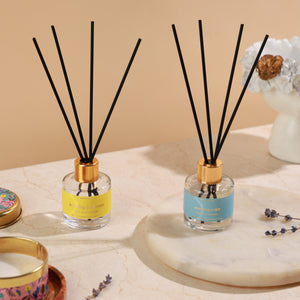

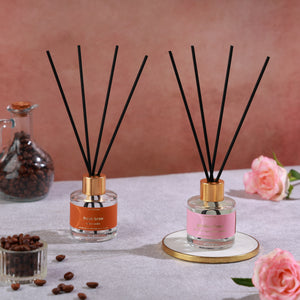

What it costs to ignore this: ₹2,247 for three unused rooms in 50ml, or ₹3,747 a year to keep one of them going on 130ml bottles.
What to do instead: move a bottle you already own into the guest room two days before guests arrive. Reeds need about forty-eight hours to saturate. Cost: ₹0.
2. The money is not small once you count the rooms. Three unused spaces — a store room, a spare bedroom and a formal sitting room — at ₹749 each is ₹2,247. Kept going all year in 130ml, a single unused room is three purchases at ₹1,249, or ₹3,747 annually. Put beside the ₹1,998 that buys a genuinely good two-room home, those figures are not a rounding error. They are the difference between a home that reads as scented and one that does not.
3. A room entered briefly is not an exception either. Take a store room somebody opens for five minutes a day. Across a 130ml bottle's 112 days that is about nine hours of human presence, so the bottle works out at roughly ₹134 an hour of occupancy. The same bottle in a living room used four hours a day comes to about ₹2.80 an hour. Nothing else in home fragrance has a spread that wide, and it is entirely a question of where you put it.
4. The exception is a room that gets opened, and it costs nothing. A guest bedroom before guests, or a sitting room before visitors, genuinely benefits — but not from a permanent bottle. Move a diffuser from a room you are not using that week, two days ahead, because reeds need about forty-eight hours to saturate before they throw properly. A bottle moved on Friday afternoon is doing nothing much on Friday evening and everything by Sunday.
5. Then spend the saving on making the used rooms better, not on more rooms. This is the part people skip. The ₹2,247 you did not spend is not a saving to be admired — it is the reason the living room can have a 130ml at ₹1,249 instead of a 50ml at ₹749, running 14–18 weeks instead of 6–8 at about ₹78 a week rather than ₹105. Concentration is not austerity. It is the same money doing a better job in fewer places.
Made in India, composed by an ISIPCA Versailles-trained perfumer — and a portion of every order supports girl-child education through Nanhi Kali.

Why evaporation does not care whether anybody is in the room
There is no mechanism in a reed diffuser that responds to a person. Six fibre reeds standing in oil draw liquid up their porous core and release it from the exposed tip, and the rate at which that happens is set by three things: how many reeds are exposed, how warm the room is, and how fast the air around the tips is being replaced. Occupancy appears in none of them. If anything, an empty room runs slightly slower because nobody is opening the door — but the difference is trivial next to the fact that a 130ml gives up roughly 8ml a week on six reeds and will do so for fourteen to eighteen weeks with or without you. This is different from nearly every other household purchase. A light nobody switches on costs nothing to leave. A diffuser in an empty room is spending on a timer.
It is also worth being honest about the second half of the problem, which is that you cannot smell an unused room properly anyway. Olfactory adaptation is essentially complete within about twenty minutes, so the only person in a position to appreciate a scented spare bedroom is somebody arriving into it with a fresh nose — and by definition nobody is arriving into it. The scent that would justify the spend is only perceptible in the first breath, and that breath is not being taken. This is why the guest-room exception works as a temporary move rather than a permanent bottle: the value is concentrated entirely in the arrival, so you only need the bottle there for the days somebody actually arrives.
Three rooms people buy for anyway, and what to do instead
 Move, do not buy₹0A spare bedroom used four or five nights a year does not need a permanent diffuser. A 130ml placed there runs out in fourteen to eighteen weeks having served perhaps two nights of it, which is ₹1,249 for two nights of fragrance nobody asked for. Instead, take the bottle from a room you are not using that week — or from your own bedroom, which you can do without for two days — and put it in the guest room forty-eight hours before they arrive. Same bottle, same money, and now somebody is there to notice it.
Sizing by space — the rooms that get nothing, and the two that do
This table is mostly zeroes, which is the point. Read down and note how much of a typical flat belongs in the ₹0 rows, and what the saving buys in the two rows that do not.
| Space | What it needs | How many | Cost |
|---|---|---|---|
| The room with the most sitting hours — living room or main bedroom ★ | One 130ml on six reeds, or four in a bedroom. This is where the money the other rows saved should go | One 130ml | from ₹1,249 |
| The second room in daily use | One bottle, bought out of step with the first so the reorders never collide | One | from ₹749 |
| A front room visitors arrive into weekly | One 50ml on four reeds — justified by arrivals with a fresh nose, not by hours of occupancy | One 50ml | from ₹749 |
| A guest bedroom used a few nights a year | Nothing. Move a bottle in forty-eight hours before they arrive and take it back after | None | ₹0 |
| A store room, box room or unused second bedroom | Nothing. The bottle empties on the same schedule as an occupied room. Air the space instead — a window for twenty minutes does more here than any purchase | None | ₹0 |
| A passage, a stairwell, or a utility balcony | Nothing. A passage is a transit space and a balcony is ventilated far faster than a passive source can charge it | None | ₹0 |
| A note on all of the above: coverage of up to about 150 sq ft assumes six reeds, a closed room, still air and a standard ceiling. None of the ₹0 rows above become worth buying for if the room is bigger, smaller or better ventilated — the objection is occupancy, and no bottle size answers it. | |||
One room · the unitFrom ₹749Shop → 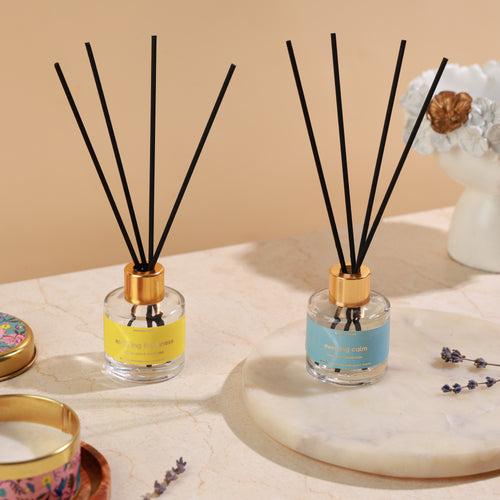 Two rooms · better value₹1,498Shop →
  Large room · a switch₹1,899Shop →
Reeds, moving bottles, and the forty-eight hours that make it work
The moving trick only works if you respect the saturation time. Fresh reeds in a bottle take roughly forty-eight hours to draw fragrance along their full length, which is why a diffuser opened on the morning of a party is doing almost nothing by evening. If you are shifting an already-running bottle into a guest room, the reeds are wetted and it will read within a few hours, but give it a day if you can. Turning the reeds over when you move it — tips down, dry ends up — brings the throw back sharply for a few days and is the single most useful free adjustment there is. Wash your hands afterwards; the oil is concentrated and it marks polished surfaces if it drips.
Then use reeds to size the bottle to the room it has been moved into. A 130ml from a 200 sq ft living room, carried into a 110 sq ft guest bedroom, is too much on six reeds. Pull two out, keep them in the box, and put them back when the bottle goes home. Reed count is the only volume control a diffuser has and it works in both directions: more reeds means a stronger room and a shorter bottle, fewer means the opposite. Six is a living-room or entrance setting, four suits a bedroom, two or three is right for a small bathroom. Nobody needs to buy anything to make that adjustment.
And spend the money you did not spend on the size, not on another room. This is the whole argument in one instruction. If skipping the store room and the spare bedroom saves you ₹1,498, that is not a reason to buy a third room — it is the reason the living room gets a 130ml at ₹1,249 rather than a 50ml at ₹749, running 14–18 weeks at about ₹78 a week instead of 6–8 at about ₹105. Later, a 300ml refill at ₹2,399 fills that 130ml roughly twice, which is where a concentrated setup becomes genuinely cheap to run. For a living room, Garden Bloom or Fresh Brew; for a bedroom, Evening Calm.
What to buy
The purpose of this table, on this page, is mostly to show what you are not buying. One line of it is the actual purchase and the unused rooms of your home are not on it at all.
| Buy | What it covers | Lasts | Price |
|---|---|---|---|
| One 50ml | A single reed diffuser — a front room visitors arrive into weekly, or a small bathroom — never a store room | 6–8 weeks | from ₹749 |
| One 130ml ★ | The value size — the room with the most sitting hours — the upgrade that skipping three unused rooms pays for | 14–18 weeks | from ₹1,249 |
| The duo | Day & Night duo — two occupied rooms in one purchase, at ₹1,498 against ₹1,548 bought separately | 6–8 weeks each | ₹1,498 |
| Sukoon | 500ml ultrasonic — a large room in daily use past about 200 sq ft — occupancy first, size second | Runs when you switch it on | ₹1,899 |
| 300ml refill | The running cost — the cheapest way to keep two well-chosen rooms going, once you own the glass | Roughly 2 × 130ml fills | ₹2,399 |
Versailles
I would rather sell you two bottles you notice than five you do not. An unused room is the only place in a house where I can promise you, in advance, that the money will produce nothing — because the bottle empties on a timer and there is nobody standing in the room while it does.
The one I argue about most is the store room, and usually the real complaint is that it smells of dust and old cardboard. A diffuser is not the answer to that. It adds a fragrance to the air; it does not remove anything. Open the window for twenty minutes, get the boxes off the floor, and you will have done more for that room than ₹749 would.
For the guest room, move a bottle in two days before they come and take it back when they go. It is free, it works better than a permanent bottle would, and it means the fragrance is there on the one night it can actually be smelled by somebody with a fresh nose. Then put the money you saved into the room where you spend your evenings, and buy the bigger bottle for it. A portion of every order funds a girl's classroom through Nanhi Kali.
Frequently asked questions
- How many hours before a room deserves one? — the occupancy threshold, costed.
- A room that is always closed — closed and used is not closed and empty.
- Does a corridor count as a room? — no — and why transit spaces fail.
- A room you only use at the weekend — five sevenths of the bottle, spent on nobody.
- Brand: the SOSA founder story.
SOSA products & prices (verified August 2026): Hotel Collection water-based ultrasonic diffuser fragrance 15ml ₹299 · 100ml ₹999 · 300ml ₹1,799 · Pack of 7 (15ml, all fragrances) ₹1,799; refills 100ml from ₹999. Seven scents: The Ritz-Carlton-inspired (white tea · bergamot · cedar), Westin-inspired (white tea · aloe · cedar), 1 Hotels-inspired (cedarwood · vetiver · green leaves), The St. Regis-inspired (amber · violet · woods), Shangri-La-inspired (jasmine · green tea · white tea), Four Seasons-inspired (citrus · floral · sandalwood), W Hotels-inspired (citrus · pepper · amber). Diffusers: Boond 300ml ₹899 · Sukoon 500ml ₹1,899 · Megh 6L ₹3,499. Water-based, phthalate-free, composed to IFRA standards for home diffusion; 3–6 drops per tank. Made in India, Pune. The Hotel Collection scents are SOSA's own interpretations inspired by the world's finest hotels; all hotel names are trademarks of their respective owners and are used only to describe the scent style — SOSA is an independent Indian fragrance house, not affiliated with or endorsed by any hotel brand. Prices and availability subject to change — see the live product pages.