





Weekly: bedding, a mug of water down every unused drain, the washing-machine gasket wiped and left to dry, the bin lid washed.
Monthly and seasonal: cushion covers, AC filters, upholstery vacuumed; curtains, rugs and mattresses seasonally, in sunlight where possible. Then the fragrance layer — and a monthly thirty-minute audit to check any of it is working.
2. Put the fabric on a calendar. Bedding weekly. Cushion covers monthly. Curtains at least seasonally. Upholstery vacuumed with the brush attachment monthly. Rugs and mattresses into direct sunlight whenever the weather allows, because heat and UV drive absorbed volatiles out of fibre much faster than airing in shade. Textiles are the reservoir, and a reservoir needs draining on a cycle rather than when you notice it.
3. Keep the wet list on a weekly round. A mug of water down every drain you do not use daily. The washing-machine gasket peeled back, wiped and left with the door ajar. The bin lid and underside washed rather than just the liner changed. Cloths, mops and sponges dried properly rather than folded damp. AC filters washed monthly in season. This is ten minutes a week and it prevents the return of almost every sharp household smell.
4. Audit monthly, because you cannot feel it. Adaptation is essentially complete in about twenty minutes, so a routine that depends on you noticing a problem will always be a fortnight behind. Once a month, leave the flat for half an hour and judge the first breath when you come back. Ask a visitor when you can. Schedule the check the way you schedule the cleaning.
5. Then add the layer — and here it is genuinely the answer. With the source gone and the routine running, there is nothing being masked. A reed diffuser from ₹749 gives rooms that should always smell settled a continuous background; the Sukoon at ₹1,899 with a Hotel Collection scent from ₹299 gives you the same on demand. It still removes nothing — it simply gives a clean home a character.
Made in India, composed by an ISIPCA Versailles-trained perfumer — and a portion of every order supports girl-child education through Nanhi Kali.
Why a fix never holds on its own
Everything you did to clear the smell was a subtraction that happened once. The washing-up of the bin, the water down the dry trap, the curtains that finally went in the machine, the two hours with every window open — all of it moved the flat to a much better level and none of it changed the speed at which the flat returns to where it was. Cooking still happens twice a day. Bodies still occupy rooms for eight hours at a time. Textiles still absorb whatever passes them and release it back over the following days. Drains still evaporate their water seals when unused. The loading never stopped; you simply emptied the container once. That is why the standard experience is three good weeks followed by a slow, unnoticed return, and why people conclude that whatever they did did not work when in fact it worked exactly as long as a one-off can.
The second reason is that you are structurally unable to police it. Olfactory adaptation is essentially complete within about twenty minutes, so you are permanently adapted to your own baseline and a slow drift of a few percent a week is completely invisible to you. By the time a home smells stale enough that you notice it from the inside, it has been drifting for a month and a visitor could have told you three weeks ago. A maintenance routine is therefore not a matter of discipline but of instrumentation — you need a scheduled measurement because the felt one does not exist. Ten minutes twice a day, a laundry calendar, a weekly wet round and a monthly thirty-minute audit is the entire system, and it takes less time in a week than the deep clean took in an afternoon.
The three rates that keep a home fresh
 The layerRefills ₹2,399Open two openings on opposite sides of the flat, open every internal door between them, and leave it for five to ten minutes. Morning and late afternoon. In a monsoon city, take whatever dry window the day offers and use a fan in the window blowing outwards rather than pulling humid air in. Include the rooms nobody uses — a shut guest room or a closed bedroom is a stagnant pocket that contributes the moment its door opens. This single habit is worth more than every product in this article combined, and it is the one people abandon first because nothing visible happens when they do it.
Symptom to cause: when the routine slips
These are maintenance failures rather than mysteries — each one names which of the three rates has lapsed, or how the fragrance layer is being run wrongly.
| What you notice | Most likely cause | How to confirm it | What actually fixes it |
|---|---|---|---|
| Staleness creeping back within a fortnight ★ | The ventilation habit has quietly dropped to once a day, or to none | Diarise it for a week and run the thirty-minute audit at the end | Two ten-minute cross-ventilations a day, internal doors open through both |
| The flat is fine except one room | That room is not in the ventilation path — usually a closed guest room or study | Open its door and window during the purge for three days and re-test | Include every room in the path; open cupboards inside it while it airs |
| The diffuser smelled strong for two weeks, then faded | Reeds clogging as heavier fragrance molecules saturate the fibre | Flip the reeds; if throw returns briefly and drops again, the reeds are done | Replace the reeds, not the liquid. Fresh reeds come with each bottle |
| The bottle is emptying much faster than expected | Heat and airflow — evaporation rises with both, and a hot draughty room drinks it | Compare consumption in a cooled bedroom against a west-facing hall | Fewer reeds in hot rooms, more in cooled ones; keep the bottle out of direct sun |
| Everything is worse for a month every monsoon | Humidity raising perceived odour and stopping textiles from drying properly | Compare the same rooms and routine in a dry month against a wet week | Dry rather than wash; longer exhaust runs; ventilate in dry windows; never dry laundry indoors |
| A musty smell returns with staining or a tide mark on a wall | Damp ingress or mould — a health and building issue, not a maintenance lapse | Inspect external walls behind furniture, under sinks and at ceiling corners in daylight | Find the water, stop it, remove the growth. No fragrance belongs in this. |
| If none of these fit: run the thirty-minute audit before changing anything. Half the time the routine is fine and what has changed is the weather, and the correct response to a wet fortnight is drying rather than scenting. | |||
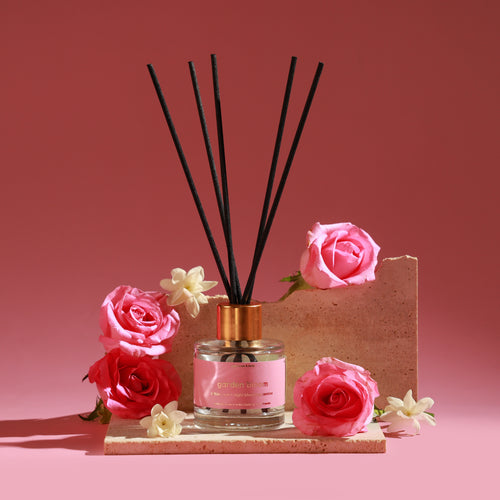 Reeds · always-on roomsFrom ₹749Shop →
  Sukoon · when you want a switch₹1,899Shop →
  Hotel Collection · the scentFrom ₹299Shop →
The routine, room by room
The daily and weekly core comes first, and it is short. Ten minutes of cross-ventilation morning and late afternoon, with the internal doors open and the unused rooms included. A weekly wet round: water down unused drains, the washing-machine gasket wiped and left ajar, the bin lid and underside washed, the fridge tray checked, a torch under the sinks, every cloth dried properly. Bedding weekly. Then the monthly and seasonal layer: cushion covers and AC filters monthly, curtains and rugs and the mattress seasonally, in sunlight wherever you can manage it. Add one diarised audit a month — out for thirty minutes, judge the first breath back — because you genuinely cannot assess this from the inside.
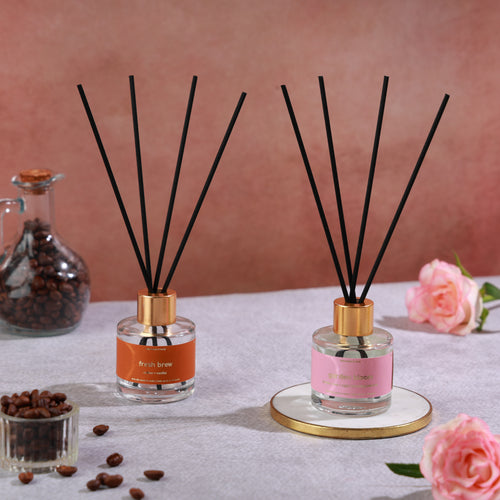
Then allocate the fragrance layer by how the room is used, not by which scent you like most. Rooms that should simply always smell settled and that nobody is standing in to operate anything — the entrance, the hall, a bathroom, a guest room — want a reed diffuser, because it runs continuously on capillary action with no electricity and nothing to switch. Six reeds is full strength and covers a room of up to roughly 150 sq ft; use four in a bedroom and two or three in a small bathroom. The reed count is the volume dial, so add or remove reeds rather than buying a stronger bottle. Rooms where you want scent for a couple of hours and silence the rest of the time — a living room before people arrive, a bedroom in the hour before sleep — want the Sukoon at ₹1,899, which takes 3–6 drops of the water-based Hotel Collection from ₹299 and covers roughly 270–320 sq ft. The Boond at ₹899 does the same job at bedside scale. The two liquids are not interchangeable: reed fragrance is oil-based, the Hotel Collection is water-based for ultrasonic machines.
Finally, run it well, because most disappointment with home fragrance is operating error rather than product. A 50ml reed diffuser lasts 6–8 weeks and a 130ml from ₹1,249 lasts 14–18, but heat and draught speed evaporation and air-conditioning slows it — the same bottle will empty faster in a west-facing hall than in a cooled bedroom, and that is physics rather than a fault. When the throw drops after several weeks, the usual cause is the reeds clogging as heavier molecules saturate the fibre: replace the reeds, not the liquid, and top up from a 300ml refill at ₹2,399 or a 500ml at ₹3,499 rather than rebuying the bottle. Keep it off polished wood and out of direct sunlight. If you are scenting two rooms, a duo is the tidier way in — Day & Night at ₹1,498, Warmth & Bloom at ₹1,598 or Fresh & Grounded at ₹1,548. And use one scent family per floor rather than a different one per room, or the flat reads as a shop rather than a home.
What to do, in order
The first three steps are the maintenance plan and they are free. The fourth and fifth are the layer — and unlike everywhere else in this cluster, by this point you have genuinely earned them.
| Step | What to do | When | Cost |
|---|---|---|---|
| 1. Remove the source | Weekly wet round: water down unused drains, gasket wiped and door ajar, bin lid washed, fridge tray, under-sink torch | Before anything else | ₹0 |
| 2. Move the air | Ten minutes of cross-ventilation twice a day, internal doors open, unused rooms included in the path | Daily, five to ten minutes | ₹0 |
| 3. Deal with what holds it | Bedding weekly, covers and AC filters monthly, curtains, rugs and mattress seasonally, sunlight wherever possible | Weekly to monthly | ₹0 |
| 4. Then the always-on layer ★ | A SOSA reed diffuser — entrances, halls, bathrooms and guest rooms that should always smell settled — six reeds, or four in a bedroom | 50ml 6-8 weeks · 130ml 14-18 | from ₹749 |
| 5. Or the on-demand layer | Sukoon with a Hotel Collection scent — living rooms and bedrooms where you want an hour of scent and then silence; roughly 270–320 sq ft | Run it when you want it | ₹1,899 |
Versailles
This is the article in this cluster where I get to sell you something without qualifying it into the ground, and I have noticed that I find it harder than the ones where I tell people to buy nothing. The reason is probably that the honest version is unglamorous: the fragrance is the smallest part of the plan. Ten minutes of open windows twice a day and a laundry calendar do most of the work, and a diffuser makes a clean home feel considered rather than blank.
The mistake I see at this stage is treating the layer as insurance. People buy a strong scent, put it in the hall, and quietly let the ventilation habit lapse because the flat smells fine. Six weeks later the routine is gone, the reeds are clogged, and the flat smells of fragrance over staleness — which is the exact thing this whole cluster is written to prevent. Fragrance is additive. It never removes anything, and it is not a reason to stop doing the free part.
If you want a plan I would actually give a friend: a 130ml reed diffuser in the entrance on six reeds, a 50ml in each bathroom on two or three, one on four reeds in the bedroom placed away from the bed, and a Sukoon in the living room for the hours people are in it. Refill rather than rebuy, change the reeds each time you refill, and keep one scent family across the flat. Then run the thirty-minute audit once a month and trust it over your own nose. A portion of every order funds a girl's classroom through Nanhi Kali.
Frequently asked questions
- Why does my house smell stale even though I clean it every day? — the general case, in order.
- How do I find the source of a stale smell? — the room-by-room method.
- Spotless but not fresh — the three signals of a fresh room.
- Clean and expensive rather than sweet — choosing the note itself.
- Brand: the SOSA founder story.
SOSA products & prices (verified August 2026): Hotel Collection water-based ultrasonic diffuser fragrance 15ml ₹299 · 100ml ₹999 · 300ml ₹1,799 · Pack of 7 (15ml, all fragrances) ₹1,799; refills 100ml from ₹999. Seven scents: The Ritz-Carlton-inspired (white tea · bergamot · cedar), Westin-inspired (white tea · aloe · cedar), 1 Hotels-inspired (cedarwood · vetiver · green leaves), The St. Regis-inspired (amber · violet · woods), Shangri-La-inspired (jasmine · green tea · white tea), Four Seasons-inspired (citrus · floral · sandalwood), W Hotels-inspired (citrus · pepper · amber). Diffusers: Boond 300ml ₹899 · Sukoon 500ml ₹1,899 · Megh 6L ₹3,499. Water-based, phthalate-free, composed to IFRA standards for home diffusion; 3–6 drops per tank. Made in India, Pune. The Hotel Collection scents are SOSA's own interpretations inspired by the world's finest hotels; all hotel names are trademarks of their respective owners and are used only to describe the scent style — SOSA is an independent Indian fragrance house, not affiliated with or endorsed by any hotel brand. Prices and availability subject to change — see the live product pages.