

Not worth it when: reception is under about 300 sq ft — which describes most independent paediatric clinics in India.
Never part of the purchase: consultation, examination, vaccination and injection, nebulisation and asthma, neonatal follow-up, procedure and sample-collection, isolation waiting.
Not worth it at any size: if the housekeeping and ventilation list is still open.
2. The variable that decides it is the room, not the practice. Clinic owners tend to frame this as a question about positioning — we are a premium practice, so we should have professional equipment. That is not how air behaves. The two numbers that decide it are the floor area of the contiguous reception and waiting volume, and how many times an hour the outside door opens. A busy 700 sq ft reception opening onto a main road is a genuine distribution problem. A quiet 250 sq ft reception behind a lobby is not, however expensive the practice.
3. There is one honest argument in favour, and it is not prestige. It is the duty cycle. A waterless machine sets intensity as seconds on against seconds off, which means it can be run lower than a passive diffuser’s natural floor, and scheduled to clinic hours only. In a paediatric setting that matters, because the whole design target is a level nobody consciously registers. If you have already decided that reception will carry something, and the room is big enough that a reed cannot cover it, the machine is the controllable option rather than the loud one.
4. It buys nothing at all in seven areas. Consultation, examination, vaccination and injection, nebulisation and asthma, neonatal and newborn follow-up, procedure and sample-collection, and any isolation or infectious waiting area stay fragrance-free. That is a standing rule in this cluster, and it means the purchase is only ever about one zone of the floor plan. If reception is a small part of your building, you are spending Rs 11,999 on a small part of your building.
5. And it is worth nothing while the housekeeping list is open. If the clinic smells of phenyl at ten in the morning, of a nappy bin by four, or of an AC that has not had its filter washed since summer, a machine will add a fragrance to those smells rather than replace them. Fragrance is additive: it adds molecules and removes none. Every rupee of a scenting budget spent before that list is closed is a rupee that will be blamed for the result.
Made in India, composed by an ISIPCA Versailles-trained perfumer — and a portion of every order supports girl-child education through Nanhi Kali.
What a machine actually does, and what clinic owners think it does
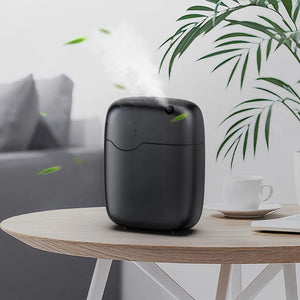
The gap between those two things is where most of the money in commercial scenting is wasted. A waterless cold-air machine atomises neat fragrance oil into dry micron droplets and pushes them into a volume of air. Its engineering advantage is that the droplets are small enough to stay suspended and travel, so the level at the far wall resembles the level at the machine. That is a solution to unevenness, and unevenness is a problem that only appears in large rooms. In a 250 sq ft reception the level is already even, because the room is small enough that ordinary air movement does the distribution for free. Owners hear "commercial grade" and read it as "better fragrance". It is not better fragrance. It is the same class of fragrance, delivered across more cubic metres.
The second misreading is about prestige, and it is worth stating plainly because it costs clinics real money. Parents cannot see your equipment. They cannot tell whether the reception carries a reed, a Sukoon or a machine mounted above the ceiling line, and they do not award credit for capital expenditure they cannot detect. What they detect is the level, and a level that reads as expensive is one they never remark on. The machine also carries a specific risk in a small room: it is built to hold its output against a large volume, so its lowest setting can sit above the threshold at which a parent in a children’s waiting area starts to notice. Buying capability you then have to suppress is the definition of the wrong purchase.
Three tests, and you need all three to pass
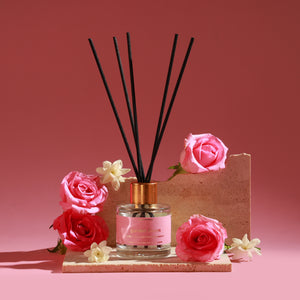
 Under 300 sq ftFrom ₹749Measure the reception and waiting area as one connected volume, and include the ceiling height rather than only the floor plate — a 400 sq ft reception under a 4.5 m ceiling holds far more air than the number suggests. Then count door openings in a busy hour. A clinic with a single glazed door onto a corridor loses very little; a clinic whose door gives directly onto a street loses the top of its level every time it swings. Under roughly 300 sq ft with a normal ceiling and a sheltered door, a machine has nothing to contribute and a reed or a Sukoon is the correct answer. Past roughly 600 sq ft, or with height or heavy door traffic, the distribution argument becomes real.
Zone by zone: what a Rs 11,999 purchase would and would not cover
Read this table as a value calculation. The machine is only ever working in the top rows, and in a typical paediatric clinic those rows are a minority of the floor plan.
| Area of the clinic | Scented? | Why | What we would use |
|---|---|---|---|
| Entrance and reception desk ★ | Yes, low | Short dwell and fresh noses arriving — the only zone where a signature registers at all | Reed ₹749, or Sukoon ₹1,899; a machine only past ~600 sq ft |
| Parent waiting seating | Only at minimum | The longest dwell in the building, and the machine’s floor may already be above it | Shared with reception, never a second unit |
| Consultation and examination rooms | No | Clinicians use their own sense of smell and a seated child cannot move away | Nothing |
| Vaccination, injection and procedure rooms | Never | A distinctive scent repeatedly paired with an injection becomes associated with it | Nothing |
| Nebulisation, asthma and neonatal follow-up | Never | Respiratory patients and newborns — the least latitude of any group in the building | Nothing |
| Isolation or infectious waiting | Never | Unwell children held in one place, sometimes nauseated, with no option to move | Nothing |
| Before any of this: close the housekeeping and ventilation list. If disinfectant, bins, filters, drains or damp are live, a machine will deliver fragrance plus the original smell, which parents like less than the original smell alone. | |||
Small reception · no power neededFrom ₹749Shop →  Mid reception · has an off switch₹1,899Shop →
 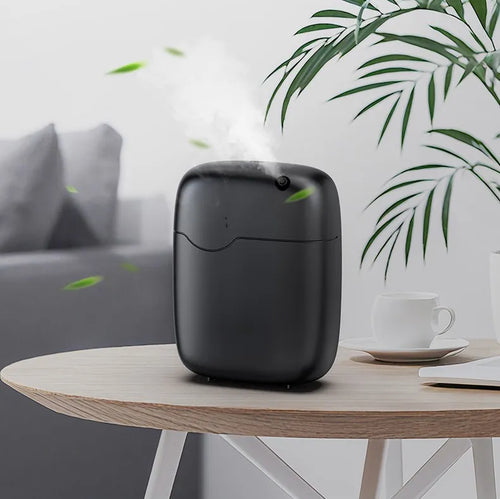 Large lobby · timed, dialable₹11,999Shop →
If you do buy one: how to run it in a paediatric setting
Start at the shortest on-time and the longest off-time the unit offers, and schedule it to clinic hours only. The Vaayu sets intensity by duty cycle rather than by a dial marked low-medium-high, which is precisely why it is usable here: seconds on against seconds off can be pushed far below the level a passive diffuser naturally holds. Scheduling to opening hours roughly halves consumption. The defaults it ships with were written for retail and hospitality, where the brief is to be noticed. Your brief is the opposite one.
Mount it high and aim it away from the seating. A child’s breathing zone sits roughly 0.8 to 1.2 m from the floor against an adult’s 1.5 to 1.7 m, so a unit standing on the reception counter delivers a stronger dose to the child than to the parent leaning over it. Above the door line, discharging along the ceiling and away from the waiting bank, is the placement that produces the flattest result. Keep it physically out of reach as a matter of course — not because of any hazard claim, but because a machine a four-year-old can press buttons on is a machine that will be found on maximum one morning.
Calibrate with a nose that has been outside for thirty minutes, and repeat it in a fortnight. Olfactory adaptation is essentially complete within about twenty minutes, so by mid-morning nobody working in the clinic can judge the level — and because they cannot smell it, they ask for more. That single mechanism produces most of the over-scented receptions in the country. Give the setting decision to someone arriving from outside. Choose the direction with the same restraint: dry, low-sweetness, Ritz-Carlton-inspired Quiet Luxury or Westin-inspired White Tea Serenity rather than anything floral or gourmand. And be able to switch it off within seconds for a family who asks.
What we would actually install
Matched to the size of the reception, which is the only variable that changes the answer. The last row is on the table because for a great many premium clinics it is the correct one.
| Option | Suits | Control you get | Price |
|---|---|---|---|
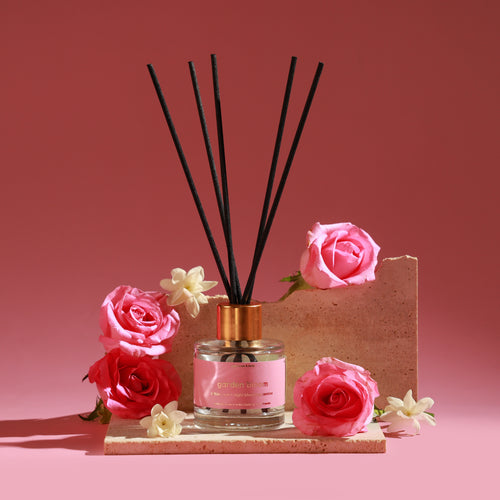
| Reed diffuser ★ | A small reception desk — a desk or a reception up to about 150 sq ft, on three reeds not six — no power, no minimum to fight down | Reed count only — no switch, no timer | from ₹749 |
| Sukoon 500ml | A reception up to ~320 sq ft — a reception of roughly 270 to 320 sq ft; intermittent mode, three drops, and a real off switch for ₹1,899 | On/off, intermittent mode, you control the drops | ₹1,899 |
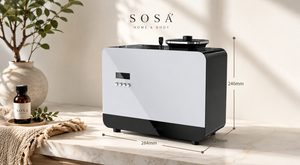
| Vaayu | A large lobby or a zoned duct — a contiguous reception past ~600 sq ft, a high ceiling, or a duct-zoned reception where scheduling matters | Duty cycle in seconds, timer, app scheduling | ₹11,999 |
| Aangan | Whole-facility HVAC — a 8,000–10,000 sq ft facility whose ducting is genuinely zoned so clinical areas can be excluded | Zone-level control, but only if the ducting is zoned | ₹25,999 |
| Nothing at all | Any clinic whose reception is under about 300 sq ft, and any clinic whose housekeeping and ventilation list is still open | Complete — and the correct answer more often than the trade admits | ₹0 |
Versailles
I sell the machine in question, and I will still tell most paediatricians not to buy it. The Vaayu is a good piece of equipment for the job it was built for, which is holding an even level across a large volume of air. A 250 sq ft reception is not that job. When a clinic of that size buys one, the first thing they do is spend a fortnight turning it down — and arrive at a level a ₹749 reed would have given them on day one.
The version of this conversation I have most often begins with a clinic owner telling me their practice is premium and therefore needs professional equipment. I understand the instinct — you have invested in everything else, and this feels like the same kind of decision. It is not. Nobody walking into your reception can see what is producing the smell. They can only judge the level, and the level that reads as expensive is the one they never mention.
Where I do recommend a machine, it is almost always a building reason: a big double-height reception, a door onto a main road, or a duct zone that lets us hold fragrance at the front and keep every clinical room out of it. Even then, reception only, scheduled to clinic hours, calibrated with a fresh nose, and switched off on request. Put the decision through your own infection-control and clinical governance leads rather than through a supplier — mine included. A portion of every order funds a girl’s classroom through Nanhi Kali.
Frequently asked questions
- Do I need a commercial machine at all? — the small-clinic answer, in full.
- At what size does professional scenting start? — the honest threshold.
- When is the Vaayu too much? — and the narrow case where it is not.
- Reed diffuser or active machine? — the reception comparison.
- Brand: the SOSA founder story.
SOSA products & prices (verified August 2026): Hotel Collection water-based ultrasonic diffuser fragrance 15ml ₹299 · 100ml ₹999 · 300ml ₹1,799 · Pack of 7 (15ml, all fragrances) ₹1,799; refills 100ml from ₹999. Seven scents: The Ritz-Carlton-inspired (white tea · bergamot · cedar), Westin-inspired (white tea · aloe · cedar), 1 Hotels-inspired (cedarwood · vetiver · green leaves), The St. Regis-inspired (amber · violet · woods), Shangri-La-inspired (jasmine · green tea · white tea), Four Seasons-inspired (citrus · floral · sandalwood), W Hotels-inspired (citrus · pepper · amber). Diffusers: Boond 300ml ₹899 · Sukoon 500ml ₹1,899 · Megh 6L ₹3,499. Water-based, phthalate-free, composed to IFRA standards for home diffusion; 3–6 drops per tank. Made in India, Pune. The Hotel Collection scents are SOSA's own interpretations inspired by the world's finest hotels; all hotel names are trademarks of their respective owners and are used only to describe the scent style — SOSA is an independent Indian fragrance house, not affiliated with or endorsed by any hotel brand. Prices and availability subject to change — see the live product pages.