


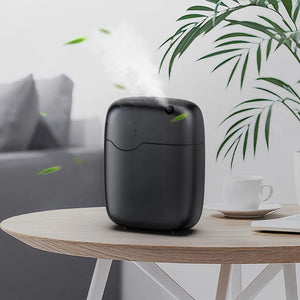
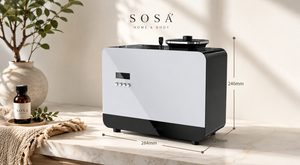
The count: three scented zones, not six. Three Sukoons at ₹5,697, with nine 15ml Hotel Collection bottles included.
The characters: Ritz-Carlton-inspired in the public zone, St. Regis-inspired in yours, Westin-inspired in the one that belongs to somebody else.
2. There are four kinds of zone, and only three carry fragrance. The threshold, where people arrive; the public zone, which is the living/dining and the mouth of the corridor; the private zone, which is the bedrooms; and the service zone — kitchen, bathrooms, utility. The threshold borrows from the public zone and the service zone gets extraction rather than scent.
3. A 3BHK supports three scented zones, not six. Public, yours, and somebody else's. That is three Sukoons at ₹5,697, which arrive with nine 15ml Hotel Collection bottles of your choice — Ritz-Carlton-inspired where the front door opens, St. Regis-inspired behind your own door, Westin-inspired where a guest or a child sleeps.
4. Make the transitions deliberate rather than dramatic. Run the levels descending — the public zone highest, your bedroom lower, the quiet zone lowest — and keep one note running through all three so the flat reads as one house. Cedar appears in the Ritz-Carlton-inspired, the Westin-inspired and the 1 Hotels-inspired, which makes that thread easy to find.
5. Do not zone a space nobody stands in. No machine in the corridor, nothing running to an empty guest bed, and a Boond at ₹899 rather than a 500ml unit in a bathroom. A reed diffuser from ₹749 keeps a waiting bedroom looked-after without becoming a fourth tank to fill.
A portion of every order supports girl-child education through Nanhi Kali.

What a zone is, and how many a 3BHK has
The word zone does a lot of quiet damage, because it borrows from lighting and furniture, where a zone is wherever you decide to put a rug. Fragrance is not that flexible. It moves with air, and air in an Indian flat moves the way doors and partitions allow it to, which means your zones were fixed by the builder rather than by you. The useful work is identifying the ones that already exist and then deciding which of them deserve a character, and that second decision is where most households overreach.
The four zones, and what each one wants
The whole model in one table — what each zone contains, what it should smell of and how it is actually run. The last two rows are the ones worth reading twice, because they are the two places households spend money without changing anything.
| The zone | What it contains | What it should smell of | How it is run |
|---|---|---|---|
| The threshold | The front door, the shoe cupboard and the first two metres of the flat | Borrowed from the public zone — nothing of its own | No machine. Ventilate the shoe cupboard and let the living/dining unit reach the door rather than standing beside it |
| The public zone ★ | The 350–500 sq ft living/dining and the mouth of the corridor | Ritz-Carlton-inspired · white tea · bergamot · cedar | One Sukoon at 90–120cm, central to the volume and on the front-door-to-balcony line, steady or the 4H timer while people are home |
| The private zone — yours | The 140–180 sq ft master bedroom behind a shut door | St. Regis-inspired · amber · violet · woods | One Sukoon across the room from the pillow and at least 1.5m away, on low with the 2H timer |
| The private zone — somebody else's | A 100–140 sq ft guest bedroom, child's room or study | Westin-inspired · white tea · aloe · cedar, or 1 Hotels-inspired if the room is worked in | One Sukoon on low with the 2H timer, switched on the day somebody is actually in there |
| The service zone | Kitchen, bathrooms and the utility area | Clean air. Extraction, dry floors and an emptied bin come first | Extractor while you cook rather than afterwards; a Boond at ₹899 is the right scale for a bathroom, a 500ml unit is not |
| Not a zone: the corridor | A passage with no door of its own | Whatever the rooms either side of it are running | No machine. It borrows and blends, which is the job it does in a hotel too — a reed diffuser from ₹749 there is decoration rather than coverage |
Hotel Collection · one per zonefrom ₹299Shop →  Sukoon · one per air mass₹1,899Shop →
 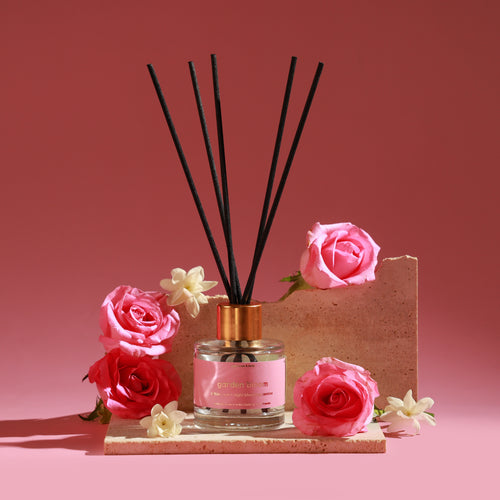 Reeds · the rooms in waitingfrom ₹749Shop →
Making the transitions deliberate
Zoning is not really about the rooms; it is about the doorways between them, because a doorway is the only place anybody smells anything consciously. Within about ten minutes in a room your nose has adapted and you are no longer registering the fragrance at all, which is why the household that lives in a well-scented flat notices it least. Every impression you are designing for is therefore made in the three or four seconds after a threshold is crossed, and that gives you one rule worth more than any other on this page: run the levels descending, from public to private to quiet. The living/dining unit is the loudest thing in the flat and is still set below the point of comment — steady or the 4H timer while people are home, on low if your rooms are at the smaller end. The master bedroom is quieter than that, on low with the 2H timer. The room somebody else sleeps in is quieter again, and switched on the afternoon they arrive rather than running all week. Walk the flat in that order and each threshold is a small step down, which is precisely what a hotel does between a lobby, a corridor and a room. Walk it the other way and every doorway is a small argument.
The second half of a deliberate transition is having something in common on both sides of the door. This is where zoning goes wrong most often, because the instruction to give each zone its own character gets followed with real enthusiasm and no thread — three scents chosen separately, each admirable, none related, and a flat that feels busy in a way nobody can name. The fix is the shared note. Cedar runs through the Ritz-Carlton-inspired, the Westin-inspired and the 1 Hotels-inspired; white tea runs through the Ritz-Carlton-inspired, the Westin-inspired and the Shangri-La-inspired. Draw your three zone characters so that at least one note repeats and the change at each door is legible as a change within one house rather than a move to a different building. There is a free test for this, and it takes a minute. Stand in the corridor with two bedroom doors open. If what you smell is pleasant and unremarkable, your zoning is coherent; if it is a muddle, two of your characters are fighting rather than sharing, and the usual culprit is a second rich scent sitting next to the amber. One rich zone per flat is the working limit.
Then the part where zoning stops paying, which is the part I would most like people to hear before spending. Six zones is not a more luxurious version of three; it is three good decisions plus three purchases that change nothing you experience. A machine in the corridor scents a passage nobody stands in for more than a minute while doing nothing for the rooms either side. A fourth Sukoon at ₹7,596 in total gives you a fourth tank to empty, rinse and refill every week for a bedroom nobody is awake in — three machines plus a 300ml 300ml refill is ₹7,496, a hundred rupees less, and it improves the zones you actually stand in. A bathroom is a service zone and wants an ₹899 Boond on a bottle you already own, if anything at all. And the one honest exception to all of this is layout rather than budget: if your living, dining and entrance are a single uninterrupted 450–500 sq ft with no door anywhere in them, your public zone is bigger than one machine's rating. Raise the unit to 90–120cm and move it central first, because that is free. If it still thins out at the ends, that volume — and only that volume — is where a waterless Vaayu at ₹11,999, rated for up to 1000m³, becomes a real conversation, with Sukoons staying behind the bedroom doors because a nebuliser does not open a door either.
The SOSA 3BHK edit
Zoning is mostly a set of decisions rather than a set of purchases, so this list is short and honest about which lines are optional. The first row is the whole model; the last row is the thing people buy instead of thinking about it.
| Buy | What it does | When it earns its place | Price |
|---|---|---|---|
| 1. Three Sukoons, one per zone ★ | 270–320 sq ft each in the public zone, your bedroom and the room somebody else sleeps in — nine 15ml Hotel Collection bottles between them, so the three characters cost nothing extra | Once the service zone is dealt with. Two at ₹3,798 is the honest place to start | ₹5,697 |
| 2. 300ml refill | The public zone runs longest and empties fastest — roughly ₹6 per ml against about ₹20 per ml in 15ml bottles, so the zone you notice most is never rationed | After a month, once one of the nine included bottles has clearly won | ₹1,799 |
| 3. Reed diffuser / Boond 300ml | A bedroom still waiting for a machine, kept looked-after with no socket and no tank; a bathroom at the right scale on the bottles you already own | Instead of a fourth machine, and only once the three zones are running | from ₹749 / ₹899 |
| 4. Pack of 7 × 15ml | A seasonal version of each zone — 105ml across all seven scents at about ₹17 per ml and roughly ₹257 a bottle | When the three zones have started smelling like one another | ₹1,799 |
| 5. Vaayu | Waterless, up to 1000m³, Bluetooth app and real scheduling, under 38dB — for a public zone that is one uninterrupted 450–500 sq ft with no door in it | Only after height and central placement have failed in that room, with bedrooms keeping their Sukoons | ₹11,999 |
| Not this: a machine in the corridor | Fragrance in a passage nobody stands in, and nothing for the rooms either side | Never. A corridor borrows by design | ₹1,899 |
Versailles
The first time somebody showed me a zoning plan for their flat it had seven zones on it, colour-coded, with a different fragrance in the entrance, the living room, the dining area, the corridor and each of three bedrooms. It was a beautiful document and it would have produced a home that felt like a department store. What I could not persuade them of at the time, and have got better at explaining since, is that zoning is subtraction. You are not deciding where to put fragrance; you are deciding where to leave it out.
Three zones, one character each, and the levels stepping down as you go further in. That is the whole method for a 3BHK, and the parts of it that matter most are free — the corridor left alone, the kitchen given an extractor instead of a diffuser, the guest room switched on the day somebody comes. Where I will happily talk you out of a purchase is the fourth and fifth zone. If nobody is awake behind that door, it does not want a machine, a bottle or a decision; it wants a reed diffuser and to be left in peace. And if your living, dining and entrance genuinely have no door between them, that is not an argument for more Sukoons either — it is one large zone, and it is the only place in this flat where a different machine is worth discussing at all.
Everything is made and supported from Pune, and a part of every order funds girl-child education through Nanhi Kali. You get a home that smells like somewhere you chose; a girl gets a classroom. That equation has always felt right to me.
Frequently asked questions
- Best three-fragrance wardrobe for a luxury 3BHK — the three characters, argued in full.
- Should every bedroom in a 3BHK have a different fragrance? — the private zone, split in two.
- Where should you place three Sukoons in a 3BHK? — placement inside each zone.
- Best SOSA whole-home fragrance setup for a premium 3BHK — the complete setup.
- Brand: the SOSA founder story.
Facts verified August 2026: SOSA Sukoon — 500ml tank, 2.4MHz ultrasonic cool mist, 270–320 sq ft coverage, 16–18 hours runtime on low and 9–12 on high, 30–50 ml/h mist output, 7-colour LED, remote and steady/2H/4H timers, BPA-free ABS with auto shut-off and overheat protection, ~17cm high — ₹1,899, including three 15ml Hotel Collection fragrances of your choice. Boond 300ml ₹899; Megh 6-litre ₹3,499. Hotel Collection water-based fragrance 15ml ₹299, 100ml ₹999, 300ml ₹1,799, Pack of 7 × 15ml ₹1,799; 100ml and 300ml refills from ₹999. Seven scents: The Ritz-Carlton-inspired (white tea, bergamot, cedar), Westin-inspired (white tea, aloe, cedar), 1 Hotels-inspired (cedarwood, vetiver, green leaves), The St. Regis-inspired (amber, violet, woods), Shangri-La-inspired (jasmine, green tea, white tea), Four Seasons-inspired (citrus, floral, sandalwood), W Hotels-inspired (citrus, pepper, amber). Waterless systems for larger and connected spaces: Vaayu ₹11,999 (up to 1000m³), Aangan ₹25,999 (8,000–10,000 sq ft), Meenar ₹38,500 (12,000–18,000 sq ft). The Hotel Collection scents are SOSA's own interpretations; SOSA is not affiliated with or endorsed by any hotel brand. Prices subject to change — see the live product pages.