Founder Diaries · Eye Clinic Scenting · 2,000+ Sq Ft
By Sonal Sahani · ISIPCA Versailles 9 min read Updated August 2026
With a measurement rather than a product, and the measurement has a name: the connected-volume test. At this size the question people ask me changes character. Below 1,500 sq ft a practice wants to know which machine; at 2,000 sq ft and above, with four or five patient-facing areas spread across a floor or two, they want to know whether they have crossed into a different category of system altogether. Usually they have not, and I would rather say that early than at the end. A 2,000 sq ft eye centre is still not a 2,000 sq ft scenting job. The clinical pathway takes nothing — workup, refraction, imaging, consultation cabins, the laser or procedure suite, recovery, sterilisation and stores — and what remains is reception plus whichever waiting areas genuinely share air with it. In centres of this size that comes to roughly 350–700 sq ft. Which puts you, on one connected path, squarely inside the range of a single Vaayu at ₹11,999 — comfortably inside it, not at the top of it — and a very long way from the commercial tier. Aangan at ₹25,999 becomes the honest answer at around 3,000 sq ft of connected public area, which is a hospital foyer with a mezzanine, not a clinic with four consulting rooms. This page is the test that tells you which of those buildings you are in, and it is deliberately physical: you walk it, with the doors in the position they hold at eleven on a Tuesday morning, and you write down what you find.
Quick answers — read this first
Multiple patient areas is a boundary question, not a size question. Walk from the front door to each waiting area with the doors as they actually are during clinic. Every area you reach without opening a door that is normally shut belongs to one connected volume.
A 2,000+ sq ft centre normally has 350–700 sq ft of connected public floor. That is a single-machine problem. One Vaayu ₹11,999, freestanding in reception, scheduled and key-locked, is the correct specification for that band.
The commercial tier starts far above you. Aangan ₹25,999 is rated at roughly 8,000–10,000 sq ft and becomes the honest answer at 3,000+ sq ft of connected public area; Meenar ₹38,500 sits above that. A clinic reception does not reach either.
Never HVAC-mount, and confirm refill supply first. Ducting into a central system puts fragrance in the clinical pathway. And
SOSA does not currently sell a separate Vaayu cold-air refill oil — the 400ml in the box lasts roughly 90+ days, which a multi-area centre standardising a scent must confirm before committing.
The short answer
Short answer: run the connected-volume test, add only the public areas on one air path, and buy one machine for that figure. Under 320 sq ft it is a
Sukoon ₹1,899; from 320 to about 800 sq ft on one path it is a
Vaayu ₹11,999. Genuinely separated public rooms are separate problems and get their own, usually smaller, answers.
Why the Vaayu rather than something larger: not for coverage — its rating of up to 1000 m³ already exceeds anything a clinic reception needs. For under 38 dB in a room where people sit a long time, a key-lock that stops the level drifting upward across a season, and 1h/4h/8h/24h run windows with day selection so it runs in clinic hours only.
Where to shop: Vaayu ₹11,999 for one connected volume above 320 sq ft.
Sukoon ₹1,899 for a separated waiting room of its own. Free shipping above ₹499.
How should a 2,000+ sq ft eye centre with several patient areas be scented?
Straight answer
1. Take the clinical pathway out of the calculation first, permanently. Workup and refraction, biometry and imaging, the visual field room, consultation cabins, the laser or minor procedure suite, any recovery or post-operative area, sterilisation, stores and records take nothing from us in any format, at any level, at any hour. At 2,000 sq ft that is typically 1,300–1,600 of your square feet gone before the first product is considered.
2. Run the connected-volume test on a working morning. Start at the patient entrance. Walk to each waiting area without touching a door. Every area you can reach is one connected volume; the first door you have to open is a boundary. Do it at eleven on a clinic day, not at seven in the evening, because the doors that are propped open during a session are the ones that decide this.
3. Measure only what is inside that volume. Reception, the main waiting bank, any overflow or dilation bay on the same path, and the optical display if patients wait in it. In the 2,000–3,000 sq ft centres I have gone through this comes to 350–700 sq ft. Write the number down; every decision below is a function of it.
4. From 320 to about 800 sq ft on one path, one Vaayu at ₹11,999 is the specification. Not for reach — you are inside its range with room to spare — but for the three things a clinic genuinely needs: under 38 dB, a key-lock, and 1h/4h/8h/24h run windows with day selection. A waiting room where the machine is audible is worse than one with no fragrance in it, and an eye centre is a quiet building.
5. Below 320 sq ft, it is still a Sukoon at ₹1,899, and a 2,000 sq ft address does not change that. I have specified a ₹1,899 machine for a centre of 2,400 sq ft, because its reception was a compact 240 sq ft counter-and-bench arrangement with everything else behind doors. Size to the arrival zone, never to the address.
6. The commercial tier is not where you think it is. Aangan at ₹25,999 is rated for roughly 8,000–10,000 sq ft and becomes the honest recommendation at 3,000+ sq ft of connected public area — a large eye hospital with an open foyer, not a centre with four consulting rooms. Meenar at ₹38,500 covers 12,000–18,000 sq ft and sits above that again. If somebody has quoted you the commercial tier for a 2,000 sq ft centre, ask them which connected public volume they measured.
7. One machine per building, not one per area. Inside a connected volume, a second source does not extend the first; it overlaps it, and the overlap is felt as an uneven floor. Separate rooms with doors that close are the only case for separate machines, and then each is sized on its own.
8. Two hard rules and one gap. Never HVAC-mount a Vaayu in a clinic: ducting fragrance into a central system routes it straight down the clinical pathway. Keep a fragrance-free seat that genuinely is one, and let reception — who breathe this for nine hours — set the level. And SOSA does not currently sell a separate Vaayu cold-air refill oil; the 400ml supplied lasts roughly 90+ days and is the whole supply at the time of writing, so a centre planning continuous running across several areas must confirm current availability with SOSA before committing. Composed and made in small batches in Pune; a portion of every order supports girl-child education through Nanhi Kali.
TL;DR: walk the building with the doors as they actually are, and add only the public areas you can reach without opening one. In a 2,000+ sq ft eye centre that is normally 350–700 sq ft — one machine, and that machine is a Vaayu at ₹11,999 for the noise floor, the key-lock and the scheduled run windows rather than for coverage. Under 320 sq ft it is still a Sukoon at ₹1,899. The commercial tier starts at 3,000+ sq ft of connected public area and a clinic of this size does not reach it. Freestanding only, never HVAC, and confirm Vaayu refill supply before standardising.
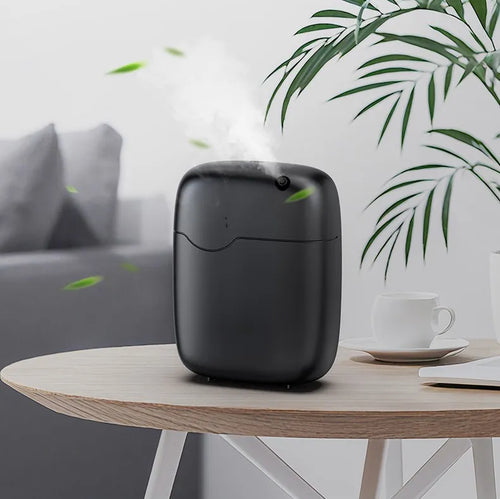
The right machine for one connected public volume above 320 sq ft
SOSA Vaayu · waterless cold-air nebulisation, Bluetooth scheduling, key-lock ₹11,999
I want to be precise about why this is the machine at this size, because the obvious reason is the wrong one. You are not buying coverage. Rated at up to 1000 m³ — roughly 2,000–3,000 sq ft — it already exceeds the 350–700 sq ft you actually have, and if coverage were the only consideration you would be over-buying. You are buying three operational specifications that no cheaper machine in the range offers. Under 38 dB, which matters more in an eye centre than anywhere else I sell into, because patients sit for long stretches with little to occupy them and a machine they can hear is an irritation with no compensating benefit. A key-lock, which is how an installation stays at the level you chose instead of drifting upward every time somebody decides the room has gone flat. And run windows of 1h, 4h, 8h or 24h with day selection, so the machine works clinic hours and is genuinely absent during cleaning and overnight. Mechanically it is waterless: pressurised air atomises undiluted oil into a dry mist, so no humidity is added and nothing is left on surfaces. 5W, 0.9 kg, black or white, CE, RoHS and SGS certified. Three conditions I would put in writing. Freestanding in reception, set well back from the corridor to consultation — it can be wall or HVAC mounted and in a clinic you must not. Start at the lowest intensity and leave it a fortnight before judging. And there is no separate Vaayu cold-air refill oil on sale at the time of writing; the 400ml in the box runs about 90+ days, which is 400 ÷ 90 = 4.4ml a day at a mid setting, and the water-based Hotel Collection is not a substitute. Confirm supply before you standardise.
Part one — the connected-volume test, in three passes
This is a twenty-minute procedure and it replaces every assumption in your quotation. Three passes: the doors as they really are, the areas that survive that pass, and the returns that will move whatever you put in. Do all three on the same morning, in a working session, and write the results on the floor plan rather than in your head.
1
PASS ONE · THE DOOR CENSUS, AT ELEVEN ON A CLINIC DAY
A building has two floor plans — the one on the drawing and the one that exists while patients are in it — and only the second one matters
Start at the patient entrance and walk to every area a waiting patient might occupy, touching nothing. The rule is simple: any space you can reach without opening a door that is normally closed is part of one connected volume. The first door you have to open is a boundary, and everything past it is a separate problem. The reason to do this during a session rather than after hours is that internal doors in eye centres are rarely in the position the drawing shows. The workup room door is often propped because the technician is calling patients in and out every four minutes. The corridor door to the consultation wing is frequently hooked open all morning and only closed at the end of the day. A fire door on a staircase may be held by a magnet that releases only on an alarm. Each of those turns a drawn boundary into no boundary at all, and each of them changes your answer — not by making the machine bigger, but sometimes by making the whole project inadvisable. If the corridor to consultation is propped open through every clinic session, then anything you run in the waiting bank is on the same air path as your consultation cabins, and the correct response is a lower level and a source at the far end of the room, or nothing. Write the census down as a list: door by door, open or shut, during clinic. It is the single most useful piece of paper in this exercise and it costs nothing to produce.
The rule: a door that is propped open during clinic is not a boundary, whatever the drawing says.
2
PASS TWO · MEASURE ONLY WHAT SURVIVED THE CENSUS
The figure you buy against is the sum of public areas inside one volume — usually a fifth to a third of a 2,000 sq ft centre
 Sukoon 500ml₹1,899 · a separated room of its own
Now measure, with a tape rather than an estimate, and only inside the volume the census defined.
Reception and the main waiting bank as one rectangle. Any overflow or dilation bay on the same path. The optical display area, if patients wait in it rather than merely pass through. Do not measure corridors that lead to clinical rooms — those are boundaries you are defending, not floor you are treating. Add them. In centres between 2,000 and 3,000 sq ft the answer has been between 350 and 700 sq ft in every one I have worked through, and the spread is explained almost entirely by whether the optical section is inside the volume or behind a partition. Two notes on accuracy. If any part of the volume is double height — an atrium entrance, a void over the desk, a mezzanine landing that looks down into reception — flag it, because coverage figures are floor areas quoted at ordinary ceiling heights and a tall space holds more air than its footprint suggests. And if your centre spans two floors connected by an open staircase with no door, the two floors are one volume and you should measure both. That last case is the only realistic way a clinic of this size gets past 800 sq ft, and it is worth knowing before rather than after.
The arithmetic: at 2,000–3,000 sq ft total, expect 350–700 sq ft of public volume — a fifth to a third, no more.
3
PASS THREE · FIND THE RETURNS, BECAUSE THEY DECIDE WHERE IT GOES
In a centre this size the air handling is doing more distribution than any machine will, and half of it moves toward rooms you are protecting
Stand under each ceiling grille in the public area and work out which are supplies and which are returns — a tissue held up will tell you in two seconds. Mark them on the plan. Then follow the logic: a source placed near a supply is carried outward into the room, and a source placed near a return is drawn into the system and delivered wherever that system delivers. In a centre of 2,000 sq ft or more, that second case is the one to worry about, because a shared air-handling unit almost always serves clinical rooms as well as reception. Placing a diffuser under a return is a slow, accidental version of the HVAC mounting I tell every clinic never to do deliberately. So the placement specification writes itself: freestanding, waist to chest height, near a supply rather than a return, at the end of the waiting bank furthest from the corridor to consultation, a metre or two clear of where people stand and well away from the reception desk chair itself. There is a second reason for the far-end placement that has nothing to do with the air. The person who will judge the level most often is the one sitting at the desk for nine hours, and if the source is eighteen inches from them and twenty feet from everyone else, the level that suits the room will be unbearable for them and the level that suits them will be undetectable in the room. Give the machine its own distance from everybody.
Part two — where each tier genuinely begins
The published coverage figures are manufacturer specifications for open volumes, and reading them straight is how centres end up two tiers above what they need. This table restates each tier as the connected public area at which I would actually recommend it in a clinic, which is a different and much more useful number.
Rated coverage against the clinic threshold
What each machine is rated for, where I would actually start recommending it, and what disqualifies it here
| Machine |
Where I would start recommending it in a clinic |
Why, in clinic terms |
What rules it out at 2,000+ sq ft |
The catch nobody mentions |
| Vaayu ₹11,999 ★ |
320–800 sq ft on one unbroken path |
Under 38 dB, key-lock, 1h/4h/8h/24h windows with day selection; rated up to 1000 m³ ≈ 2,000–3,000 sq ft |
Nothing — this is the tier a centre of this size lands in |
No separate cold-air refill oil on sale at the time of writing |
| Reed diffuser ₹749–₹1,349 |
Under 150 sq ft, or a separated corner |
Silent, no power, no humidity, nothing anyone can adjust |
Cannot hold a 400 sq ft public floor at any bottle count |
No off switch — it is carried out of the room by hand |
| Boond ₹899 |
A small separated room only, about 150 sq ft |
The cheapest way to find out whether you want a machine |
Undersized for any main reception at this address |
Ultrasonic, so it adds humidity to the room |
| Sukoon ₹1,899 |
150–320 sq ft, including inside a 2,400 sq ft centre |
270–320 sq ft rated, remote, steady/2H/4H, three 15ml scents in the box |
Only the volume rules it out — and often it does not |
No key-lock, and it adds humidity |
| Megh ₹3,499 |
Never, as a coverage step |
6L tank and roughly 100 hours a fill — runtime and humidity |
Rated ~215 sq ft, less than the Sukoon below it in price |
Presented as an upgrade far too often, including to clinics |
| Safar ₹3,999 |
Personal scale only, never a room |
Cordless, waterless, 20ml, 6.9cm, three speeds, 1/2/3-hour auto-off |
Not a room product in any configuration |
No published coverage figure exists at all |
| Aangan ₹25,999 |
3,000+ sq ft of connected public area |
Commercial nebulising rated ~8,000–10,000 sq ft — a hospital foyer |
A 2,000 sq ft centre has no volume that reaches this |
HVAC-integrated, which is why it is rarely a clinic answer |
| Meenar ₹38,500 |
Multi-storey public atrium scale |
Commercial HVAC scenting rated 12,000–18,000 sq ft |
Two tiers past anything on your floor plan |
Same integration objection, at a larger scale |
|
The honest caveat: rated coverage figures are manufacturer specifications for open volumes and vary with ceiling height, air exchange, occupancy and intensity setting; the thresholds in the third column are my own recommendations for clinic arrival zones, not standards. Nothing on this page is medical, clinical, ventilation, air-handling, infection-control, accreditation or regulatory advice — all of those belong to your own clinicians and licensed contractors. No SOSA product or setting is described as safe or unsafe for any patient or staff group, and no claim is made about how any person perceives or responds to fragrance beyond the plain fact that some people are sensitive to it, which is why the clinical pathway stays fragrance-free and why a fragrance-free seat must genuinely exist. Aangan and Meenar are HVAC systems and I would not put either into a clinic's shared air handling for the same reason I would not duct a Vaayu into it — which is why the commercial tier is, in practice, a large open-foyer answer rather than a clinic answer at all. SOSA publishes no bulk pricing, installation service, warranty term or multi-site programme; ask through the contact page before committing. |
Shop this guide
One machine for the connected volume, and smaller answers for genuinely separated rooms
The SOSA principle
Tiers are sold on rated area and bought on floor area, and the two are almost never the same building. A 2,000 sq ft eye centre with five patient areas has one public volume of a few hundred square feet, and the honest upgrade path stops at one machine.
If a proposal jumps you to the commercial tier, ask which connected volume it was measured against.
Part three — what multiple patient areas actually change
Here is the thing that surprises people at this size: having four or five patient-facing areas changes the placement problem and barely touches the product problem. If they are all on one connected volume, you have one room with an unusual shape, and one source at the point where the air gathers will serve it more evenly than four sources ever could. Uneven shape is handled by placement rather than by multiplication — find the position where the entrance draught and the AC supply both move air outward into the space, and let the building distribute. What multiple areas genuinely change is the exposure question. A patient in a 2,000 sq ft centre may pass through reception, sit in a main waiting bank, be moved to a dilation bay, and wait again — an hour and a half in your air rather than twenty minutes, sometimes with dilated pupils and very little to distract them. That is an argument for a lower level rather than a larger machine, because the dose has to be set for ninety minutes and not for the first ten seconds. Every clinic I have ever revisited was running lower a year later than on the day it was installed, and none of them regretted it.
The second thing that changes is who is in the air all day. A larger centre has more staff sitting inside the scented volume for a full shift — reception, the optical counter, sometimes a coordinator's desk — and their exposure is four or five times any patient's. So the level is their decision rather than yours, and I would put that in operational terms: whoever is at the desk should be able to switch it off entirely, without asking, on any day they want to. That instruction sits oddly with a key-lock, so let me be exact about the distinction. The lock exists to stop the level being raised quietly over a season, which is the drift that ruins clinic installations. It should never be used to stop the machine being turned off. Set the run window, lock the intensity, and give the desk the ability to end the day early. If your staff would rather have nothing at all, that is a complete answer and needs no further justification.
And the case in which a 2,000 sq ft centre should not do this: when the census in Part one comes back with the consultation corridor propped open through every session. At that point the waiting bank and the clinical rooms are on one air path, and running any source in the waiting bank means running it into the corridor whether you intend to or not. The options are all cheap and none of them is a machine. Fit a closer or a hold-open that actually releases. Reroute the traffic so the door can stay shut. Move the source to the entrance end of the room, twenty feet further from the corridor mouth, and drop the level until it is undetectable at the threshold. Or accept a reed diffuser at two of six reeds by the entrance and nothing else in the building — a deliberately small fragrant zone at the door, which is a legitimate and rather elegant answer for a clinic whose plan does not permit anything larger. Choosing that at 2,400 sq ft is not under-buying. It is reading the building correctly.
The published coverage number tells you what a machine can fill. The census tells you what you are allowed to fill — and in a clinic, the second number is the specification.
— Sonal Sahani, SOSA
Part four — the specification, written out
If the test came back with one connected volume between 320 and 800 sq ft, this is the whole installation on one page. Every row is a decision somebody will otherwise make badly six months from now.
The installation specification
Decision, the setting I would specify, and what goes wrong when it is left open
| Line in the specification |
The value I would write |
What goes wrong if it is left blank |
Who in the practice owns it |
| Mounting ★ |
Freestanding in reception. Never HVAC or duct mounted |
Fragrance delivered into the clinical pathway by the air handling |
The clinical lead, and nobody else |
| Position within the room |
Far end of the waiting bank from the corridor mouth, near a supply grille, not a return |
A machine that empties into the ceiling and reaches nobody |
Whoever walked the building with the tissue |
| Height and clearance |
Waist to chest, stable surface, a metre clear of standing traffic |
A level that suits the desk and is invisible in the room |
The reception team |
| Intensity |
Lowest setting, held for a fortnight before any change |
The adaptation-and-increase cycle across a season |
One named person, not a rota |
| Run window |
Clinic hours only, via 1h/4h/8h/24h windows and day selection |
Fragrance layered over cleaning chemistry, making a third smell |
Whoever sets the housekeeping schedule |
| Key-lock |
On, after the level is set — and it must never block switching off |
Quiet upward drift that nobody can attribute later |
The practice owner |
| Off authority |
Every person on the desk, unconditionally, no permission needed |
An installation the people inside it all day cannot escape |
Written into the desk's own instructions |
| Fragrance-free seating |
A named bay or the entrance seats, genuinely outside the volume |
A promise that cannot be kept the first time somebody asks |
Whoever seats patients |
| Consumable planning |
Confirm current Vaayu refill availability with SOSA before committing |
A standardised scent with no confirmed way to continue it |
Purchasing, in writing, before the order |
Honest notes for buyers: nothing on this page is medical, clinical, ventilation, air-handling, building, infection-control, accreditation or regulatory advice, and no clinical outcome, patient response, safety property or business result is claimed for any product, setting, placement or schedule. No SOSA product or setting is described as safe or unsafe for any patient or staff group; some people are sensitive to airborne fragrance, which is exactly why the clinical pathway stays fragrance-free and why a fragrance-free seat must genuinely exist. Fragrance adds a scent alongside what is already in the air — it removes, neutralises, masks or purifies nothing — and SOSA sells no air purifier, no dehumidifier and no room spray; every SOSA spray is a car perfume. Coverage figures are manufacturer specifications and vary with ceiling height, air exchange, occupancy and intensity: Boond ₹899 ~150 sq ft, Sukoon ₹1,899 270–320 sq ft,
Megh ₹3,499 only ~215 sq ft, which is less than a Sukoon — a runtime and humidity machine, never a coverage upgrade, Safar ₹3,999 with no published coverage figure at all, Vaayu ₹11,999 up to 1000 m³ ≈ 2,000–3,000 sq ft, Aangan ₹25,999 ~8,000–10,000 sq ft, Meenar ₹38,500 12,000–18,000 sq ft. Boond, Sukoon and Megh are ultrasonic and add humidity; reeds and the Vaayu add none. Reed strength positions are on SOSA's own internal scale
at six reeds, not an industry standard, a concentration or a quality ranking; replacement reeds are not sold separately, and the reed range has no oud, no musk-forward composition and no aquatic. Reed oil cannot go in an ultrasonic machine, water-based Hotel Collection cannot go in a reed bottle, and neither goes in a Vaayu. Oil-only reed refills are 300ml ₹2,399, which is ₹2,399 ÷ 300 = ₹8.00 a millilitre, and 500ml ₹3,499, which is ₹3,499 ÷ 500 = ₹7.00 a millilitre, against ₹749 ÷ 50 = ₹14.98 for the smallest bottle. Hotel Collection water-based fragrance is for ultrasonic machines only: 15ml ₹299 (₹299 ÷ 15 = ₹19.93 a millilitre), 100ml ₹999 (₹999 ÷ 100 = ₹9.99), 300ml ₹1,799 (₹1,799 ÷ 300 = ₹6.00), and a pack of seven 15ml at ₹1,799, which is 7 × 15ml = 105ml, so ₹1,799 ÷ 105 = ₹17.13 a millilitre — the pack buys variety, not value. A Sukoon plus a 300ml is ₹1,899 + ₹1,799 = ₹3,698.
SOSA does not currently sell a separate Vaayu cold-air refill oil; the 400ml supplied in the box lasts roughly 90+ days and is the whole supply available at the time of writing, so a practice planning continuous running across several patient areas — and any practice standardising a scent it intends to keep — must confirm current refill availability with SOSA before committing, and the water-based Hotel Collection is never a substitute for it. SOSA publishes no bulk or commercial pricing, corporate account, maintenance contract, installation service, stated warranty term, delivery window or multi-site programme, and whether the Bluetooth app is iOS or Android is not published — ask through
the contact page before committing.
Never mount a Vaayu, or any diffuser, into a clinic's shared HVAC. Hotel Collection scents are inspired by hotel styles only; SOSA is independent and unaffiliated, and no hotel group is a SOSA customer, partner or reference. Free shipping above ₹499.

For the separated room the census found — and for the large centre with a small reception
SOSA Sukoon · 500ml ultrasonic, remote, steady / 2H / 4H ₹1,899
Two situations at this size end here rather than at the Vaayu, and both are common enough to deserve their own paragraph. The first is a genuinely separated public room — a first-floor waiting area with its own lobby and a door that closes, a satellite counter on another floor, a paediatric bay behind a partition — which is a separate 150–320 sq ft problem and takes the machine sized for it rather than a share of a larger one. The second is the 2,000 sq ft centre whose reception is simply small: a counter, two benches, everything else behind doors, 240 sq ft on the tape. A large address does not create a large arrival zone, and specifying upward because the building is impressive is exactly the mistake this page exists to prevent. The Sukoon covers 270–320 sq ft, holds 500ml, runs 16–18 hours on low, and has a remote so the desk can drop the level without leaving it, plus steady, 2H and 4H modes. Three 15ml Hotel Collection scents come in the box, which is enough to settle on one before buying the 300ml at ₹1,799 — that is ₹1,799 ÷ 300 = ₹6.00 a millilitre against ₹299 ÷ 15 = ₹19.93 for the small bottles, so the small ones are for choosing and the large one for running. Two honest limitations. It is ultrasonic, so it aerosolises water and adds humidity to the room. And it has no key-lock, so if quiet upward drift is your concern, that is an argument for the tier above rather than a reason to run this one harder.
A note from Sonal
The enquiry that produced the door census came from a centre of a little over two thousand square feet with a beautifully drawn plan and a proposal for a system three tiers above anything I would have suggested. I asked for one thing before answering: a photograph of the corridor to consultation, taken at eleven on a clinic morning, without arranging anything first.
The door was hooked open. It had been hooked open every morning for two years, because the technician calling patients in was doing it forty times a session and had solved the problem in the obvious way. Which meant their waiting bank and their consultation wing were one air path, and the entire proposal — the large machine, the even coverage, the signature scent — would have been an efficient method of delivering fragrance somewhere it had no business being.
We did not sell them the commercial system. They fitted a door closer, which cost a fraction of anything on my price list, and three months later took a single machine for a public volume of just under five hundred square feet, run on a clinic-hours window at the lowest intensity, sited at the entrance end of the bank. The thing I want other centres to take from it is not the product. It is that the most consequential measurement in this whole exercise is free, takes twenty minutes, and can only be done while patients are in the building. Composed and made in small batches in Pune, and a part of every order funds a girl's classroom through Nanhi Kali.
Frequently asked questions
We are 2,400 sq ft. Does that put us at the top of the Vaayu's range or past it?
Neither, and the question contains the mistake. The Vaayu's rating describes an open volume of up to 1000 m³, roughly 2,000–3,000 sq ft, but you are not scenting 2,400 sq ft — you are scenting the connected public floor inside it, which at that address is normally 350–700 sq ft. So you sit comfortably inside the range with a great deal of headroom, which is why I would run it at its lowest intensity. Being well inside a machine's range is a good position to be in; it is being at the edge of one that produces problems.
At what point does an Aangan at ₹25,999 become the right answer?
At around 3,000 sq ft or more of connected public area — a large eye hospital with an open foyer, a mezzanine and several hundred people moving through it, not a clinic with a reception and four consulting rooms. Its rated coverage is roughly 8,000–10,000 sq ft, and Meenar at ₹38,500 covers 12,000–18,000. There is a second reason a clinic rarely lands there: those are HVAC-integrated systems, and I would not put fragrance into a clinic's shared air handling for exactly the reason I tell you never to duct a Vaayu. In practice the commercial tier is a large-foyer answer rather than a clinic answer.
Our waiting areas are on two floors. One machine or two?
It depends entirely on the staircase. If the two floors are joined by an open stair or a void with no door, they are one connected volume and you measure both and buy once — that is the main way a clinic of this size gets past 800 sq ft. If the stair has a door that is normally closed, or the upper waiting area has its own lobby, they are two rooms and each is sized independently, which usually means one larger machine downstairs and a Sukoon at ₹1,899 upstairs. Do not expect them to smell identical; different volumes with different traffic never do.
Should we use different scents in different patient areas?
Not within one connected volume — you would simply be making a seam where the two meet, and the result reads as confusion rather than as variety. Across genuinely separated rooms it is possible, but I would still keep one scent through the building. A clinic is judged on competence, and the target is considered rather than scented; several different fragrances in one practice is the fastest way to make a building feel styled. If you want the optical section to read a little warmer, do it with materials and light rather than a second fragrance, and only if that section's air does not carry into the clinical corridor.
We want one signature scent across three branches. Anything we should settle first?
Supply, before anything else. SOSA does not currently sell a separate Vaayu cold-air refill oil; the 400ml supplied in the box lasts roughly 90+ days and is the whole supply available at the time of writing. For a home buyer that is an inconvenience. For a practice that has taught three receptions, a website and a patient population to associate one scent with its name, it is a business problem — so confirm current refill availability with SOSA through the contact page before you commit, not after. The same applies to anything you would reasonably expect to exist and does not: SOSA publishes no bulk pricing, installation service, maintenance contract, warranty term or multi-site programme. Ask, in writing, first.
Eye clinics · size and machine choice · 2,000+ sq ft
Run the connected-volume test, then buy one machine
A 2,000+ sq ft eye centre with several patient areas is normally one public volume of 350–700 sq ft, because the clinical pathway takes nothing. Walk the building at eleven on a clinic morning with the doors as they actually are, measure only what you can reach without opening one, and specify a single machine for that figure. From 320 to about 800 sq ft on one path, the Vaayu at ₹11,999 is right — for under 38 dB, a key-lock and scheduled run windows rather than for coverage. Below 320 it is still a Sukoon at ₹1,899, whatever the address. Freestanding in reception, never ducted into shared HVAC, and confirm current refill availability before standardising a scent. Free shipping above ₹499.
Vaayu ₹11,999 → Sukoon ₹1,899
Continue the read
The sizing family, in order
Editorial standards & sources
About this guide: Written by Sonal Sahani, ISIPCA Versailles-trained founder and perfumer at SOSA Home & Body. It applies the cluster's sizing correction to eye centres of 2,000 sq ft and above: the scented volume is the connected public floor established by walking the building with the doors in their working position, which typically comes to 350–700 sq ft, and the clinical pathway is fragrance-free throughout. It states where each machine tier genuinely begins for a clinic, corrects the common assumption that a 2,000 sq ft centre is at the limit of a single machine, places the commercial tier at 3,000+ sq ft of connected public area, and rules out HVAC mounting in a clinic entirely. Nothing here is medical, clinical, ventilation, air-handling, infection-control, accreditation or regulatory advice; no clinical outcome, patient response, safety property or business result is claimed. Coverage figures are manufacturer specifications. No competitor is named or rated, and no hotel group is a SOSA customer, partner or reference.
SOSA range, specifications and prices used in this guide (verified August 2026): Vaayu ₹11,999 — waterless cold-air nebulisation of undiluted fragrance oil; no water, no heat, no added humidity, no white mineral dust. Coverage up to 1000 m³, about 2,000–3,000 sq ft. 400ml refillable tank lasting roughly 90+ days at a mid setting. Bluetooth app plus onboard controls, 1h / 4h / 8h / 24h run windows, day selection, adjustable intensity, auto-stop and key-lock.
Under 38 dB. DC 12V / 1A, 5W. Freestanding or wall / HVAC mount. CE, RoHS and SGS certified.
SOSA does not currently sell a separate Vaayu cold-air refill oil; the 400ml supplied in the box is the fragrance available at the time of writing, so a practice planning continuous or multi-site use should confirm current refill availability with SOSA before committing. The water-based Hotel Collection is made for ultrasonic machines and must not be used in a Vaayu. Other machines: Boond 300ml ₹899 (~150 sq ft, ultrasonic) · Sukoon 500ml ₹1,899 (270–320 sq ft, 16–18 hours on low, remote and steady/2H/4H timers, three 15ml fragrances included, ultrasonic) · Megh 6L ₹3,499 (
~215 sq ft — a runtime and humidity machine that covers less than a Sukoon, never a coverage upgrade) · Safar ₹3,999 (waterless cold diffusion, cordless, 20ml, about 6.9cm, three speeds, 1/2/3-hour auto-off — sold as a car and travel diffuser, personal-scale only;
SOSA publishes no coverage figure for it) · Aangan ₹25,999 (HVAC nebulising, ~8,000–10,000 sq ft) · Meenar ₹38,500 (commercial HVAC, 12,000–18,000 sq ft). Water-based Hotel Collection for ultrasonic machines: 15ml ₹299 · 100ml ₹999 · 300ml ₹1,799 · pack of seven ₹1,799; scents are
inspired by the atmosphere of well-known hotels — SOSA is an independent Indian brand and is not affiliated with, endorsed by or supplying any hotel group. Reed diffusers ₹749–₹1,349 (50ml 6–8 weeks, 130ml 14–18 weeks, six fibre reeds, no 100ml size; replacement reeds are not sold separately). Reed oil cannot be used in an ultrasonic machine and Hotel Collection oil cannot be used in reeds.
SOSA sells no room spray or home spray — every SOSA spray is a car perfume. Nothing in this guide is medical, clinical or safety advice. A fragrance diffuser adds a scent to the air. It does not clean, purify, filter, sanitise or disinfect air, does not remove or neutralise disinfectant, damp or occupancy smells, and has no effect on comfort, anxiety, waiting time, recovery or any clinical outcome. Some people are sensitive to airborne fragrance, which is why this guide recommends that examination rooms, diagnostic areas, consultation cabins, procedure suites and post-operative areas remain fragrance-free, that a fragrance-free seating option always exist, and that a diffuser is never mounted into shared HVAC in a clinical building. Decisions about clinical policy, ventilation standards, infection control and patient suitability rest entirely with the practice and its clinicians. A persistent stale, damp or disinfectant smell is a ventilation, moisture or cleaning problem — SOSA sells no dehumidifier and no air purifier, and fragrance should never be used to cover one. Coverage, runtime and longevity figures are manufacturer specifications and typical ranges, not guarantees, and vary with room volume, ceiling height, air exchange, occupancy and season.
SOSA publishes no commercial or bulk pricing, no corporate account, no annual maintenance contract, no installation service, no stated warranty term and no multi-location programme; warranty length, spare parts, servicing and app platform availability are unconfirmed, and larger or multi-site enquiries should go through
the contact page before any commitment. Composed and made in small batches in Pune, India. Free shipping above ₹499. A portion of every order supports girl-child education through Nanhi Kali. Prices subject to change — see the live product pages.



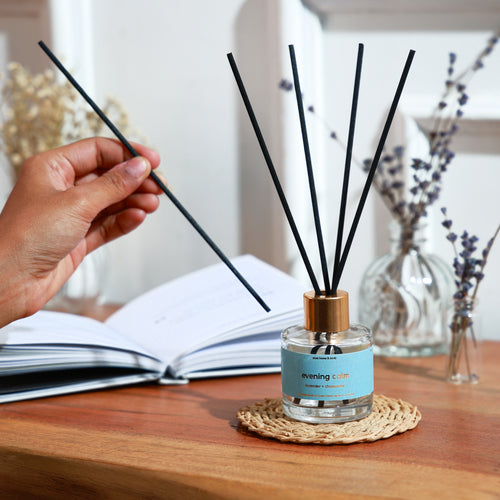 Evening Calm · the softest in the range₹799Shop →