
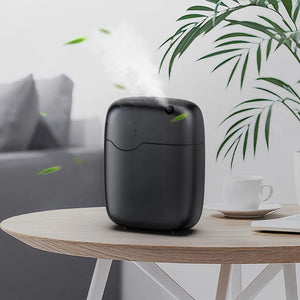

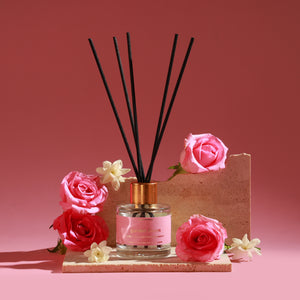

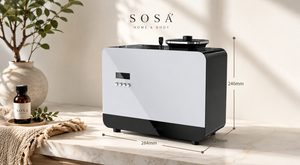
What we would use: one Sukoon at ₹1,899 on three drops in intermittent mode, or two reed points at ₹1,249 each.
Possibly two points: if reception and the seating bay are separated by a corner, two mild sources beat one strong one.
Before installing: find the return-air grille. If it serves both reception and the consultation corridor, you have one air space, not two.
2. Match the equipment to the shaded area, not the lease. A Sukoon covers roughly 270 to 320 sq ft, so it is sized for exactly that shaded area. This is the first clinic size at which a powered diffuser is proportionate rather than excessive. The Vaayu at ₹11,999 is rated for large areas and remains the wrong machine here — not the premium upgrade, the wrong tool. If you specify from the total floor area rather than the scentable area, you will buy one size too big every time.
3. Consider two mild points rather than one strong one. Receptions at this size are rarely a single square box. If yours turns a corner, or has a pram bay or a separate seating alcove, put a source in each and run both low: a Sukoon at the counter and a 130ml reed at ₹1,249 in the alcove, for instance. Two sources at low output produce a more even and much more forgiving result than one source working hard, and the concentration never spikes in any one spot.
4. Trace the return-air path before you drill anything. Doors help, but ducting decides. Find every return grille and work out what it serves. If the reception return also draws from the consultation corridor, then reception and the corridor are one air space and your fragrance-free rooms are downstream of your diffuser. A tissue held at the grille shows you which way the air is going in about five seconds. Do this before committing to a position, not after a doctor complains.
5. Keep the level where a 300 sq ft room would want it. The commonest error at 750 sq ft is assuming the intensity should rise with the floor area. It should not. The target is unchanged: a parent should not consciously register the fragrance, and a child sitting for forty minutes should certainly not. A larger clinic needs a better-placed source, not a stronger one. Three drops in intermittent mode is the starting point regardless of whether the clinic is 300 or 750 sq ft.
Made in India, composed by an ISIPCA Versailles-trained perfumer — and a portion of every order supports girl-child education through Nanhi Kali.

Why 750 sq ft is the first proportionate size
Below about 500 sq ft, a clinic is effectively one air space and any powered source is rated for the whole premises rather than for a zone within it. That is why the honest recommendation at 300 sq ft is a reed or nothing. At 750 sq ft, two things change at once. The reception becomes a room in its own right, typically 250 to 350 sq ft with its own seating and its own air movement, and the consultation rooms usually acquire doors that actually close rather than curtains or half-height partitions. For the first time the line between scented and fragrance-free is drawn on something physical. That is what makes a powered diffuser reasonable here — not the extra footage in itself.
The second change is that the two exposure populations separate. In a 300 sq ft clinic the parent at the counter and the child in the chair are two metres apart and breathe the same air. At 750 sq ft the seating is usually four to eight metres from the counter, often round a corner, which means you can deliberately place the source at the short-dwell position and let the concentration fall away towards the long-dwell one. That is a design choice you simply do not have in a small clinic, and it is worth more than any increase in equipment specification. A well-placed ₹1,899 diffuser at this size outperforms a badly placed ₹11,999 one, because the expensive machine’s advantage is reach, and reach is not the problem you have.
One point, two points, or none at all
 Mid reception₹1,899If the reception and waiting are one continuous space of roughly 250 to 350 sq ft, one Sukoon is the whole installation. Place it high — on a shelf or wall bracket above head height — behind or beside the counter, aimed away from the seating row, and run three drops of a dry low-sweetness fragrance in intermittent rather than continuous mode. Schedule it to clinic hours only: there is no reason to scent an empty building overnight, and running to occupancy roughly halves consumption.
Zone by zone at 750 sq ft
Shade the first three rows on your own plan and add up the area. That number, not 750, is what you specify equipment against.
| Area of the clinic | Scented? | Why | What we would use |
|---|---|---|---|
| Reception counter and entrance ★ | Yes, low | Short dwell, arriving noses, and the only position where a signature registers | Sukoon ₹1,899, three drops, intermittent |
| Waiting seating and pram bay | At minimum only | Thirty to sixty minutes for a child who cannot leave — the longest exposure in the building | Spillover from reception, or one reed on three reeds |
| Admin, billing and staff room | Yes | No seated patients, no clinical function, and staff have a say in their own room | Whatever reception uses, or nothing |
| Consultation and examination rooms | No | At this size the doors close properly, so the fragrance-free rule is finally enforceable — enforce it | Nothing |
| Vaccination, injection and sample collection | Never | A distinctive scent paired repeatedly with a needle becomes a cue that arrives before the needle does | Nothing |
| Nebulisation and asthma area | Never | Added fragrance is a recognised trigger for some people, and this room exists for exactly those patients | Nothing, and check its return grille |
| Before any of this: trace the return-air path before choosing a position. Hold a tissue at each grille and note which way it pulls. If the reception return also serves the clinical corridor, reception and that corridor are one air space and the table above cannot be delivered as written. | |||
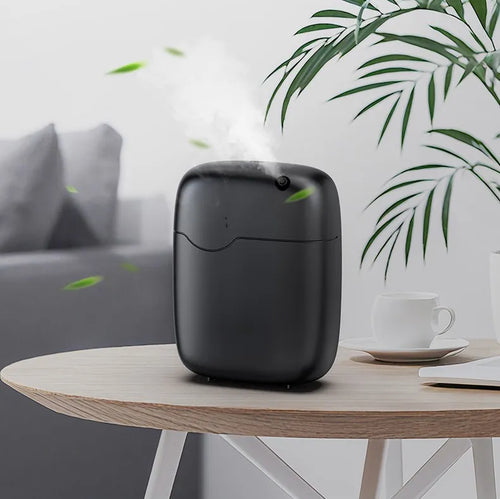
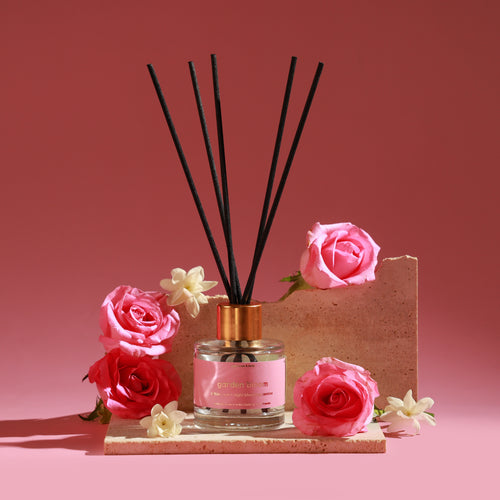 Small reception · no power neededFrom ₹749Shop → Mid reception · has an off switch₹1,899Shop →
  Large lobby · timed, dialable₹11,999Shop →
Drops, mode and calibration
Three drops, intermittent, scheduled to clinic hours. The Sukoon takes three to six drops of water-based Hotel Collection per tank; in a clinic use three. Run it in intermittent rather than continuous mode, which gives the room time to fall back between bursts and stops concentration building through the afternoon. Switch it off outside clinic hours — an empty building does not need scenting, overnight running loads soft furnishings that then re-release in the morning, and occupancy scheduling roughly halves what you spend on fragrance.
Calibrate with a nose that has been outside for thirty minutes. Olfactory adaptation is essentially complete within about twenty minutes, so by mid-morning nobody in the building can judge the level — and because they cannot smell it, they ask for more drops. That single mechanism is behind almost every over-scented clinic reception. Give the job to someone arriving from the street, repeat it a fortnight later when the natural creep happens, and treat a parent’s comment on the fragrance as a signal to reduce rather than as praise.
Mind the humidity, and mind the direction. The Sukoon is ultrasonic and water-based, so it adds a little moisture. In a dry, heavily air-conditioned reception that is a small bonus; during a coastal monsoon in a clinic that already smells slightly musty it is the wrong technology, and a reed is the better choice that season. On direction, stay dry and low-sweetness — Ritz-Carlton-inspired Quiet Luxury or Westin-inspired White Tea Serenity — and keep gourmand and heavy floral profiles out of a clinic entirely.
What we would actually install
The starred row is the answer for most 750 sq ft clinics. Note what the Vaayu row says: it is not a better version of the Sukoon at this size, it is a machine for a different building.
| Option | Suits | Control you get | Price |
|---|---|---|---|
| Reed diffuser | A small reception desk — a second mild point in an alcove or pram bay, or the whole answer if you would rather run nothing powered | Reed count only — no switch, no timer | from ₹749 |
| Sukoon 500ml ★ | A reception up to ~320 sq ft — the right machine at this size — three drops, intermittent, scheduled to clinic hours, placed high | On/off, intermittent mode, you control the drops | ₹1,899 |
| Vaayu | A large lobby or a zoned duct — still over-specified at 750 sq ft; rated for large areas, and your scentable zone is ~300 | Duty cycle in seconds, timer, app scheduling | ₹11,999 |
| Aangan | Whole-facility HVAC — an 8,000–10,000 sq ft facility with zoned ducting — several buildings away from this one | Zone-level control, but only if the ducting is zoned | ₹25,999 |
| Nothing at all | a clinic with heavy respiratory or newborn work, or one where reception and the clinical corridor share a return grille and cannot be separated | Complete — and the correct answer more often than the trade admits | ₹0 |
Versailles
Seven hundred and fifty square feet is the size at which clinic owners start ringing us about the Vaayu, and it is the size at which I most often talk them out of it. The reasoning they bring is always the same: the clinic has grown, the interior has been done properly, and the ₹1,899 diffuser feels like it belongs to the old premises. But you do not specify a diffuser against your ambitions; you specify it against the area you are allowed to scent, and that area is your reception, not your lease.
The other thing I ask at this size is where the return grilles are, and almost nobody knows. It takes five minutes and a tissue to find out, and it changes the answer more often than any other single check. I have seen a beautifully specified reception diffuser feeding a consultation corridor through a shared return, with the paediatrician quietly opening a window between patients and nobody connecting the two facts.
If your survey comes back badly — one return, no way to separate it — then the honest recommendation at 750 sq ft is to install nothing and spend the money on airing, bins and filter maintenance instead. That is not me being modest. It is that scenting a reception which shares air with an examination room means scenting the examination room, and no clinic should do that. Take the decision with your own clinical governance and infection-control leads. A portion of every order funds a girl’s classroom through Nanhi Kali.
Frequently asked questions
- Is a reed enough at 500 sq ft? — a radius, not a floor area.
- Strategy at 1,000 sq ft — where zoning becomes a design question.
- What central AC does to fragrance — why HVAC beats walls.
- Running it only during clinic hours — yes — and why it halves consumption.
- Brand: the SOSA founder story.
SOSA products & prices (verified August 2026): Hotel Collection water-based ultrasonic diffuser fragrance 15ml ₹299 · 100ml ₹999 · 300ml ₹1,799 · Pack of 7 (15ml, all fragrances) ₹1,799; refills 100ml from ₹999. Seven scents: The Ritz-Carlton-inspired (white tea · bergamot · cedar), Westin-inspired (white tea · aloe · cedar), 1 Hotels-inspired (cedarwood · vetiver · green leaves), The St. Regis-inspired (amber · violet · woods), Shangri-La-inspired (jasmine · green tea · white tea), Four Seasons-inspired (citrus · floral · sandalwood), W Hotels-inspired (citrus · pepper · amber). Diffusers: Boond 300ml ₹899 · Sukoon 500ml ₹1,899 · Megh 6L ₹3,499. Water-based, phthalate-free, composed to IFRA standards for home diffusion; 3–6 drops per tank. Made in India, Pune. The Hotel Collection scents are SOSA's own interpretations inspired by the world's finest hotels; all hotel names are trademarks of their respective owners and are used only to describe the scent style — SOSA is an independent Indian fragrance house, not affiliated with or endorsed by any hotel brand. Prices and availability subject to change — see the live product pages.