


Why a fan differs from a vent: a fan recirculates the whole room in a broad, slow loop. A vent fires a narrow jet in one direction. Broad and slow distributes; narrow and fast strips.
The test: hold a strip of tissue at the bottle's height with the fan running. It should stir and settle. If it streams continuously, the setting is too high for that position.
Distribution is not creation. A fan spreads what the reeds release; it cannot increase the total. Presence still comes from reed count and composition.
2. On a high setting it hurts, in the same way an AC vent hurts. Continuous fast air over six fibre reeds pushes evaporation past what capillary action can supply. The oil level falls, the reed tops dry, and the room still smells of very little.
3. The threshold is a property of your room, not of the fan. Ceiling height, blade sweep, how far the bottle sits from the centre and how open the space is all move it. What is speed two in one room is speed four in another.
4. Find it with a strip of tissue. At the bottle's exact position and height, the tissue should stir and settle rather than stream. That is the working rule we give customers; treat it as SOSA guidance rather than a measurement, because it is a judgement call by design.
5. Place at the edge of the circulation, not under the blades. A console or sideboard outside the blade circle, waist to chest height, on a tray, gets the benefit of the loop without sitting in the downdraught.
6. Remember what a fan cannot do. It distributes; it does not create. The total fragrance leaving a bottle is fixed by reed count, composition and temperature. If the room needs more presence, add reeds or change the composition — do not turn the fan up.
Composed and handmade in small batches in Pune, and a portion of every order supports girl-child education through Nanhi Kali.
Part one — the two things a fan does, and how they trade off
A ceiling fan and an air-conditioning vent are both mechanical air, and the reason they behave so differently towards a reed diffuser comes down to geometry. A vent is a jet; a fan is a loop. A jet fires fast air along one line and then breaks up against whatever it meets. A fan pushes a broad column of air downwards through the middle of a room, spreads it outward along the floor, lifts it up the walls and draws it back in at the ceiling — a whole-room circulation that touches almost everything at a moderate pace. That difference is why a fan can be a friend and a vent essentially never is. But a fan's loop gets faster as the dial goes up, and past a certain point it stops being a loop and starts being a gale.
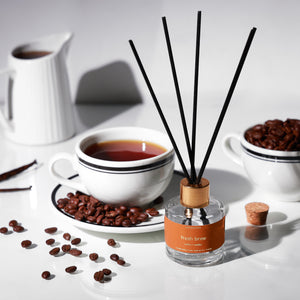
 Fresh Brew₹849 · 9.5/10Turn the same fan to its top settings on a May afternoon and the air at the edge of the room is no longer a loop; it is a continuous wind. Evaporation is limited by how fast vapour leaves the reed surface, so beyond a certain air speed the reed is being asked to deliver at a rate the fibre cannot sustain. The signature is unmistakable once you know it: the oil level falls faster than the calendar says it should, the room reads quiet anyway, and the top few centimetres of the reeds go pale and papery while oil remains in the glass. Because replacement reeds are not sold separately — an honest gap in our range — that last part is the loss that stings. A 50ml rated at six to eight weeks can finish appreciably early under a fast fan; how early depends on the room, and we quote that as working guidance rather than a figure.
Part two — speed by speed
The same bottle, the same room, the dial moved one notch at a time. Read the second column as the thing to check rather than a number to trust: your room's blade sweep and ceiling height will shift which setting behaves this way.
| Fan setting | Tissue at bottle height | Effect on scent throw | Effect on a 50ml bottle | Verdict |
|---|---|---|---|---|
| Low — first or second notch ★ | Stirs occasionally, settles between | Markedly better; reaches corners and seating | Effectively unchanged | The setting to aim for |
| Off entirely | Hangs still | Fragrance pools near the glass | Slightly longer, for the wrong reason | Dead air — the other failure mode |
| Middle notch | Moves steadily, rarely settles | Good throw, first signs of thinning | Modestly shortened | Acceptable; watch the level |
| High | Streams continuously | Falls away — the room reads quiet | Shortened noticeably | Move the bottle further out |
| Full, bottle under the blades | Held out flat | Worst of the range | Well short of the window | Avoid — this is vent territory |
| The honest caveat: fan settings are not standardised, and neither are Indian ceilings. These rows describe behaviour we see repeatedly in our own testing and in customer correspondence — they are SOSA working guidance, not measurements, and the tissue at your bottle's exact position beats every row above. Note also that none of this changes the total output of the bottle: a fan moves fragrance around, it does not make more of it. Strength ratings quoted here are positions on SOSA's internal scale at six reeds, not an industry standard. | ||||
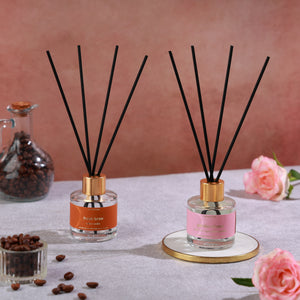
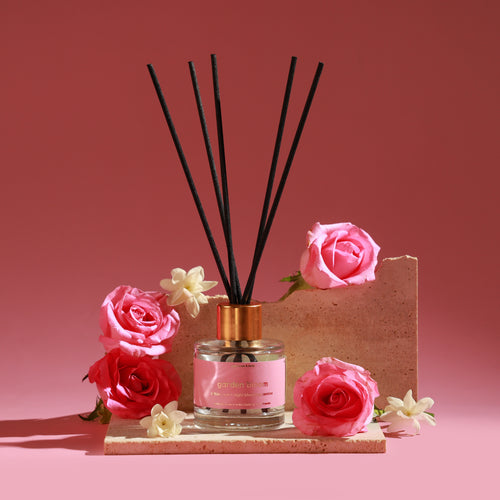
Garden Bloom · 8.9/10from ₹799Shop → 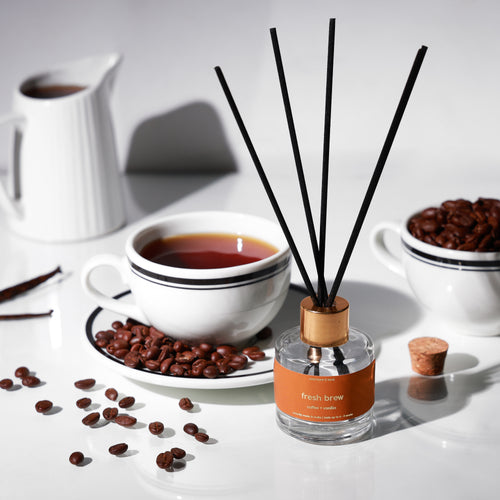 Fresh Brew · 9.5/10from ₹849Shop →
 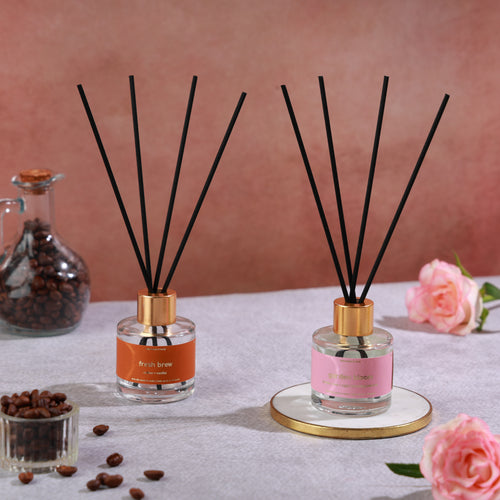 Warmth & Bloom duo₹1,598Shop →
Part three — what a fan does to the shape of a scent in a room
There is a second, subtler effect that people notice without being able to name. A still room is layered. Fragrance from a reed diffuser tends to sit and drift downward and outward slowly, so the air near the floor and around the furniture holds more of it than the air at head height across the room, and the difference between standing and sitting can be surprisingly large. A slow fan collapses those layers into one, mixing the room vertically so that what you smell at the sofa is roughly what you smell at the door. That evenness is usually what people mean when they say a fan "makes it smell better" — not more fragrance, but the same fragrance distributed where noses are rather than pooled where they are not.
This also explains a complaint we see in the monsoon. In humid, still air fragrance hangs close to its source and the room feels stuffy rather than scented; the same bottle with the fan on low reads clean and open. Nothing has changed chemically — our compositions sit on a heat-stable CCT base tested through 85% monsoon humidity — but the distribution has. And if you run a fan alongside an air conditioner you have created a third pattern belonging to neither: a position that was calm with only the AC running can turn into a stream once the fan joins in. Worth a fresh tissue check each season rather than an assumption.
Finally, the limit worth stating plainly. A fan improves distribution within the volume it circulates; it does not extend a bottle's reach beyond the format's honest ceiling. Past roughly 250–300 sq ft of connected open space, a single passive point source will not fill the room however well the air moves, and the correct answer is more sources rather than more air — two 50ml bottles at opposite ends of an open living-dining beat one 130ml in the middle, because output per bottle is fixed. If what you want instead is a room that changes on demand, that is a machine's job: a Sukoon at ₹1,899 covers 270–320 sq ft with timers. Most homes end up running both formats, and there is no shame in the pairing.
Part four — setting the fan for fragrance, room by situation
How I would actually run it, in the rooms where the question comes up most. Every row here is free; the only decisions are where the bottle stands and where the dial sits.
| Situation | Fan setting | Where the bottle goes | What to expect |
|---|---|---|---|
| Living room, fan over the seating ★ | First or second notch | Sideboard outside the blade circle, chest height | Even presence across the whole room |
| Bedroom, fan running all night | Low, or medium if you must | Chest of drawers by the door, well off centre | Steady background; check the level monthly |
| Open living-dining | Low on both fans | Two bottles, one at each end | Sources, not force — the only way to cover it |
| Study or home office | Low | Shelf on the far wall, not on the desk | Clear, non-distracting; ideal for a dry composition |
| Hosting evening | Leave it low — do not turn it up | Entrance console, plus the main room | Add three reeds for the weekend instead |
| Peak summer, fan on full | Unavoidable — adjust placement instead | As far from the centre as the room allows | Expect a shorter bottle; the refill makes that affordable |
Versailles
Almost all the airflow advice in this category is negative — keep away from vents, keep away from windows, keep away from draughts — and that has left people with the impression that a reed diffuser wants a sealed, motionless room. It does not. Dead air is a failure mode in its own right, and a bottle in a still alcove is as disappointing as one in a gale, just for the opposite reason.
The ceiling fan is where that becomes obvious, because the same appliance produces both outcomes depending on a dial. I have watched a room that customers described as weak become perfectly present with nothing changed but a fan set to its first notch. No purchase, no extra reeds, no different fragrance.
What I would resist is the next step people take, which is to turn the fan up further in search of more. That is the moment distribution turns into stripping, and you begin paying in weeks for a room that reads quieter. If the low setting is not enough, the honest levers are reed count and composition. Everything is composed and handmade in small batches in Pune, and a part of every order funds a girl's classroom through Nanhi Kali.
Frequently asked questions
- Should you put a reed diffuser near a fan? — near, not under, and exactly where the edge is.
- Does airflow make it stronger or finish faster? — intermittent versus continuous air.
- Does air conditioning affect reed diffusers? — the jet, the cold and the seal.
- The complete airflow and placement guide, and why can't I smell my reed diffuser?
- Brand: the SOSA founder story.
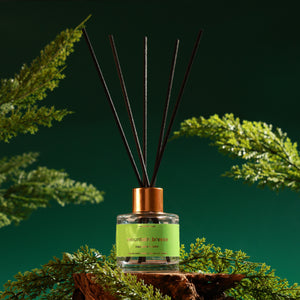
SOSA reed diffuser range & prices (verified August 2026): alcohol-free, phthalate-free, paraben-free and IFRA-compliant compositions on a heat-stable coconut-derived (CCT) carrier, low-VOC, supplied in a refillable glass bottle with six fibre reeds; 50ml lasts 6–8 weeks and 130ml lasts 14–18 weeks. Morning Freshness (Malabar lemon · peppermint · Nilgiri eucalyptus) 50ml ₹749 · 130ml ₹1,249 · 9.0/10; Garden Bloom (British rose · night-blooming jasmine) 50ml ₹799 · 130ml ₹1,299 · 8.9/10; Evening Calm (Kashmir lavender · chamomile) 50ml ₹799 · 130ml ₹1,299 · 8.9/10; Fresh Brew (Coorg coffee · Kerala vanilla) 50ml ₹849 · 130ml ₹1,349 · 9.5/10; Mountain Breeze (Himalayan pine · sage · Indian cedar) 50ml ₹849 · 130ml ₹1,349 · 9.4/10. Reed diffuser refills are oil only — you reuse your own vessel and reeds: 300ml ₹2,399 (roughly 8–11 months) · 500ml ₹3,499 (roughly 14–18 months), about ₹7–8 per ml against ₹15–17 per ml for a 50ml bottle. Duo sets ₹1,498–₹1,598 for 2 × 50ml and ₹2,498–₹2,598 for 2 × 130ml. Strength figures are positions on SOSA’s own internal strength scale, not an industry standard. Replacement reeds are not sold as a separate SKU; SOSA guidance is to refresh reeds every few months. The reed line is separate from the water-based Hotel Collection for ultrasonic machines (15ml ₹299 · 100ml ₹999 · 300ml ₹1,799) and the two are not interchangeable. Diffusers: Boond 300ml ₹899 · Sukoon 500ml ₹1,899 · Megh 6L ₹3,499 · waterless Vaayu ₹11,999. Composed and handmade in small batches in Pune, India; tested through 45°C summer heat and 85% monsoon humidity. Free shipping above ₹499. A portion of every order supports girl-child education through Nanhi Kali. Prices subject to change — see the live product pages.