




Closed and empty — a locked store room, an unused bedroom: no. Evaporation runs on the clock and returns nothing.
Why the difference is so large: a closed room exchanges only about 0.2–0.5 of its air an hour, against three to eight cross-ventilated. That is what the coverage figure assumes.
2. It is also the cheapest room in the house to keep running. Low air movement and, in most Indian homes, air conditioning both slow evaporation. A 130ml on four reeds in a closed AC bedroom comfortably reaches the top of its 14–18 week range, so ₹1,249 spread over eighteen weeks is about ₹69 a week of use. The same bottle in a hot hall with a fan running lands nearer fourteen weeks, about ₹89. Placement is a running-cost decision as much as a fragrance one.
3. If nobody uses it — no, and the closed door makes no difference at all. A locked store room, a shut spare bedroom, a room kept closed because it is full of furniture: none of these should have a bottle. The diffuser evaporates on the clock regardless, so all a closed door does is make the fragrance nobody smells slightly more concentrated. That is not a benefit. The variable is the person in the room, not the door.
4. Use fewer reeds, not more, in a closed room. People do the opposite. A room that holds fragrance well needs less put into it, and six reeds in a closed 130 sq ft bedroom is a level most people find too present to sleep in. Four reeds is right, three if the room is small or heavily air-conditioned. Fewer reeds means less exposed surface evaporating, so the room is calmer and the bottle lasts longer — the two things you wanted, from an adjustment that costs nothing.
5. Two closed rooms worth doing, itemised. A main bedroom and the bathroom off it are both closed, both used daily, and both perform above their stated figures. One 130ml Evening Calm at ₹1,299 on four reeds, one 50ml at ₹749 on two: ₹1,299 + ₹749 = ₹2,048, leaving ₹452 from ₹2,500. Nothing for the store room, however tightly it is shut.
Made in India, composed by an ISIPCA Versailles-trained perfumer — and a portion of every order supports girl-child education through Nanhi Kali.
Why the coverage figure is a closed-room figure in the first place
Every number in this cluster carries the same condition: up to about 150 sq ft, on six reeds, in a closed room with still air and a standard ceiling. That condition is not a disclaimer, it is the physics. A reed diffuser has no fan and no pump — fragrance climbs the porous core of each reed by capillary action, evaporates from the exposed tip, and from that point the room's own air decides everything. The rated area is not a radius the bottle projects; it is the size of air pocket a bottle can hold at equilibrium when nothing is carrying that air away. A closed room exchanges roughly 0.2 to 0.5 of its air an hour. A cross-ventilated one — two openings, a breeze, a fan — exchanges three to eight. No passive source can charge air that is being replaced that quickly, and this single difference explains almost every case of a correctly sized diffuser appearing to underperform.
Which means the reader with a permanently closed room is in an unusual position: they are the household the headline number was actually written for. A closed 140 sq ft bedroom will hold a single bottle's output properly, and it will do it on fewer reeds than the box supplies. The bottle will also last longer, because evaporation rises with heat and airflow and falls without them — an air-conditioned closed bedroom is the slowest, coolest, stillest place in most flats. The corollary is uncomfortable but honest: if the room is closed and nobody is in it, none of these advantages apply to anybody. The fragrance still reaches equilibrium, the bottle still empties in fourteen to eighteen weeks, and the only difference a closed door makes is that the fragrance nobody smells is slightly more concentrated than the fragrance nobody would have smelled anyway.
The three kinds of closed room, and what each one deserves
 130ml, four reedsFrom ₹1,249A bedroom kept shut, a study with the door closed, an air-conditioned room in summer. Air changes slowly, evaporation is slow, and the bottle both reads accurately and lasts. Use four reeds, not six — six is a hall setting and in a closed bedroom it is too present to sleep in. A 130ml at ₹1,249 on four reeds reaches the top of 14–18 weeks, about ₹69 a week of use, and one bottle covers most of a season. This is the best value available anywhere in the range.
Sizing by space — closed rooms, sorted by who is in them
Sort your closed rooms by occupancy rather than by size, and the shopping list writes itself. Two of these rows buy nothing at all despite being the most tightly closed rooms in the house.
| Space | What it needs | How many | Cost |
|---|---|---|---|
| Closed, air-conditioned bedroom, 120–150 sq ft, occupied nightly ★ | One 130ml on four reeds. The stillest room in the flat, so the bottle reaches the top of its range | One 130ml | from ₹1,249 |
| Closed study or home office in daily use | One 130ml on four reeds, or a 50ml if the room is under about 100 sq ft and you want to try a blend first | One | from ₹749 |
| Closed bathroom off the bedroom, under about 40 sq ft | One 50ml on two or three reeds. A 130ml here is more liquid than the room can use | One 50ml | ₹749 |
| A closed room opened two or three times a week — a puja room or box room | A 50ml on two reeds if it matters at the moment the door opens. Two reeds slows the bottle to match | One 50ml, or none | ₹749 or ₹0 |
| A locked store room or a bedroom nobody sleeps in | Nothing. The closed door does not slow the bottle down in any way that helps you. Air the room instead | None | ₹0 |
| A flat closed up while the family is away for weeks | Nothing. Take the reeds out of any running bottle and cap it before you go, and put them back on your return | None | ₹0 |
| A note on all of the above: the coverage figure of up to about 150 sq ft assumes exactly the conditions in the first three rows — closed, still, standard ceiling. That is why closed rooms are the only ones where the published number behaves as published, and why a closed room needs fewer reeds rather than more. | |||
One room · the unitFrom ₹749Shop → 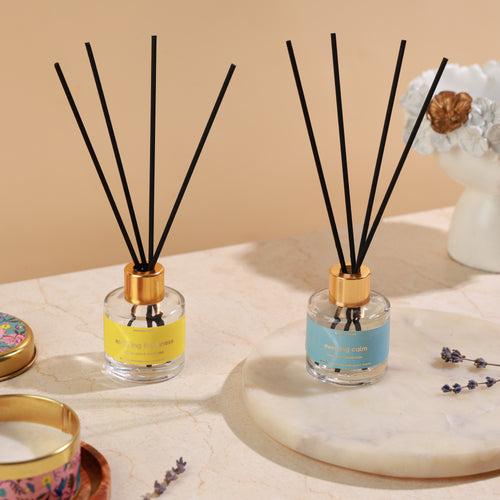 Two rooms · better value₹1,498Shop →
  Large room · a switch₹1,899Shop →
Reeds, air-conditioning and what a closed room does to the running cost
Four reeds, not six, and three if the room is small and cold. This is counter-intuitive and it is the adjustment that matters most in a closed room. A space that holds fragrance well needs less put into it, so the setting that makes a hall work will make a shut bedroom feel like a shop. Start at three, wait forty-eight hours — reeds must saturate along their full length before they throw properly, so a first-day verdict is meaningless — then add one if a visitor cannot detect it from the doorway. Most closed bedrooms land on four. Remember the trade runs both ways: fewer reeds is a calmer room and a longer bottle, more reeds is a stronger room and a shorter one.
Air conditioning is on your side, but the vent is not. A cool room evaporates more slowly than a hot one, which is why the same 130ml can last past eighteen weeks in an AC bedroom and only fourteen in a warm hall — a difference of about ₹20 a week on an identical bottle. What ruins it is placing the diffuser in the direct path of the vent or a fan: that empties the bottle fast and pushes everything against one wall rather than distributing it. Put it on a chest of drawers or a shelf with gentle air movement, out of direct sunlight, which fades fragrance and heats the oil, and stand it on a tray, because reed oil marks polished wood permanently if the bottle is knocked. Keep it out of reach of children and pets.
Then judge it from outside the room, because you cannot judge it from inside. Olfactory adaptation is essentially complete within about twenty minutes, and a closed room makes this worse rather than better — you shut the door, you stay, and within half an hour you are the least reliable judge of the space in the building. Leave the flat for half an hour and take the first breath on returning, or ask whoever visits next. Almost every "my closed bedroom has stopped smelling of anything" is adaptation, and the next commonest cause is clogged reeds rather than an empty bottle. When it genuinely does run out, a 300ml refill at ₹2,399 fills a 130ml roughly twice and is the moment to fit fresh reeds.
What to buy
For a closed, occupied room the recommendation is the second line of this table on four reeds. For a closed, unoccupied one there is no line, which is the honest answer rather than an omission.
| Buy | What it covers | Lasts | Price |
|---|---|---|---|
| One 50ml | A single reed diffuser — a closed bathroom under about 40 sq ft on two reeds, or a puja room opened two or three times a week | 6–8 weeks | from ₹749 |
| One 130ml ★ | The value size — a closed bedroom or study in daily use — on four reeds, the top of 14–18 weeks and about ₹69 a week | 14–18 weeks | from ₹1,249 |
| The duo | Day & Night duo — a closed bedroom and a second closed room solved together, at 6–8 weeks each | 6–8 weeks each | ₹1,498 |
| Sukoon | 500ml ultrasonic — a large room where doors stay open and the air moves — the case a reed diffuser cannot hold | Runs when you switch it on | ₹1,899 |
| 300ml refill | The running cost — the cheapest way to keep a closed bedroom going, since that bottle will be the slowest in the house | Roughly 2 × 130ml fills | ₹2,399 |
Versailles
This question has two answers and they point in opposite directions, so I try to separate them before anything else. A closed room somebody sleeps in is the best room in the house for what we make — the coverage figure we publish was measured in exactly those conditions, and in a still, cool room a bottle both reads accurately and lasts longer than it will anywhere else.
A closed room nobody is in is the worst. The door does not pause anything. What people are usually asking about in that case is a stale, shut-up smell, and I have to be honest that a diffuser is not the answer to it — we add a fragrance to a room, we do not remove anything from it. Open the window for twenty minutes. That is a better and cheaper intervention than anything on our website.
The one adjustment I would press on anybody with a closed bedroom is to take two reeds out. A room that holds fragrance needs less put into it. Four reeds instead of six is calmer to sleep in and pushes the bottle to the top of its range, which is about ₹69 a week rather than ₹89. It costs nothing and it is the difference between a bottle you enjoy and one you find overwhelming. A portion of every order funds a girl's classroom through Nanhi Kali.
Frequently asked questions
- Why doors beat square feet — closed doors make separate air spaces.
- Rooms nobody uses — why a closed door does not help.
- The hours threshold — occupancy costed by the hour.
- A room with the balcony door open — the opposite problem, costed.
- Brand: the SOSA founder story.
SOSA products & prices (verified August 2026): Hotel Collection water-based ultrasonic diffuser fragrance 15ml ₹299 · 100ml ₹999 · 300ml ₹1,799 · Pack of 7 (15ml, all fragrances) ₹1,799; refills 100ml from ₹999. Seven scents: The Ritz-Carlton-inspired (white tea · bergamot · cedar), Westin-inspired (white tea · aloe · cedar), 1 Hotels-inspired (cedarwood · vetiver · green leaves), The St. Regis-inspired (amber · violet · woods), Shangri-La-inspired (jasmine · green tea · white tea), Four Seasons-inspired (citrus · floral · sandalwood), W Hotels-inspired (citrus · pepper · amber). Diffusers: Boond 300ml ₹899 · Sukoon 500ml ₹1,899 · Megh 6L ₹3,499. Water-based, phthalate-free, composed to IFRA standards for home diffusion; 3–6 drops per tank. Made in India, Pune. The Hotel Collection scents are SOSA's own interpretations inspired by the world's finest hotels; all hotel names are trademarks of their respective owners and are used only to describe the scent style — SOSA is an independent Indian fragrance house, not affiliated with or endorsed by any hotel brand. Prices and availability subject to change — see the live product pages.