


The real answer: Four Seasons-inspired Warm Welcome — citrus, floral and sandalwood — 15ml ₹299. It has the most staying power of the seven Hotel Collection scents, and the sandalwood base is precisely why.
It needs a machine: Boond ₹899 for a bedroom up to 150 sq ft, or Sukoon ₹1,899 for 270–320 sq ft, which arrives with three 15ml scents of your choice.
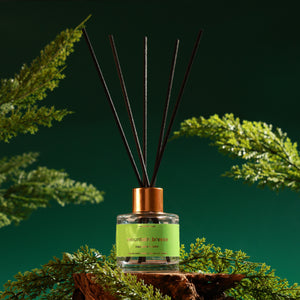
What the reed line is not: Mountain Breeze ₹849 is Himalayan pine, sage and Indian cedar — a green, dry, resinous wood. It is not a sandalwood substitute and I will not sell it as one.
2. There is real sandalwood at SOSA, on the ultrasonic side. The Four Seasons-inspired Warm Welcome at ₹299 for 15ml is citrus and florals sitting on sandalwood, and it has the most staying power of the seven scents in the collection for exactly that reason. This is the honest recommendation and it is a good one.
3. It needs a machine, so budget for one once. Boond at ₹899 is the bedroom machine — 300ml tank, up to 150 sq ft, about six hours, USB, night light. Sukoon at ₹1,899 covers 270–320 sq ft, runs 16–18 hours on a fill on low, and comes with three 15ml scents included — a complete setup rather than a deposit.
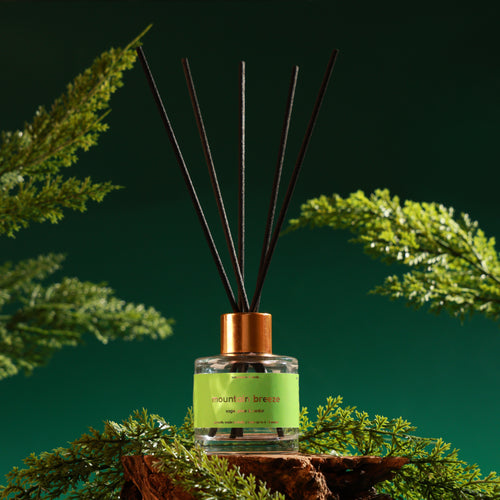
4. Do not let anyone hand you Mountain Breeze as a sandalwood. Mountain Breeze at ₹849 is Himalayan pine, sage and Indian cedar — 9.4 on our strength scale and the deepest woody reed we make. It is a fine wood and it is a green one: cool, dry, resinous, altitude rather than temple. Sandalwood is creamy, soft, warm and lactonic. These two woods are not neighbours and swapping one for the other is how people end up disappointed.
5. Judge any sandalwood claim by what the label is willing to name. Australian sandalwood is real sandalwood and should say so. Synthetic santalol-type materials are respectable and should say so. A cedar-and-amber construction wearing the word sandalwood is the only one of the three that is a problem, and it is a problem of labelling rather than of chemistry.
Alcohol-free, phthalate-free, IFRA-compliant, made in Pune. A portion of every order supports girl-child education through Nanhi Kali.

The three things in the bottle when a label says sandalwood
No other fragrance material in India carries this much distance between the word and the contents. When a bottle says rose, you are usually somewhere in the neighbourhood of rose even if the material is reconstructed. When a bottle says sandalwood, you could be holding any of at least four quite different things, three of which are perfectly legitimate and one of which is simply borrowing the name. The useful skill for a buyer is not detecting fraud — it is knowing which of the honest options you have been given, because they smell different from one another and you will live with the difference for months. Below are the three you are most likely to actually meet in a home product, with the reference standard treated separately in the next section because it deserves it.
 Warm Welcome₹299There is more than one sandalwood tree, and Santalum spicatum from Western Australia is a real member of the same genus, cultivated at a scale Santalum album is not. It is legitimately sandalwood and it is legitimately different: drier, slightly nuttier, a little more resinous, and noticeably less creamy than the Indian species. Someone whose reference point is a Mysore chandan stick will register the difference immediately and may describe it as thinner. Someone who simply likes soft woods will find it entirely lovely. It is the workhorse of a great deal of good perfumery and it belongs on a label under its own name rather than under a borrowed one.
 Sukoon₹1,899Here is the sentence most brands will not write down: the overwhelming majority of sandalwood you have ever smelled in a home product — and a great deal of what you have smelled in fine fragrance — was a synthetic santalol-type material, and it was fine. These are molecules built to sit in the same creamy, milky, low-projecting register as the natural oil, and the good ones do it convincingly and stably. They also do something the natural material cannot do reliably at this price: they behave the same way in every batch, they do not fluctuate with a harvest, and they hold their character at 40°C in a Chennai flat in May. In a home fragrance, where the material has to survive months of heat rather than eight hours on skin, that stability is not a consolation prize. It is the requirement.
 Mountain Breeze₹849The third category is not sandalwood by any definition, and it is the one that fills the shelf. It is a cedar base with an amber or woody-amber material stacked on top, sometimes with a vanillic touch to fake the creaminess, sold under the word sandalwood because the word sells. You can identify it by behaviour rather than by note list: it projects hard for the first hour and then collapses, which is the exact opposite of what sandalwood does. It also tends to read sharp and slightly scratchy at the top rather than soft, because cedar is a pencil-shaving smell and amber is a sweet-resinous one and neither of them is milky. I have no objection to cedar-amber accords — they can be beautiful — and every objection to calling one sandalwood.
Mysore sandalwood, and the honest reason it is not in your diffuser
Santalum album — Indian sandalwood, the Mysore standard — is the reference against which every other sandalwood in the world is measured, and that is not sentiment or national pride. It is a description of a chemical profile. The species carries a higher proportion of the alpha- and beta-santalols that produce the specific effect people mean by creamy: soft, milky, faintly lactonic, warm without being sweet, round without any edge at all. Australian sandalwood is drier. Every synthetic gets some part of it. Nothing gets all of it. When perfumers describe a material as irreplaceable they are usually exaggerating; with this one they are usually not.
The reason you are unlikely to find it in a home diffuser is a supply story, and it is worth understanding before you judge any brand for its absence. Sandalwood is heartwood, and heartwood takes decades. The tree does not produce commercially meaningful oil as a sapling; the fragrant heartwood accumulates slowly over a very long maturation, which means every tree harvested represents an investment made a generation earlier. Through the twentieth century demand ran far ahead of that clock. Decades of overharvesting, much of it illegal, reduced natural stands to the point where the species became a conservation matter rather than a commercial one, and India responded with protection: Santalum album is a regulated species here, its harvest and its trade are tightly controlled, and moving the wood or the oil around is a paperwork exercise rather than a purchase.
The practical consequence for you, standing in front of a shelf with a home-fragrance budget in mind, is simple and slightly unromantic. Genuine Mysore sandalwood oil is expensive enough that it is effectively reserved for fine fragrance, for traditional and ritual use, and for attar houses working in millilitres. The economics of a room diffuser — where the material has to be dosed generously, evaporate continuously and be replaced every couple of months — do not survive contact with that price. So when a home fragrance under a few thousand rupees says sandalwood, it is not lying about the smell it is aiming at; it is describing a register, built from one of the three materials above. Plantation cultivation of album has expanded considerably in recent years and that will change the arithmetic over time. It has not changed it yet, and any brand telling you their ₹800 diffuser is full of Mysore oil is telling you something the supply chain cannot support.
The four things sold as sandalwood, side by side
This is the table I would want if I were buying rather than making. Four materials, what each one actually smells like, how available it genuinely is, whether the industry labels it honestly, and — the column most guides leave out — what SOSA itself uses, because a page that audits everyone else and not itself is marketing rather than information.
| Sold as sandalwood | What it actually smells like | Availability | Honesty of labelling | What SOSA uses |
|---|---|---|---|---|
| Mysore · Santalum album | The reference. Creamy, milky, soft, round, warm without sweetness. Nothing else does all four | Scarce. Slow-maturing heartwood, decades of overharvesting, protected species and tightly regulated trade in India | Frequently claimed, rarely present at home-fragrance prices | Not claimed. The price belongs to fine fragrance and attars, not to a room diffuser |
| Australian · Santalum spicatum | Genuinely sandalwood and genuinely different — drier, nuttier, more resinous, less creamy | Good. Cultivated at commercial scale in Western Australia | Honest when named. A label that says "Australian sandalwood" is doing the right thing | A legitimate material we are happy to work with, and one that should always be named as itself |
| Synthetic santalol-type materials | The creamy, low-projecting sandalwood register, built molecule by molecule. The good ones are convincing | Excellent, and batch-to-batch identical — which matters more in a home product than in a perfume | Respectable and widely used. Most sandalwood you have ever smelled at home was this | Yes — this is the modern, stable, heat-tolerant way to put a real sandalwood register in an Indian room |
| Cedar-and-amber constructions | Not sandalwood. Sharp, pencil-shaving cedar over sweet amber. Loud for an hour, then gone | Everywhere. It is the cheapest way to reach the word | The problem. Not a material issue — a naming issue | Never sold under the word sandalwood. Our cedar is in Mountain Breeze and it is called cedar |
What sandalwood does in a room that nothing else does
Most fragrance materials trade projection against persistence. The ones that fill a room quickly are light and volatile and therefore leave quickly; the ones that stay for months are heavy and tend to announce themselves. Sandalwood breaks the trade. It is the single most persistent soft material in perfumery — it sits low, it never pushes, it is almost impossible to locate in a room, and it is still there fourteen hours later and still there the next morning in the curtains. There is no loud phase to get through and no crash afterwards. It behaves less like a fragrance being added to a room and more like a property the room has acquired.
This is exactly the behaviour you want in a home and almost nowhere else. On skin, a material with no projection is a disadvantage; the point of a perfume is partly that somebody notices. In a house the opposite is true. The best-smelling rooms I have walked into were not rooms where I thought what is that fragrance — they were rooms where I could not find the source and did not think about it at all. Sandalwood is structurally suited to that job. It is also why it has been the base of Indian interiors for as long as anyone has been keeping records: chandan in a temple is not there to be a top note, it is there to be the floor of the room.
Which brings me to the format argument, and I want to make it plainly rather than talk you into the more expensive product. A reed diffuser gives you permanence of a different kind — it never needs switching on, never needs a socket, never needs water, and it simply sits there for six to eight weeks doing its job. That is a genuine advantage and for four of the five SOSA reeds it is the reason I recommend them over a machine. But a reed cannot give you this note, because we do not make a sandalwood reed. And an ultrasonic machine has a compensating virtue that happens to line up with sandalwood specifically: it runs. A Sukoon on low will hold a fill for sixteen to eighteen hours, which means a material whose entire virtue is that it does not leave gets sixteen to eighteen continuous hours to demonstrate it. For a bright citrus I would call that overkill. For sandalwood it is the whole argument. The trade is real — you are exchanging a socket, a tank of water and the act of switching something on for the only genuine sandalwood in the house — and for this note I think it is clearly worth making.
Sandalwood is a memory before it is a preference
I want to make this point carefully, because it is easy to make it sentimentally and sentimentality is not useful to a buyer. Here it is stated as plainly as I can: for a very large number of Indian buyers, sandalwood is not a smell they have decided they like. It is a smell they have known since before they could name smells. It is a temple. It is chandan on a forehead. It is an agarbatti in the first hour of a morning, a wooden box in a grandmother's cupboard, the inside of a house that no longer exists. That is a categorically different relationship to a material than liking it, and it has one very practical consequence: the tolerance for approximation is nearly zero.
If somebody buys a rose diffuser and it turns out to be a slightly generic rose, the reaction is mild — it is fine, it is not what I hoped, I will finish the bottle. If somebody buys a sandalwood and it turns out to be cedar and amber under a borrowed name, the reaction is disproportionate to the money involved, and it should be. They were not buying a woody accord. They were buying a specific memory back, and what arrived was a sharp, sweet, loud thing that collapsed by evening and did not resemble the memory at all. That is why I have spent most of this page on materials rather than on products, and it is why the recommendation at the end of it is a ₹299 bottle rather than something more flattering to our margins.
It is also why I will not send you to Mountain Breeze as a substitute. It is a very good reed — 9.4 on our strength scale, the deepest woody we make, Himalayan pine and sage and Indian cedar, and buyers describe it as a Himachal homestay, which is exactly the register it is aiming at. But a Himachal homestay is not a temple. It is cool where sandalwood is warm, dry where sandalwood is creamy, green where sandalwood is milky, and it works by evoking altitude and open air rather than by settling into the floor of a room. If you want that, buy it — it is one of the two scents I am proudest of. If you came here for chandan, it will not do, and I would rather lose the ₹849 than have you find that out in week two.
What to buy for sandalwood — and the gap, said again
In the order I would actually buy it, for somebody who searched for a sandalwood reed diffuser and has read this far. The last row is the gap, restated, because the reed line genuinely does not contain this note and no arrangement of the other five scents adds up to it.
| Buy | What it is | When it is the right answer | Price |
|---|---|---|---|
| 1. Warm Welcome 15ml ★ | Four Seasons-inspired — citrus, floral and real sandalwood. The most staying power of the seven, because of the sandalwood base | First, for everyone who came here for sandalwood. ₹299 settles the question | ₹299 |
| 2. Sukoon | 500ml tank, 270–320 sq ft, 16–18 hours a fill on low, and three 15ml scents of your choice included | If the room is a hall, a living room or an open-plan end of a flat. A complete setup, not a deposit | ₹1,899 |
| 3. Boond | 300ml tank, up to 150 sq ft, around six hours, USB-powered, with a night light | If it is one bedroom and you want the smallest sensible spend to get real sandalwood running | ₹899 |
| 4. Warm Welcome 100ml or 300ml | The same scent in a size that stops you reordering. 3–6 drops per tank goes a long way | Once the 15ml has proved it is the one you keep filling the tank with | ₹999 / ₹1,799 |
| 5. Mountain Breeze 50ml | Himalayan pine, sage, Indian cedar — 9.4, the deepest woody reed we make. A green wood | Only if you want a wood in a reed. Buy it for what it is, not as a sandalwood | ₹849 |
| No sandalwood reed: the honest gap | There is no sandalwood, no oud and no vetiver anywhere in the SOSA reed line, and no combination of the five scents approximates one. The sandalwood exists only in the water-based Hotel Collection, which is ultrasonic-only | Said plainly rather than stretched to fit. If a reed is non-negotiable, buy nothing here | ₹299 + machine |

Versailles
Sandalwood is the request I find hardest to answer, and it is not because the material is difficult. It is because I know what most people are asking for when they ask, and it is not a note list. They are asking for a room they remember. Somebody wrote to us last year asking for a sandalwood reed and described, unprompted, the wooden almirah in her nani's house in Mysore. I could not sell her that, and I did not want to sell her something adjacent to it and let her discover the difference alone in her flat.
So the position we have taken is the unglamorous one. There is no sandalwood reed diffuser at SOSA — the reed line is five scents and none of them is this — and there is real sandalwood in the Four Seasons-inspired Warm Welcome, which costs ₹299 and needs a machine. I would rather tell you that in the first line than build a page that takes eleven hundred words to admit it. And I will not put Mountain Breeze in front of you as a sandalwood, because Indian cedar and Himalayan pine make a beautiful cool green wood and a genuinely poor substitute for a warm creamy one.
The one thing I would ask you to carry away, whether you buy from us or from anybody else: judge a sandalwood by how it behaves in hour four, not hour one. Real sandalwood, natural or well-built, has almost no opening — it is quiet, it is low, you nearly lose track of it, and then it is still in the room at the end of the day and in the curtains the next morning. Anything that arrives loudly and leaves by evening was a cedar-amber accord wearing the word. Everything we make is composed in Pune, and a part of every order funds a girl's classroom through Nanhi Kali.
Frequently asked questions
- Oud in India and Luxury oud at home — what oud is, and why almost nothing sold as oud is oud, and what to buy when nobody makes the reed.
- Vetiver in India and Oud in a living room — khus, and the one place SOSA has real vetiver, and the honest substitution.
- Sandalwood in a bedroom and Vetiver at home — the creamiest answer in the house, and the driest thing SOSA makes.
- Oud versus sandalwood versus vetiver — three woods, three different rooms.
- The decision tree — one bottle, no reading, if you want one bottle and no argument.
- The complete guide — every decision, and every gap, in one place.
- Brand: the SOSA founder story.
SOSA — facts verified August 2026: The SOSA reed line is five scents, all alcohol-free on a heat-stable CCT (caprylic/capric triglyceride) base, phthalate-free, paraben-free, IFRA-compliant, 0 ppm formaldehyde, six fibre reeds in a refillable glass bottle, composed and made in Pune, India. Evening Calm (Kashmir lavender · chamomile · soft musk) 50ml ₹799 · 130ml ₹1,299 · 8.9, the softest in the range. Garden Bloom (British rose · night-blooming jasmine) 50ml ₹799 · 130ml ₹1,299 · 8.9. Morning Freshness (Malabar lemon · peppermint · eucalyptus globulus) 50ml ₹749 · 130ml ₹1,249 · 9.0. Mountain Breeze (Himalayan pine · sage · Indian cedar) 50ml ₹849 · 130ml ₹1,349 · 9.4, the deepest woody. Fresh Brew (Coorg coffee · Kerala vanilla · caramel) 50ml ₹849 · 130ml ₹1,349 · 9.5, the deepest in the range. Longevity 6–8 weeks on 50ml and 14–18 weeks on 130ml. Refills 300ml ₹2,399 · 500ml ₹3,499. Climate-tested through 45°C heat soak and 85% RH monsoon humidity. The reed line contains no sandalwood, no oud, no vetiver and no amber, and this guide says so rather than stretching the nearest scent to cover it. The Hotel Collection is a separate, water-based, ultrasonic-only range — 15ml ₹299 · 100ml ₹999 · 300ml ₹1,799 — dosed at 3–6 drops per tank; the Four Seasons-inspired Warm Welcome (citrus · floral · sandalwood) is the sandalwood referenced throughout and has the most staying power of the seven. Reed oil and Hotel Collection fragrance are not interchangeable in either direction and there is no hotel-inspired reed diffuser. Machines: Boond ₹899 (300ml tank, up to 150 sq ft, around six hours, USB, night light) and Sukoon ₹1,899 (500ml tank, 270–320 sq ft, 16–18 hours a fill on low, three 15ml scents included). Free shipping above ₹499. A portion of every order supports girl-child education through Nanhi Kali. SOSA is an independent Indian fragrance house; the Hotel Collection scents are SOSA's own interpretations inspired by the world's finest hotels and SOSA is not affiliated with or endorsed by any hotel brand. Prices subject to change — see the live product pages.