


Why cheap florals smell sweet: a reconstruction replaces two hundred-odd missing compounds with a sweetener; heavy sweet molecules are the cheapest available fixative, so sugar is used to buy longevity; and sweetness intensifies as a room warms, which is why a floral that is merely sweet in a Bengaluru winter is cloying in a Chennai May.
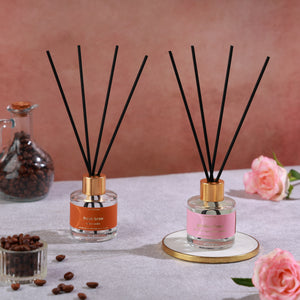
If dryness matters more than floralcy: Mountain Breeze ₹849 at 9.4 has no sweetness in it at all, and Evening Calm ₹799 at 8.9 is herbal rather than sugary. Both are substitutions, not matches. Fresh Brew at 9.5 is the one to avoid outright.
The honest gap: there is one floral in the whole reed line. No tuberose, no gardenia, no lily, no peony, no orange blossom, no osmanthus and no single-note rose. And SOSA is a small independent house: our phthalate, paraben and formaldehyde figures are batch-verified in-house against raw-material specifications rather than published as third-party laboratory certificates, and I would rather say that than let the word "tested" do ambiguous work.
2. Understand that the sweetness you disliked was added, not inherited. Cut a garden rose and hold it under your nose: it is green, slightly peppery, a little citric, faintly tea-like, with sweetness present as one thread among hundreds. Real jasmine is not sweet either — it is warm, animalic and heady. Whatever made your last floral taste of icing was a decision, and it was almost certainly the cheap decision.
3. There are exactly three reasons that decision gets taken. A reconstruction needs a filler where the missing compounds used to be; sweet heavy materials are the least expensive fixative available; and sweetness is what reads as "nice" in the first three seconds, which is the entire duration of a shelf test. None of the three has anything to do with what a flower actually smells like.
4. Judge a floral in a warm room, not a cool one. The molecules that carry sweetness are heavy, and heat mobilises them. A floral that is merely a bit sweet at 22°C is cloying at 34°C, which is why Indian buyers experience the fault far more sharply than the people who formulated the fragrance. Every SOSA reed is climate-tested through a 45°C heat soak and 85% monsoon humidity for exactly this reason.
5. If dryness matters more to you than floralcy, say so and buy accordingly. Mountain Breeze at ₹849 has no sweetness in it whatsoever, and Evening Calm at ₹799 is herbal rather than sugary. Neither is a floral in the sense you asked for; both are honest substitutions. Fresh Brew at 9.5 is a warm gourmand and is the one scent in the range to avoid outright on this brief.
Alcohol-free, phthalate-free, paraben-free, IFRA-compliant, 0 ppm formaldehyde, six fibre reeds in a refillable glass bottle, composed in Pune. A portion of every order supports girl-child education through Nanhi Kali.
The three mechanisms that put sugar into a flower that never had any
Begin with the premise, because almost everyone gets it the wrong way round. A real rose is not sweet. Go and cut one from a garden — not a florist's rose bred for shipping, an ordinary one that has been allowed to grow — and put your nose into it before it has had time to warm up. What arrives first is green: leaf, stem, something close to cut grass. Behind it there is a peppery edge, then a citric brightness that most people are surprised to find in a rose at all, then a tea-like dryness, and somewhere in the middle of all of that, one thread among hundreds, a little honeyed sweetness. It is a component. It is not the subject. The same is true of jasmine, which people describe as sweet because they have only ever met the reconstruction: real jasmine is warm, animalic and heady, closer in character to skin than to sugar, and the thing that makes it beautiful is precisely the part that is not sweet.
So when a floral fragrance arrives tasting of icing, something has been added. It has not been over-extracted or over-concentrated; a flower does not become sweet by being intensified, it becomes more itself. Sweetness has to be put in from outside. And once you accept that, the interesting question stops being why do I dislike sweet florals and becomes why does everybody keep making them — a question with three answers, none of them aesthetic. Below are the three, in the order they usually occur in a formulation, and I have set them out plainly because a buyer who understands them can smell the difference in a shop without any training at all.
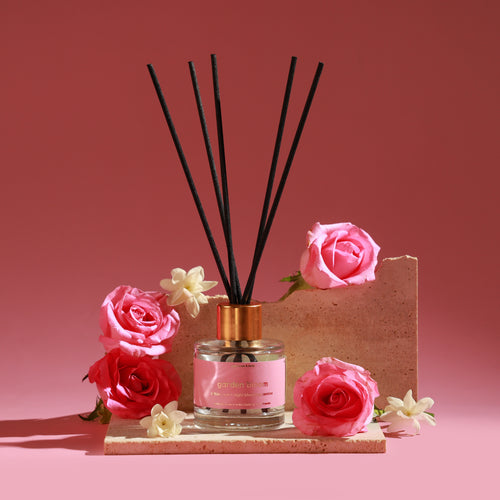
 Garden Bloom₹799A real rose carries over three hundred aromatic compounds, and the reason it smells alive is that they are all present, at wildly different concentrations, doing different things at different moments. A commercial reconstruction cannot afford three hundred materials. It uses a handful — the markers, the four or five molecules that make your brain say rose — and it then has to do something about the enormous perceptual hole where the other two hundred and ninety used to be. Sweetness is what goes in the hole, because sweet material is cheap, forgiving and instantly legible. The result is a fragrance that is recognisably rose-shaped and completely hollow, and your nose files it, quite correctly, under soap. That is not a metaphor: soap perfumery has used exactly this economy for a century, which is why the reference is so specific and so universal. Our buyers reach for it unprompted — "the first one that smells like a real rose garden — not like Lifebuoy rose soap" from Aanya M. in Mumbai, and "finally a rose that isn't Phenyl rose" from Sneha B., also in Mumbai. Neither of them is describing a preference for weaker rose. They are describing the gap between a flower and a shorthand for one.
 Refill 300ml₹2,399Every reed diffuser is sold on how long it lasts, and there are only two ways to make a fragrance last. The expensive way is structure: build a composition in which lighter material is held down by heavier material chosen for how it smells, and sit the whole thing on a carrier that does not degrade. The cheap way is to load the formula with heavy sweet molecules, which are naturally slow to evaporate and will therefore still be in the room in week six whether or not anyone wants them there. Sweetness, in other words, is frequently not a creative choice at all — it is a fixative choice wearing a creative disguise. Garden Bloom takes the first route. Its longevity comes from the way the rose, jasmine and musk are stacked and from a heat-stable CCT carrier — caprylic/capric triglyceride, coconut-derived — rather than from a sugar crutch. It runs 45 days to two months on the 50ml at ₹799 and 14–18 weeks on the 130ml at ₹1,299, which is roughly ₹13 a day, and it does that without the eighth week smelling like the inside of a sweet shop.
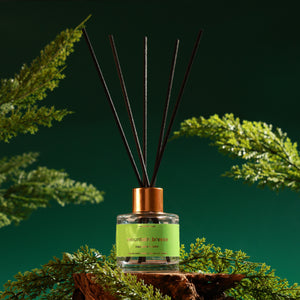
 Mountain Breeze₹849This is the mechanism that never appears in a product description and it is the one that matters most in India. The molecules that carry sweetness are heavy, and heavy molecules need energy to leave a liquid and reach your nose. Warm the room and you give them that energy: the sweet part of a fragrance rises disproportionately as temperature climbs, while the light green and citric parts, which were already volatile, have long since gone. The consequence is that a floral does not have one character, it has a temperature curve. A blend that is pleasantly sweet in a Bengaluru winter is a completely different and far less welcome object in a Chennai May, and the person who signed it off in a temperate studio never met that version of it. This is why I treat dryness as climate insurance rather than as a style preference, why every SOSA reed is tested through a 45°C heat soak and 85% relative humidity, and why the indole in Garden Bloom's jasmine is held below the fecal threshold so the flower stays floral above 30°C instead of turning. Priya S. in Bengaluru put it more usefully than I can: "it stays warm and floral all summer — I expected it to turn awful by April. It hasn't."
The portable test: smell for the green
You will not have a gas chromatograph in the shop, and you do not need one. There is a single question that separates a composed floral from a sweetened one, and you can ask it of any bottle, any brand, any price, in about four seconds. Smell for the green. A real floral has a stem in it somewhere — something bitter, something peppery, something leafy sitting underneath or beside the flower, the part of the plant that was not the blossom. It may be faint. It is always there, because it is there in the material, and a composition built from real material or from an honest reconstruction of one keeps it deliberately, since it is what gives the flower dimension.
A sweet reconstruction has no stem. It cannot have one, because the stem is the first thing that gets cut. Green notes are difficult, they are unloved in a three-second shelf test, they read as "sharp" or "odd" to a panel that has been asked to rate pleasantness, and they cost money. So they go, and the sweetener that replaced the missing compounds fills the space where the bitterness should have been. When you smell a floral and find nothing underneath the flower — no edge, no shadow, no leaf, nothing but a smooth pleasant sweetness that arrives complete and never develops — you are smelling an absence, and the absence is the plant.
Two practical refinements. First, do the test warm: cup your hand over the neck of the bottle or hold a reed for thirty seconds before you smell it, because the mechanism above means a cool sample will always flatter a sweet formula. Second, do it at the end rather than the beginning. Sweetness front-loads magnificently, which is exactly why it survives a shelf test; the honest moment in any fragrance is the third minute, not the first. If the third minute is sweeter than the first, you have found a formula built on fixative rather than structure, and you now know precisely what you are buying.
Sweetened floral versus composed floral, line by line
The same brief — a rose diffuser — resolved two different ways. The left column is not a bad factory or a dishonest one; it is a factory optimising for cost per litre and for the first three seconds of a shelf test, which are perfectly rational things to optimise for. The right column is what the alternative costs and what it buys. I have included the carrier, the phthalate position and the reed type because those three lines decide more about how a floral behaves in an Indian room over three months than the flower on the label does.
| What decides it | Sweetened floral | Composed floral · Garden Bloom |
|---|---|---|
| Material | A marker-led rose reconstruction — four or five molecules that read as "rose" | British rose in its garden register plus night-blooming jasmine (sambac/mogra) — two flowers, two jobs |
| Supporting compounds | Largely absent; a sweetener occupies the space where the other ~290 compounds of a real rose would be | Green, peppery and tea-like facets kept in deliberately — the stem is not cut |
| What provides longevity | Heavy sweet molecules used as a low-cost fixative — the sugar is doing the work | Structure plus a soft musk drydown on a heat-stable carrier — 45 days to 2 months on the 50ml, 14–18 weeks on the 130ml |
| Behaviour at 45°C | Sweetness rises disproportionately as heavy molecules mobilise; pleasant in December, cloying in May | Heat-soak tested at 45°C; indole held below the fecal threshold so the jasmine stays floral above 30°C |
| Behaviour at 85% humidity | Wicking slows and stalls in a monsoon room; the profile thickens and dulls | Tested through 85% RH monsoon conditions and sealed AC bedrooms |
| Carrier | Usually DPG, which cracks and turns bitter above about 40°C | Heat-stable CCT — caprylic/capric triglyceride, coconut-derived. Alcohol-free |
| Phthalate content | Commonly used to slow evaporation cheaply; most plug-ins test at 800–2,000 ppm | Phthalate-free, paraben-free, IFRA-compliant, 0 ppm formaldehyde — batch-verified in-house, not third-party certified |
| Reed type | Rattan, which clogs in Indian humidity and gives the fade-then-nothing pattern | Six fibre reeds, more porous and even-wicking, in a refillable glass bottle |
Floral · Garden Bloom₹799Shop → 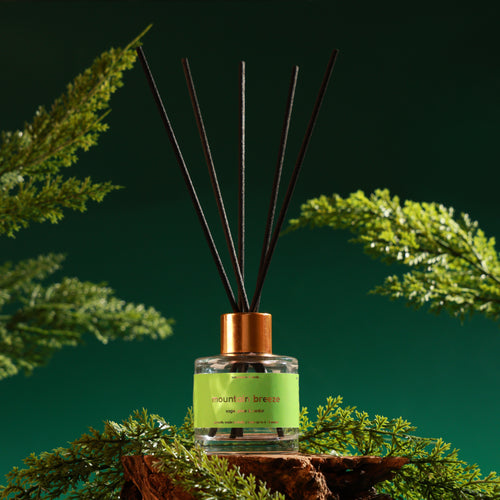 Driest · Mountain Breeze₹849Shop →
  Ultrasonic only · Shangri-La-inspired₹299Shop →
What Garden Bloom does instead — rose in the garden register, jasmine for warmth, musk for the day
Every decision in Garden Bloom is a decision about where the warmth is going to come from, because warmth is what people actually want when they ask for a floral and sugar is merely the laziest way to supply it. The rose is worked in its garden register: green, faintly peppery, a little citric at the top, tea-dry underneath, which is the rose you meet in a garden at seven in the morning rather than the one you meet in a bar of soap. That register is harder to hold together, because without the sweetener you have to keep the supporting facets present and in balance, and they are the facets that a three-second shelf test punishes. It is also the register that survives being lived with, which is a different test and the only one that matters once the bottle is on your console.
The second flower does the job the sweetener would otherwise have done. Night-blooming jasmine — real sambac, mogra — is warm without being sugary, and it is warm in a direction that no sweetener can imitate, because its warmth is animalic rather than confectionary. It also happens to be a genuinely difficult material to use in India: jasmine contains indole, which is floral at low concentration and unmistakably fecal above it, and Indian rooms run hot enough to push a careless formula over that line by April. Holding the indole below the fecal threshold is why the jasmine in this bottle stays floral above 30°C, and it is the single most technically demanding thing in the composition.
The third decision is the drydown, and it is the one I would defend hardest. Soft musk is warm without being sweet — that sentence is the whole argument — and it is the most useful material in perfumery for making a floral wearable across a full day rather than for a first impression. Musk does not add a flavour to the room; it lengthens and softens what is already there, so the flower at hour nine is a quieter version of the flower at hour one rather than a sticky residue of it. Combined, those three decisions produce a scent that sits at 8.9 on the SOSA strength scale — a medium floral, not a loud one, and deliberately so, because volume and sweetness are the two ways florals become oppressive indoors and there was no reason to accept either.
A note on reeds, since it is free and it fixes most complaints. All six fibre reeds is full strength and suits a living room or an entryway; three is a bedside; two or three in a small bathroom will make a 50ml run close to three months. Flip them every five to seven days for Garden Bloom. And put the bottle where air already moves — a hallway console, a metre from where you sit — but never directly under a running split AC, which strips the light green facets off first and leaves you with exactly the flat, base-heavy version of the fragrance that this entire page is about avoiding.
What to buy — and the gap I am not going to talk around
In buying order, with the honest substitutions marked as substitutions rather than dressed up as matches. Before the table, the admission it needs to sit beside: there is exactly one floral in the SOSA reed line. No tuberose, no gardenia, no lily, no peony, no orange blossom, no osmanthus, no ylang, no magnolia and no single-note rose. If you came here wanting a tuberose that is not sweet, I do not have one, and I would rather you knew that on this page than discovered it in week two. The nearest thing in the house is on the ultrasonic side rather than the reed side: the Shangri-La-inspired Hotel Collection scent at ₹299 (jasmine · green tea · white tea), which is the driest floral we make — the green tea and white tea keep it austere in a way no reed in the line attempts. It is water-based and needs a machine: Boond at ₹899 for rooms up to about 150 sq ft, or Sukoon at ₹1,899 for 270–320 sq ft. It cannot go in a reed diffuser and reed oil cannot go in a machine; there is no hotel-inspired reed diffuser and there is not going to be one.
| Buy | What it is | When it is the right answer | Price |
|---|---|---|---|
| 1. Garden Bloom 50ml ★ | British rose in the garden register, night-blooming jasmine, soft musk drydown — 8.9, medium floral | First, for anyone who wants an actual floral without the sugar. 45 days to 2 months | ₹799 |
| 2. Garden Bloom 130ml | The same composition sized for above 150 sq ft — living rooms, entryways, open-plan | Once you know it is the one. 14–18 weeks, roughly ₹13 a day | ₹1,299 |
| 3. Mountain Breeze 50ml — a substitution | Himalayan pine, sage, Indian cedar at 9.4 — dry, green, resinous, with no sweetness in it at all | If "not too sweet" is genuinely the priority and you would trade floralcy for it | ₹849 |
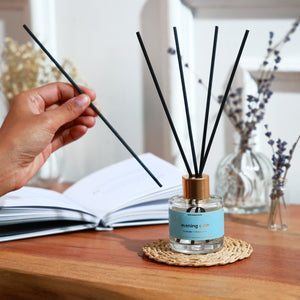
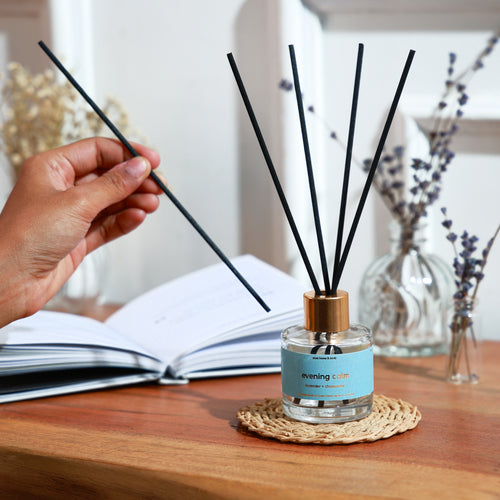
| 4. Evening Calm 50ml — a substitution | Kashmir lavender and chamomile at 8.9, the softest thing we make — herbal rather than sugary | For a bedside, or if florals as a category have always been a bit much | ₹799 |
| 5. 300ml refill | Tops up the bottle and reeds you already own rather than buying the glass twice | Once one scent is clearly the one you keep going back to | ₹2,399 |
| Not in the range: the honest gap | One floral in the whole reed line. No tuberose, gardenia, lily, peony, orange blossom, osmanthus or single-note rose. The driest floral in the house is the Shangri-La-inspired jasmine · green tea · white tea, and it is ultrasonic-only. Fresh Brew at 9.5 is the one to avoid outright on this brief | Said plainly rather than stretched to fit | ₹299 · machine from ₹899 |
Versailles
At ISIPCA we were made to smell raw materials before we were allowed anywhere near a formula, and the single most useful shock of that year was rose absolute. I had grown up, like everybody else, on rose in soap and rose in agarbatti and rose in the little bottles at the chemist, and I expected sweetness. What I got was green, pepper, a citric lift and a dry tea-like finish, with the honeyed part sitting well back. The rose I had known my whole life was a summary of a rose written by an accountant.
That is the honest origin of Garden Bloom. The brief I gave myself was not "make a floral that is less sweet" — that only produces a thin version of the same mistake. It was: put the missing parts back, then find the warmth somewhere other than sugar. Night-blooming jasmine supplies it in one direction and soft musk in the other, and between them the composition never needed a sweetener to feel generous. The cost of that decision is that Garden Bloom does not win a three-second sniff against a sweeter bottle on the same shelf. I made my peace with losing that test, because nobody lives in a shelf.
And if what you actually want is dryness rather than flowers, I would rather sell you the right thing than the flattering thing. Mountain Breeze has no sweetness in it at all and Evening Calm is herbal rather than sugary; both are substitutions and I have called them that. There is one floral in this reed line, no tuberose and no gardenia, and our phthalate and formaldehyde figures are verified batch by batch in our own house rather than by an external laboratory. Everything is composed in Pune, and a part of every order funds a girl's classroom through Nanhi Kali.
Frequently asked questions
- The floral category and A floral home — what a two-flower composition buys you, and where a floral belongs and where it does not.
- Bedrooms and Living rooms — florals at three reeds, and the cooking problem florals have.
- Bathrooms and The hotel question — why a floral behaves differently in 50 sq ft, and there is no hotel-inspired reed, and what is nearest.
- Modern florals — what separates a modern floral from a nostalgic one.
- The decision tree — one bottle, no reading, if you want one bottle and no argument.
- The complete floral guide — every decision in one place.
- Brand: the SOSA founder story.
SOSA reed diffusers — facts verified August 2026: Five scents, all alcohol-free, on a heat-stable CCT (caprylic/capric triglyceride) base, phthalate-free, paraben-free, IFRA-compliant, 0 ppm formaldehyde, six fibre reeds in a refillable glass bottle, composed and made in Pune, India. Those safety figures are batch-verified in-house against raw-material specifications rather than certified by an accredited third-party laboratory. Garden Bloom (British rose · night-blooming jasmine sambac/mogra · soft musk drydown) 50ml ₹799 · 130ml ₹1,299 · 8.9 on the SOSA strength scale, a medium floral, 45 days to two months on the 50ml and 14–18 weeks on the 130ml, indole held below the fecal threshold so the jasmine stays floral above 30°C. Evening Calm (Kashmir lavender · chamomile · soft musk) 50ml ₹799 · 130ml ₹1,299 · 8.9, the softest in the range. Morning Freshness (Malabar lemon · peppermint · eucalyptus globulus) 50ml ₹749 · 130ml ₹1,249 · 9.0. Mountain Breeze (Himalayan pine · sage · Indian cedar) 50ml ₹849 · 130ml ₹1,349 · 9.4, the deepest woody. Fresh Brew (Coorg coffee · Kerala vanilla · caramel) 50ml ₹849 · 130ml ₹1,349 · 9.5, the deepest in the range and the warm gourmand. Duos: Day & Night ₹1,498, Fresh & Grounded ₹1,548, Warmth & Bloom ₹1,598 (50ml × 2). Refills 300ml ₹2,399 · 500ml ₹3,499. Climate-tested through 45°C heat soak and 85% RH monsoon humidity. Most plug-in air fresheners test at 800–2,000 ppm phthalate. The reed line contains one floral only — no tuberose, gardenia, lily, peony, orange blossom, osmanthus, ylang, magnolia or single-note rose, and no oud, sandalwood, vetiver or amber; where this guide is asked for one of those it says so rather than stretching the nearest scent to cover it. Hotel Collection scents are water-based and ultrasonic-only: 15ml ₹299 · 100ml ₹999 · 300ml ₹1,799, with machines Boond ₹899 (300ml, up to about 150 sq ft) and Sukoon ₹1,899 (500ml, 270–320 sq ft). Reed diffuser oil and the Hotel Collection are separate products and are not interchangeable in either direction; there is no hotel-inspired reed diffuser. Free shipping above ₹499. A portion of every order supports girl-child education through Nanhi Kali. SOSA is an independent Indian fragrance house; the Hotel Collection scents referenced here are SOSA's own interpretations inspired by the world's finest hotels and SOSA is not affiliated with or endorsed by any hotel brand. Prices subject to change — see the live product pages.